At the top of the hierarchy of diagnostic procedures in prehospital emergency care sit technological modalities such as the 12-lead ECG, point-of-care ultrasound (POCUS), or blood gas analysis. Yet the most frequent, fastest, and potentially most misleading diagnostic act is the verbal history. This article examines communication not as a soft skill, but as an exact clinical tool — one whose miscalibration, through poorly formulated questions, directly induces cognitive errors and leads to an incorrect working diagnosis.
1. Introduction: communication as a diagnostic procedure
In emergency medicine, time pressure is an inherent part of the working environment. In the pursuit of maximum efficiency, paramedics tend to shorten the questioning process. Yet communication with a patient is not merely an addendum to the physical exam — it is an active data-collection process, one that, from a patient-safety perspective, is on par with invasive procedures.
Under the concept of evidence-based medicine (EBM), every diagnostic test has its sensitivity and specificity. If we consider a question to be a test, then the way it’s asked determines its predictive value. Faulty questioning technique improperly shifts the probability of a diagnosis even before objective findings are processed — what the literature defines as pre-test probability skewed by cognitive bias.
2. Psychological mechanisms and cognitive biases
Leading questions and false positivity
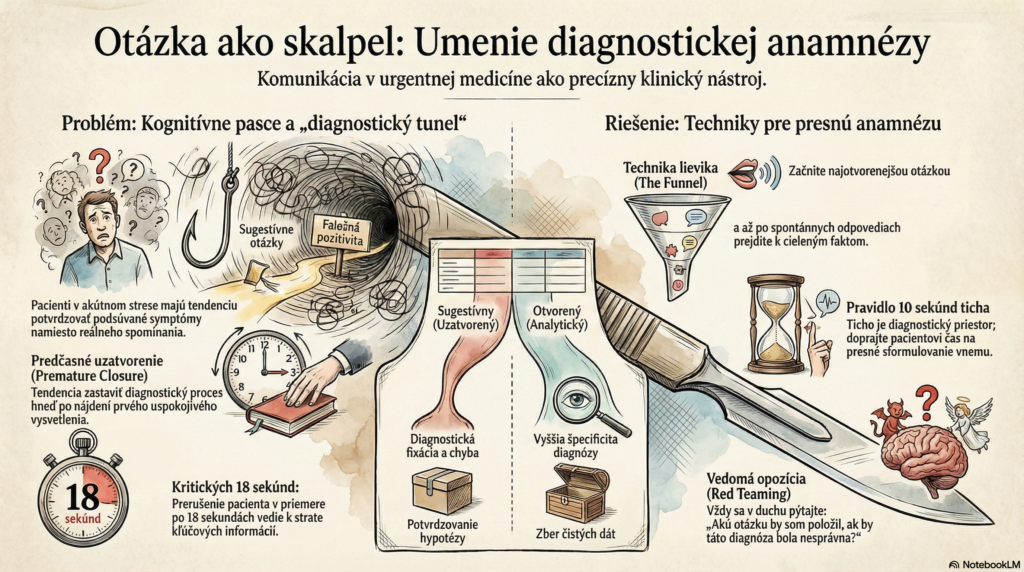
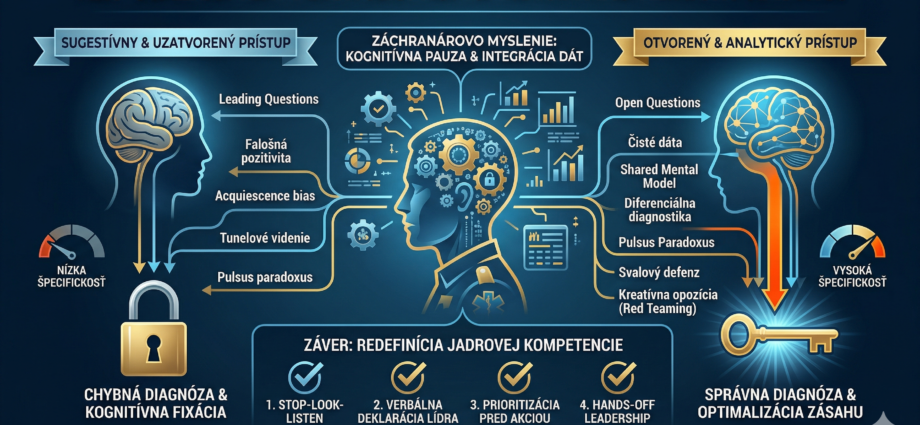
A leading question is one whose structure contains the expected answer (e.g., “That pain is burning, isn’t it?”). Research on eyewitness psychology and clinical diagnosis shows that patients under acute stress and pain exhibit a high degree of suggestibility and a tendency toward acquiescence bias.
When a paramedic asks a leading question, they don’t trigger the patient’s recall process — they trigger a confirmation process. If you ask a patient with chest pressure whether the pain radiates to their left arm, their brain, flooded with catecholamines, may interpret any sensation in that area as confirming your hypothesis. This creates a false positive in the history, which then anchors the paramedic in a diagnosis of acute coronary syndrome (ACS), potentially causing them to overlook other life-threatening conditions such as aortic dissection or pulmonary embolism.
Cognitive fixation and premature closure
Pat Croskerry, a leading expert on cognitive errors in medicine, defines premature closure as the tendency to stop the diagnostic process as soon as the first satisfactory explanation is found (Croskerry, 2003). Poorly structured questioning accelerates this process.
If we use closed questions too soon, we build a “diagnostic tunnel.” Open-ended questions (“Describe that pain to me”), by contrast, activate the patient’s broader neural networks and yield “clean data.” Research shows that if a physician or paramedic interrupts a patient’s opening narrative after an average of 18 seconds, they lose key information that could change the direction of the diagnosis (Beckman & Frankel, 1984).
3. The impact of stress and time pressure on questioning quality
In emergencies, paramedics experience a phenomenon known as cognitive narrowing. Under time pressure, the brain switches from the analytical system (System 2) to the intuitive, fast system (System 1), as defined by Kahneman (2011).
In System 1, the paramedic subconsciously tries to “nudge” the patient toward answers that fit learned patterns (heuristics). This leads to using leading questions as a cognitive shortcut. However, this time saved in the first minute often leads to enormous time losses later, when the team tries to treat a diagnosis it “manufactured” through faulty questioning. Crew resource management (CRM) principles emphasize that effective communication requires deliberately slowing down at key moments to avoid fixation errors (Brindley & Fanning, 2013).
4. Practical scenarios: analyzing technique
Let’s compare two approaches with a patient presenting with acute dyspnea and chest pain.
Scenario A: leading/closed approach (high error risk)
- Paramedic: “Does it hurt in your chest when you breathe in?”
- Patient: “Yeah, I guess so.”
- Paramedic: “Is it more of a sharp, stabbing pain?”
- Patient: “It stabs there, yeah.”
- Clinical impact: The paramedic fixates on pleuritic pain. They close in on a diagnosis of possible pneumonia or pleurisy. They overlook the possibility of pulmonary embolism, because instead of asking about the circumstances of onset, they suggested the character of the pain.
Scenario B: open/analytical approach (EBM approach)
- Paramedic: “Tell me in your own words exactly what you’re feeling in your chest.”
- Patient: “It’s weird… like there’s a stone inside that isn’t moving, but I can’t quite catch a full breath because of it.”
- Paramedic: “What changes when you try to take a deep breath?”
- Patient: “The pain doesn’t change, but I feel like the air just isn’t going through.”
- Clinical impact: The paramedic learns the pain isn’t tied to breathing (not pleuritic), but that the patient feels short of breath. This shifts the diagnostic algorithm toward ACS or other visceral causes.
In Scenario B, the paramedic used no descriptive adjective (“sharp,” “burning”). They let the patient choose their own descriptors, obtaining data with higher specificity.
5. Implementation in practice: evidence-based recommendations
Based on the analysis of cognitive processes and CRM principles, we recommend the following structure for verbal diagnostics:
- The funnel technique: Start with the most open question (“What’s going on?”, “Tell me about it.”). Only after gathering spontaneous information should you move to more targeted, and finally closed, questions (e.g., a SAMPLE history check).
- The rule of silence (the 10-second rule): After asking an open-ended question, wait at least 10 seconds without interrupting. Silence is diagnostic space the patient needs to formulate an accurate description of their sensation.
- Reflective listening: Repeat the patient’s own words back to them without adding interpretation. “So you’re saying it feels like a stone?” This validates the information without distorting it.
- Deliberate opposition (red teaming): Silently ask yourself: “What question would I ask if this weren’t a heart attack?” This helps counter confirmation bias.
6. Conclusion
The way a paramedic asks questions directly shapes the patient’s answer, and subsequently defines the direction of treatment. Leading questions in emergency medicine are not a sign of speed, but a sign of diagnostic imprecision that raises the risk of cognitive fixation. Effective verbal diagnostics requires discipline in using open questions, respecting cognitive limits under stress, and deliberately applying CRM principles. Communication must be regarded as precise medical technology, where every word acts as a filter on diagnostic truth.
References:
- Croskerry, P. (2003). The Importance of Cognitive Errors in Diagnosis and Strategies to Prevent Them. Academic Medicine, 78(8), 775–780.
- Kahneman, D. (2011). Thinking, Fast and Slow. New York: Farrar, Straus and Giroux.
- Beckman, H. B., & Frankel, R. M. (1984). The Effect of Physician Behavior on the Collection of Data. Annals of Internal Medicine, 101(5), 692–696.
- Brindley, P. G., & Fanning, R. M. (2013). Crew Resource Management and Teamwork in Anesthesia. In: Patient Safety in Anesthesia. Elsevier.
- Silverman, J., Kurtz, S., & Draper, J. (2013). Skills for Communicating with Patients. Radcliffe Publishing.
- Ely, J. W., et al. (2011). Checklists to reduce cognitive errors. Academic Medicine, 86(3), 307–313.