
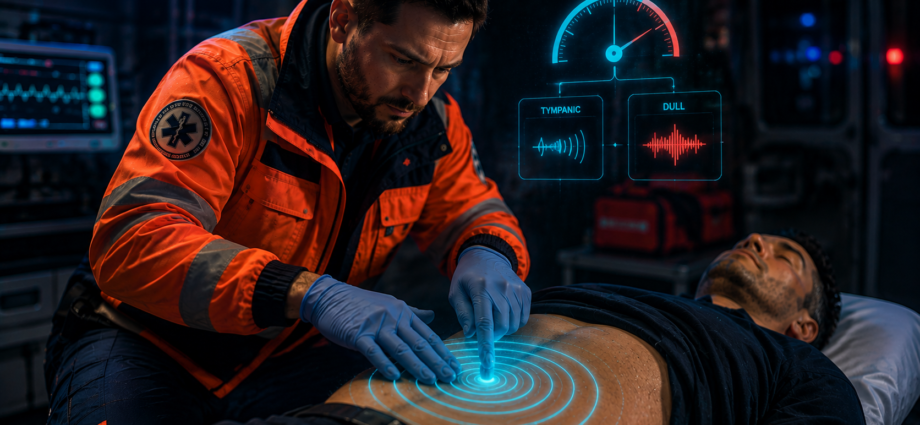
Percussion of the Abdomen:
why most crews skip it, and when it’s worth it
The step most often sacrificed to time pressure in the field. Sometimes rightly so. Other times it’s the only way to tell gas from fluid in ten seconds.
Percussion is a given in hospital practice, and in the field it’s most often the step that simply gets skipped. The reason is understandable — with an unstable patient, or when the plan is already clear and fast, there’s no point spending time tapping when you have another priority. The problem arises when percussion is skipped automatically, without ever considering whether it might give you information you wouldn’t otherwise get.
What percussion physically does
Percussion generates a vibration in the underlying tissue, and based on the character of the resulting sound, it distinguishes what lies beneath the percussed area of the abdominal wall — gas, fluid, or a solid organ/mass. It’s the only step of the physical abdominal exam that can orientationally distinguish these three states without any imaging.
Technique — how to percuss correctly
The standard technique is indirect (bimanual) percussion: the middle finger of the non-dominant hand is placed flat against the skin, and the other hand’s middle fingertip strikes its middle phalanx. The strike should come from the wrist, short and springy, not from the elbow.
Percussion works just as well in the field as it does in the hospital — it requires no equipment, only quiet surroundings. As with auscultation, the main limitation is the environment: in a noisy moving ambulance or at a loud scene (traffic, a crowd), distinguishing tympanic from dull sound becomes significantly harder.
When percussion is worth it in the field
Rather than trying to percuss every patient “because it’s part of the protocol,” it’s more useful to know the specific situations where percussion genuinely changes the clinical picture and is worth the extra 20–30 seconds.
A patient with a distended abdomen — is it ileus with accumulated gas, or ascites with fluid? You may not be able to reliably tell visually, but percussion can, within seconds.
In a patient with altered mental status, agitation, or hypogastric pain without an obvious cause, percussion above the symphysis is a quick way to confirm or rule out a full bladder as the cause of the agitation — especially in patients who cannot themselves report the urge to void.
Percussion can orientationally locate the lower border of the liver (the transition from dull percussion over the chest to tympanic over bowel) and suggest splenic enlargement. In the field this has limited priority, but it can support suspicion of hepatomegaly or splenomegaly in trauma (e.g., suspected splenic rupture) or in chronic liver disease.
When it’s fine to skip percussion
Hemodynamically unstable patient — percussion won’t change your priority management (IV access, fluids, transport), and it’s seconds you could use better elsewhere.
Clear trauma mechanism with an indication for immediate transport — with suspected hemoperitoneum, the priority is rapid transport to a facility with imaging capability, not percussion in the field.
Severe pain on palpation/percussion that gives the patient no additional benefit — if inspection and palpation have already told you it’s peritonism requiring transport, there’s no need to confirm the finding by repeatedly percussing a painful abdomen.
Forceful percussion and repeated palpation are not recommended when an abdominal aortic aneurysm is suspected. If you do percuss, do it gently and orientationally — the goal is not to precisely measure aortic width by tapping; that’s not what field percussion is for.
How to document the percussion finding
“Percussion OK.”
“Diffusely tympanic on percussion in all quadrants, no dullness noted above the symphysis or in the flanks.”
“Lower abdomen feels kind of firm.”
“Dull on percussion above the symphysis, extending approximately 4 cm toward the umbilicus, suspected full bladder from urinary retention. Patient disoriented, unable to report time of last void.”
(no note, silently omitted without explanation)
“Percussion not performed due to patient’s hemodynamic instability and transport priority.”
Field case
On inspection, mild asymmetric distension in the hypogastrium. Percussion: dull above the symphysis, extending up to the level of the umbilicus. History (from family) of benign prostatic hyperplasia, no voiding since this morning.
Patient care record entry: “Dull on percussion in the hypogastrium extending to the umbilicus, suspected significant urinary retention given known history of BPH, no voiding since morning. Agitation and confusion likely related to retention and discomfort, GCS 14, no focal neurological deficit. Transport for urological/internal medicine evaluation, consider catheterization at receiving facility.”
A ten-second percussion changed the working hypothesis from “suspected delirium/stroke” to a clearly explainable agitation from a full bladder — information that significantly changes both prioritization and communication with the receiving facility.
Summary
1. Stable patient with unexplained abdominal distension → percussion is worth it (gas vs. fluid)
2. Agitation/confusion without a clear cause, especially in an older patient → percuss above the symphysis to rule out urinary retention
3. Unstable patient, clear indication for rapid transport → skip percussion, prioritize management
4. Suspected AAA → percuss gently and orientationally only, never as the primary diagnostic tool
The next part of the series covers palpation — the final and most information-rich step of the abdominal exam, and also the one that most shapes the patient’s experience of the entire examination.
- Abdominal Inspection: what you see before you ever touch the patient
- Auscultation of the Abdomen: more than “sounds present/absent”
- Percussion of the Abdomen: why most crews skip it, and when it’s worth it (this article)
- Palpation Step by Step: light and deep technique
- Specific examination maneuvers and signs
- Abdominal exam in trauma vs. medical pain
- Abdominal exam in the complicated patient
- Vital signs as part of the abdominal exam
- Bickley LS, Szilagyi PG. Bates’ Guide to Physical Examination and History Taking. 13th ed. Wolters Kluwer, 2021.
- Macleod J, Douglas G. Macleod’s Clinical Examination. 14th ed. Elsevier, 2018.
- Cline DM, et al. Tintinalli’s Emergency Medicine: A Comprehensive Study Guide. 9th ed. McGraw-Hill, 2020.
- Cardenas D, et al. Percussion in Abdominal Examination: Diagnostic Value Revisited. Postgrad Med J. 2018;94(1108):100–104.
- StatPearls. Abdominal Examination. NCBI Bookshelf. Updated 2024.
- Kühn F, et al. Abdominal Aortic Aneurysm. Dtsch Arztebl Int. 2020;117(48):813–820.
- Cortis K, Baldacchino S. Urinary Retention in the Elderly: A Review. Geriatrics (Basel). 2021;6(1):19.