
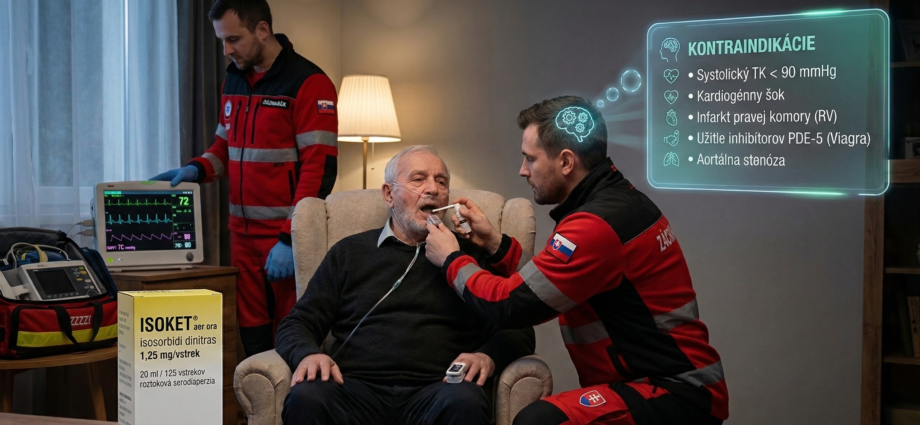
Introduction Isoket aer ora (isosorbide dinitrate) is a short-acting organic nitrate for rapid vasodilation. In prehospital care it is the first-line drug for acute coronary syndrome (ACS) and acute left ventricular failure with pulmonary edema. Its main benefit is an immediate reduction in preload and consequently reduced myocardial oxygen demand.
1. Drug Identification
- Active substance: Isosorbidi dinitras.
- Trade names in Slovakia: Isoket spray (aer ora).
- ATC classification: C01DA08 (Organic nitrates).
- Dosage form in EMS: Oral spray (1 spray = 1.25 mg of active substance).
- Pharmacological group: Vasodilator, venodilator.
2. Mechanism of Action (Pharmacodynamics) Isoket acts as a nitric oxide (NO) donor:
- Molecular level: NO activates guanylate cyclase, raising cGMP levels in vascular smooth muscle. This leads to dephosphorylation of myosin light chains and subsequent relaxation (vasodilation).
- Venous system: Dominant venodilation increases venous capacitance.
- Arterial system: Dilation of large epicardial coronary arteries and peripheral arteries (at higher doses).
- Pulmonary effect: Reduces pressure in the pulmonary circulation (pulmonary capillaries).
3. Hemodynamic Effects – IN DETAIL
- SVR (systemic vascular resistance): Mild decrease (dose-dependent).
- Preload: Marked decrease (the main effect). Reduces venous return to the right heart.
- Afterload: Mild decrease due to arterial dilation.
- Contractility: No direct effect, but improves secondarily due to reduced ventricular wall tension.
- Coronary perfusion: Improves due to dilation of epicardial vessels and redistribution of flow to subendocardial regions.
Destabilization risks:
- Right ventricular (RV) infarction: A critical risk. These patients are “preload-dependent” — giving Isoket can cause a fatal drop in blood pressure and circulatory collapse.
- Aortic stenosis: Risk of a sharp drop in blood pressure due to fixed cardiac output.
4. Pharmacokinetics (from a Paramedic’s Perspective)
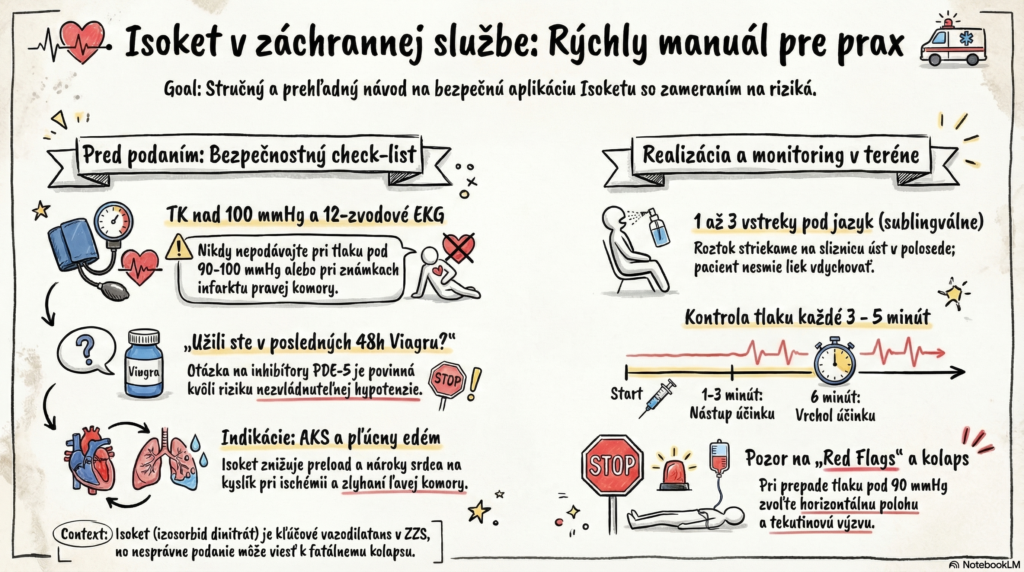
- Route of administration: Sublingual (sprayed onto the oral mucosa). Must never be inhaled in EMS use!
- Onset of action: 1 to 3 minutes.
- Peak effect: 3 to 6 minutes.
- Duration of effect: Approximately 30 to 60 minutes.
- Metabolism: Rapid hepatic metabolism (the first-pass effect is bypassed with sublingual administration).
5. Indications in Prehospital Practice
- Acute coronary syndrome (ACS): Angina pectoris, STEMI, NSTEMI (to relieve ischemic pain).
- Acute pulmonary edema: With hypertension or left ventricular failure (reducing pulmonary vascular pressure).
- Hypertensive crisis: With signs of cardiac failure.
6. Dosing in EMS
- Adult: 1 to 3 sprays (1.25–3.75 mg) sublingually/onto the mucosa. May be repeated at 5-minute intervals if pain persists and blood pressure is stable.
- Maximum dose: Limited by a drop in blood pressure (systolic BP must not fall below 90–100 mmHg).
- Scope of practice: Physician (RLP). A basic-crew paramedic (RZP) follows standard treatment protocols (typically 1 spray for ACS, if systolic BP > 100 mmHg).
7. Contraindications
- Absolute: Systolic BP < 90 mmHg, cardiogenic shock, right ventricular infarction (inferior leads on ECG), use of PDE-5 inhibitors (sildenafil/Viagra, etc.) within the last 24–48 hours.
- Relative: Hypertrophic obstructive cardiomyopathy, pericardial tamponade, severe anemia.
8. Adverse Effects
- Cardiovascular: Reflex tachycardia, hypotension, orthostatic collapse.
- Neurological: “Nitrate” headache (common), dizziness.
- Dermatologic: Flushing (redness of the face and neck).
9. Drug Interactions in EMS
- PDE-5 inhibitors (Viagra, Cialis): Extremely dangerous synergy leading to uncontrollable hypotension.
- Alcohol / antihypertensives: Potentiate the vasodilatory effect.
10. Specifics in Emergency Medicine
- Monitoring: BP must be measured before administration and 3–5 minutes after each spray.
- ECG: Always obtain a 12-lead ECG before administration (to rule out RV infarction — elevation in leads II, III, aVF warrants a 12-lead ECG with right-sided leads V3R, V4R).
- Position: Administer with the patient sitting or semi-upright (prevention of syncope).
11. Red Flags
- Sharp drop in BP: If systolic BP falls below 90 mmHg after Isoket, immediately place the patient in a horizontal position and consider a fluid challenge (normal saline).
- Inferior STEMI: If you see elevation in II, III, aVF, approach Isoket with extreme caution or withhold it (risk of RV infarction).
- History of PDE-5 inhibitor use: Always ask about sildenafil use.
12. Antidote
- No specific antidote exists. For overdose/hypotension: Trendelenburg position, IV crystalloids, and in extreme cases, vasopressors (norepinephrine).
13. Practical Field Scenario Situation: A 68-year-old man with severe retrosternal pain, shortness of breath, and cold sweat. Status: BP 160/100, HR 90, ECG shows ST elevation in V1–V4 (anterior wall). Decision-making:
- Obtain a 12-lead ECG (confirms anterior STEMI).
- Administer 1 spray of Isoket sublingually.
- Recheck BP after 3 minutes (BP 145/90, pain slightly improved).
- Continue with the ACS protocol (aspirin, heparin, ticagrelor, morphine/fentanyl). Hemodynamic rationale: Since this is an anterior infarction and BP is high, Isoket safely reduces preload and pain without risk of collapse (unlike an inferior infarction).
14. Practical Summary – 5 Key Points
- Ask about Viagra: A mandatory question before administration.
- BP above 100: Never give Isoket if systolic pressure is below 90–100 mmHg.
- Right ventricle = STOP: Do not give Isoket if right ventricular infarction is suspected.
- Sublingual: Spray onto the mucosa, do not inhale into the lungs.
- Semi-upright: The patient must be sitting or lying with the upper body elevated during administration.
Professional Sources and Literature:
1. Slovak Ministry of Health guidance on prehospital emergency care for acute coronary syndrome.
2. SmPC (Summary of Product Characteristics) – Isoket aer ora, registration no. 13/0200/91-S.
3. ESC Guidelines 2023 for the management of acute coronary syndromes (European Society of Cardiology).
4. Dobiáš, V. et al.: Emergency Healthcare. Osveta, 2021. (Chapter: Pharmacotherapy in emergency medicine.)
5. Katzung, B. G.: Basic and Clinical Pharmacology. Grada, 2015. (Chapter: Vasodilators and the treatment of angina pectoris.)
6. Remedium 2026: Compendium medicamentorum. (Current pharmacological standards in Slovakia.)