
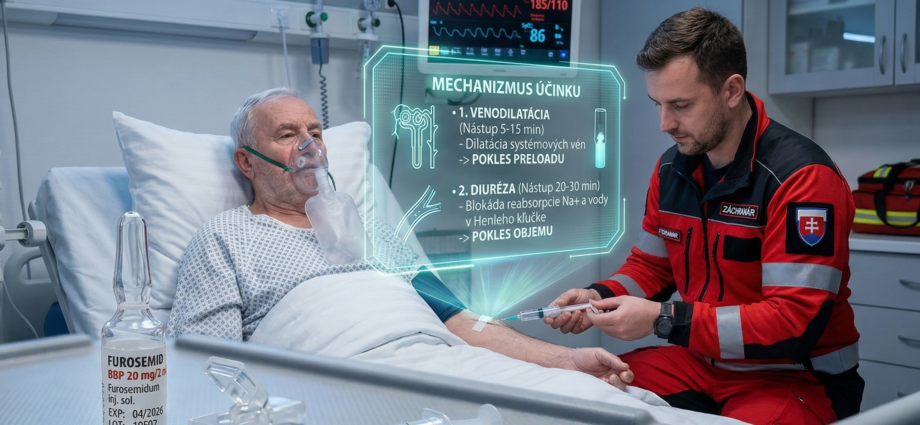
Introduction Furosemide is a highly effective loop diuretic used in emergency medicine to rapidly reduce intravascular volume and relieve symptoms of acute left ventricular failure. Besides its diuretic effect, it also has an early vasodilatory effect, making it an important tool for treating acute pulmonary edema even before diuresis itself sets in.
1. Drug Identification
- Active substance: Furosemidum.
- Trade names in Slovakia: Furosemid BBP, Furosemid Kabi, Furon (oral form).
- ATC classification: C03CA01 (Sulfonamides, plain).
- Dosage form in EMS: Injection solution 20 mg/2 ml (10 mg/ml), or Forte ampoules (125 mg/10 ml or 250 mg/25 ml).
- Pharmacological group: Loop diuretic.
2. Mechanism of Action (Pharmacodynamics) Furosemide acts primarily in the kidneys, but also has important extrarenal effects:
- Renal effect: Inhibits the Na+/K+/2Cl− symporter in the thick ascending limb of the loop of Henle. This blocks reabsorption of sodium, potassium, and chloride, producing massive osmotic diuresis (water follows sodium).
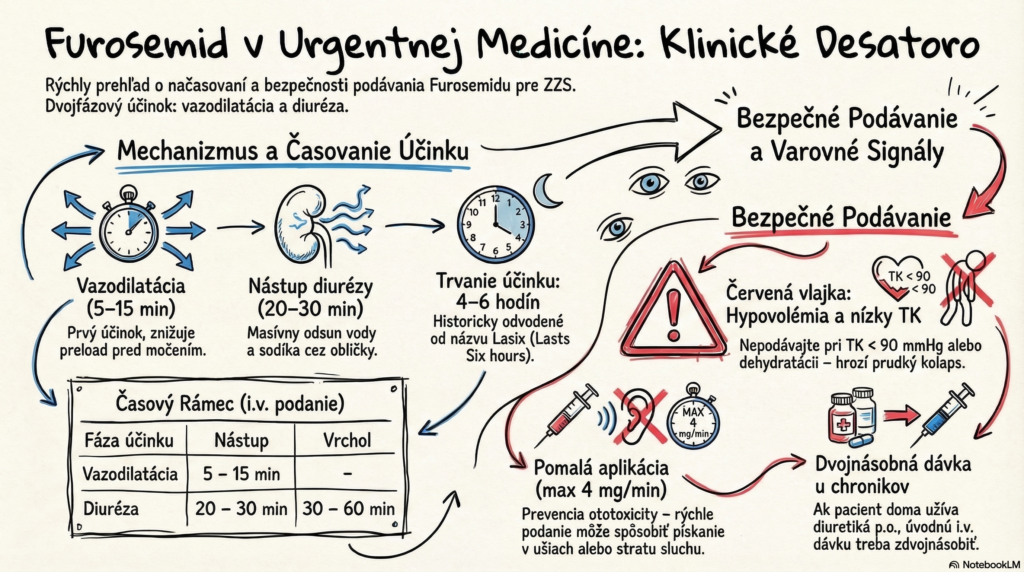
- Extrarenal effect (vasodilation): Shortly after IV administration (within 5–15 minutes) it induces dilation of the systemic veins. This effect is mediated by prostaglandin release and precedes the diuretic effect itself.
- Effect on electrolytes: Increases excretion of Ca2+ and Mg2+.
3. Hemodynamic Effects – IN DETAIL
- SVR (systemic vascular resistance): Mild decrease due to early vasodilation.
- Preload: Significant decrease. First via venodilation (shifting blood into venous capacitance), and later via reduced circulating plasma volume (diuresis).
- Afterload: Mild decrease.
- Contractility: No direct effect, but improves due to reduced pulmonary congestion and better myocardial oxygenation.
- Pulmonary circulation: Reduces pulmonary capillary wedge pressure (PCWP), reducing fluid transudation into the alveoli.
4. Pharmacokinetics (from a Paramedic’s Perspective)
- Routes of administration: IV (the gold standard in EMS), IM (if venous access is unavailable, slower onset).
- Onset of action: Vasodilation 5–15 min; diuresis 20–30 min.
- Peak effect: 30–60 min.
- Duration of effect: 4–6 hours.
- Metabolism: Minimal hepatic metabolism. Elimination: 65% renal, the remainder fecal.
5. Indications in Prehospital Practice
- Acute pulmonary edema (APE): In cardiac failure with hypervolemia.
- Acute left ventricular failure: With signs of pulmonary congestion.
- Hypertensive crisis: Associated with pulmonary edema, or in patients with renal failure.
- Forced diuresis: For certain types of poisoning (rare in the field).
6. Dosing in EMS
- Adult: Initial dose 20–40 mg IV, given slowly (max rate 4 mg/min). In chronic diuretic users, the dose should be doubled (e.g., 80 mg IV).
- Pediatrics: 1 mg/kg IV (maximum 20 mg).
- Scope of practice: Physician (RLP). A basic-crew paramedic (RZP) administers it per delegated competencies/protocols (in Slovakia, typically for APE after consultation or per standards).
7. Contraindications
- Absolute: Anuria (renal failure unresponsive to furosemide), hypovolemia and dehydration, severe hypokalemia and hyponatremia, hepatic coma.
- Relative: Hypotension (systolic BP < 90 mmHg), pregnancy (crosses the placenta).
8. Adverse Effects
- Metabolic: Hypokalemia (arrhythmia risk!), hyponatremia, hypomagnesemia.
- Cardiovascular: Excessive drop in BP, hemoconcentration (thrombosis risk).
- Sensory: Ototoxicity (tinnitus, hearing loss) — occurs with too-rapid IV administration of high doses.
9. Drug Interactions in EMS
- Gentamicin/amikacin: Increase the risk of hearing and kidney damage.
- Digoxin: Furosemide-induced hypokalemia increases digitalis glycoside toxicity.
- NSAIDs: Reduce the diuretic effect of furosemide.
10. Specifics in Emergency Medicine
- Monitoring: Watch BP and clinical signs of improvement (better breathing).
- Error #1: Giving furosemide to a dyspneic patient whose cause isn’t pulmonary edema (e.g., a COPD/asthma exacerbation, where dehydration can thicken secretions).
- Error #2: Administering it too quickly (“as a bolus”), which can cause permanent hearing damage.
11. Red Flags
- Sharp hypotension: If BP drops markedly after administration, the patient may not have actually been hypervolemic (watch out for differential diagnosis).
- Muscle cramps / arrhythmias: A sign of acute electrolyte derangement (falling K+).
- Tinnitus (ringing in the ears): An immediate signal to slow down or stop the injection.
12. Antidote
- No specific antidote exists. Overdose is managed symptomatically: fluid and electrolyte replacement (normal saline, potassium).
13. Practical Field Scenario Situation: A 75-year-old female patient, suddenly short of breath at night, in an orthopneic position, coughing up pink froth. Status: BP 190/110, HR 110, SpO2 82%, diffuse crackles over the lungs. Decision-making:
- Oxygen therapy, positioning.
- Isoket spray sublingually (reducing preload).
- Furosemide 40 mg IV, slowly.
- CPAP ventilation (if available). Hemodynamic rationale: The patient has high afterload (hypertension) and volume overload. Furosemide helps, via venodilation and subsequent fluid excretion, to reduce the demand on the left ventricle.
14. Practical Summary – 5 Key Points
- Give it slowly: Never “push” furosemide quickly — protect the patient’s hearing.
- Nitrates first: In pulmonary edema with high BP, nitrates (Isoket) take priority for a faster effect on preload.
- Watch out for COPD: If you’re not sure (crackles vs. wheezing), be cautious with furosemide.
- Double the dose: If the patient already takes Furon at home, they’ll need a higher IV dose in EMS.
- Catheter: On a longer transport, remember the patient will soon need to urinate (risk of agitation with a full bladder).
Professional Literature for Furosemide BBP
1. Slovak Ministry of Health guidance on the diagnosis and treatment of acute heart failure in prehospital care.
2. SmPC (Summary of Product Characteristics) – Furosemid BBP 10 mg/ml, registration no. 18/0246/16-S.
3. ESC Guidelines 2021 for the diagnosis and treatment of acute and chronic heart failure.
4. Lüllmann, H. et al.: Pharmacology and Toxicology. Grada, 2014. (Chapter: Diuretics.)
5. Dobiáš, V.: Prehospital Emergency Medicine. Osveta, 2021.
6. Katzung, B. G.: Basic and Clinical Pharmacology. Grada, 2015. (Chapter: Diuretic Agents.)