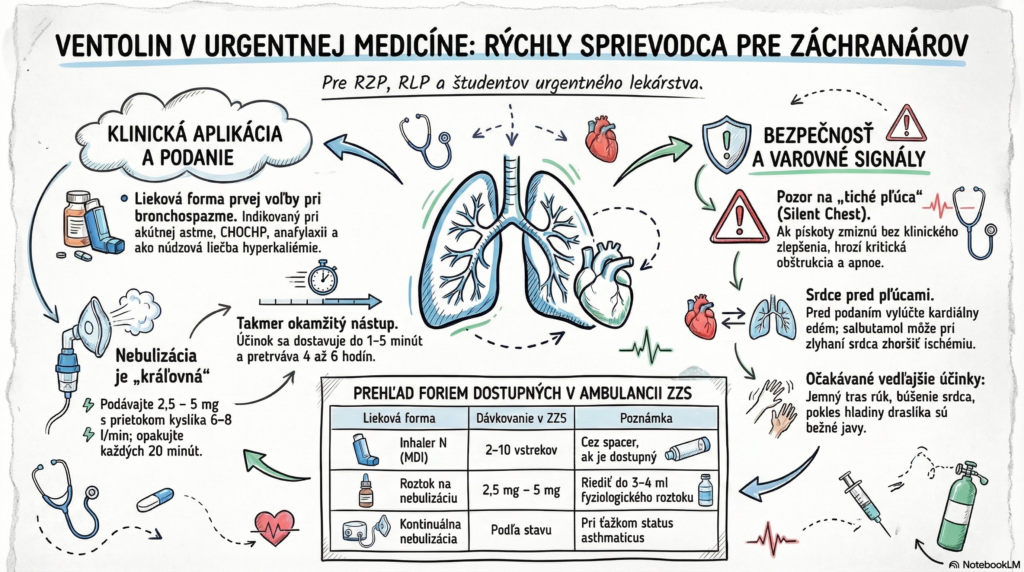
Introduction Ventolin (salbutamol) is a selective, short-acting beta-2 adrenergic receptor agonist (SABA). In emergency medicine it’s the drug of choice for acute exacerbation of bronchial asthma, COPD, and bronchospasm associated with anaphylaxis. Its main advantage is a nearly immediate onset of action and high selectivity for bronchial smooth muscle.
1. Drug Identification
- Active substance: Salbutamoli sulfas.
- Trade names in Slovakia: Ventolin (Inhaler N, nebulizer solution).
- ATC classification: R03AC02 (Selective beta-2-adrenoreceptor agonists).
- Dosage form in EMS:
- Inhaler N: 100 micrograms/dose (pressurized aerosol).
- Nebulizer solution: 5 mg/ml, usually in 2.5 mg plastic ampules.
- Pharmacological group: Bronchodilator, SABA.
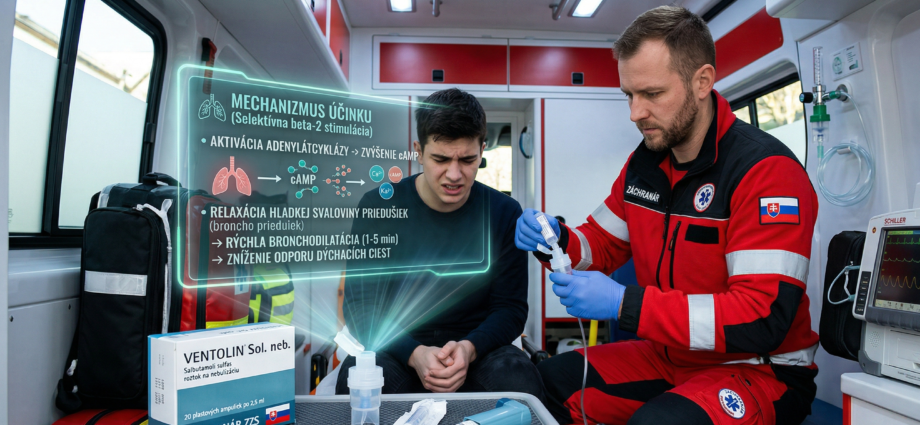
2. Mechanism of Action (Pharmacodynamics) Salbutamol stimulates beta-2 receptors in the airways:
- Adenylate cyclase activation: Leads to increased intracellular cAMP.
- Smooth muscle relaxation: Elevated cAMP activates protein kinase A, which lowers intracellular calcium and inhibits myosin light-chain kinase.
- Result: Rapid, strong bronchodilation, reduced airway resistance, and improved mucociliary transport.
- Other effects: Mast cell membrane stabilization (reduces histamine release).
3. Hemodynamic Effects – IN DETAIL Although salbutamol is selective, at the high doses typical in EMS it also affects beta-1 receptors in the myocardium:
- Heart rate: Tachycardia (direct stimulatory effect + reflex response to peripheral vasodilation).
- Blood pressure: Systolic BP may rise mildly, diastolic may fall (skeletal muscle vasodilation).
- Arrhythmogenic potential: Can trigger palpitations or ventricular extrasystoles.
- Metabolic effect: Hypokalemia risk (salbutamol shifts potassium into cells by stimulating the sodium-potassium pump).
4. Pharmacokinetics (from a Paramedic’s Perspective)
- Routes of administration: Inhaled (nebulization or MDI — metered-dose inhaler).
- Onset of action: 1–5 minutes.
- Peak effect: 30–60 minutes.
- Duration of effect: 4–6 hours.
- Metabolism: Hepatic. Elimination: renal (roughly 70%).
5. Indications in Prehospital Practice
- Acute asthma: Management of bronchospasm at all severity levels.
- COPD exacerbation: Reducing dyspnea and pulmonary hyperinflation.
- Anaphylaxis: Adjunctive treatment of bronchospasm (after epinephrine administration).
- Hyperkalemia: As an emergency measure to lower serum potassium (requires high nebulized doses).
6. Dosing in EMS
- Nebulization (preferred): 2.5 mg to 5 mg (diluted in 3–4 ml normal saline) continuously with oxygen (flow 6–8 l/min). May be repeated every 20 minutes.
- Inhaler (MDI): 2–10 puffs (via spacer, if available).
- Scope of practice: Both physician (RLP) and basic-crew paramedic (RZP) — standard treatment for a patient with wheezing and prolonged expiration.
7. Contraindications
- Absolute: Hypersensitivity to salbutamol.
- Relative: Tachycardia (above 140/min), unstable coronary artery disease, severe untreated hyperthyroidism, pregnancy (risk of uterine relaxation — tocolytic effect).
8. Adverse Effects
- Neurological: Fine tremor (hand shaking), restlessness, headache.
- Cardiovascular: Tachycardia, arrhythmias, palpitations.
- Metabolic: Hypokalemia, mild hyperglycemia.
- Respiratory: Paradoxical bronchospasm (very rare).
9. Drug Interactions in EMS
- Beta-blockers (e.g., metoprolol): Antagonism! Non-selective beta-blockers cancel Ventolin’s effect and can trigger fatal bronchospasm.
- Corticosteroids: Synergy (corticosteroids increase beta-2 receptor sensitivity and density).
- Diuretics: Potentiate hypokalemia.
10. Specifics in Emergency Medicine
- Error #1: Nebulization in cardiac edema. If a patient is wheezing due to left ventricular failure (cardiac asthma), salbutamol’s tachycardia can worsen myocardial ischemia. Always distinguish pulmonary edema from bronchial asthma.
- Error #2: Insufficient dose. Don’t be afraid of continuous nebulization in severe status asthmaticus.
- Spacer: In dyspneic patients, coordinating inhalation with an MDI is nearly impossible; always use a nebulizer or spacer.
11. Red Flags
- Silent chest: If wheezing disappears after Ventolin and the patient’s condition doesn’t improve, this signals critical obstruction and impending apnea.
- Hypokalemia: Caution in patients taking diuretics or digitalis.
- Lactic acidosis: Prolonged high-dose nebulization can transiently raise lactate in asthmatics.
12. Antidote
- Cardioselective beta-blockers (under physician supervision), though Ventolin overdose in EMS is generally managed symptomatically (fluids, arrhythmia monitoring).
13. Practical Field Scenario Situation: A 19-year-old man, known asthmatic, acute dyspnea after contact with a cat. Prolonged expiration, audible distant wheezing, SpO2 88%. Status: Orthopneic position, using accessory breathing muscles. Decision-making:
- Oxygen mask with nebulizer.
- Ventolin 5 mg + 3 ml normal saline (nebulized).
- Secure IV access and give hydrocortisone 200 mg. Hemodynamic rationale: We monitor pulse. If it rises above 130, we consider reducing nebulization intensity, but priority remains airway patency.
14. Practical Summary – 5 Key Points
- Heart before lungs: Rule out a cardiac cause of dyspnea (ECG) before administration.
- Nebulization is king: More effective in EMS than a spray.
- Tremor is normal: Reassure the patient that hand shaking and palpitations are common side effects.
- Oxygen as the carrier: Nebulize Ventolin with oxygen, ideally, not air.
- Potassium drops: Remember the hypokalemia risk with repeated doses.
Professional Sources and Literature:
- GINA 2024 (Global Initiative for Asthma): Global Strategy for Asthma Management and Prevention.
- GOLD 2024: Global Strategy for the Diagnosis, Management, and Prevention of COPD.
- SmPC (Summary of Product Characteristics) – Ventolin Inhaler N / Ventolin nebulizer solution.
- Dobiáš, V. et al.: Emergency Healthcare. Osveta, 2021.
- Slovak Ministry of Health guidance on the treatment of acute conditions in pulmonology.