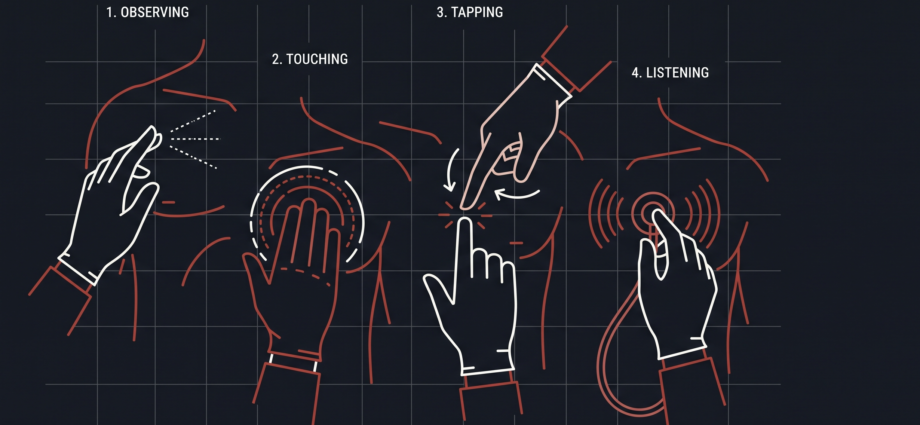
Inspection, Palpation, Percussion, Auscultation —
the four pillars of physical examination
A physical examination isn’t a routine “listen to the lungs and poke the belly.” It’s a structured process with its own order, technique, and limits — and in the field, without imaging or a lab, it’s often the only source of objective data a paramedic has.
This series covers the physical examination systematically — by body region, by technique, by what each finding means for decision-making in the field. This first installment lays the groundwork: what the four pillars of the physical exam are, in what order they’re performed, and why it’s precisely the order that fails most often in the field.
Why systematics, not improvisation
An experienced paramedic develops their own examination “rhythm” after years of practice — often unconsciously. The problem arises when this rhythm is disrupted by stress, noise, time pressure, or an atypical patient presentation. That’s exactly when steps get skipped. The four-pillar system — inspection, palpation, percussion, auscultation — isn’t academic formality; it’s insurance against missing a finding under pressure.
The acronym IPPA (Inspection, Palpation, Percussion, Auscultation) is used in prehospital practice as a mnemonic for the order of steps. This order holds with one important exception, covered in installment VYS-07 on abdominal examination.
1. Inspection — the exam begins at the doorway
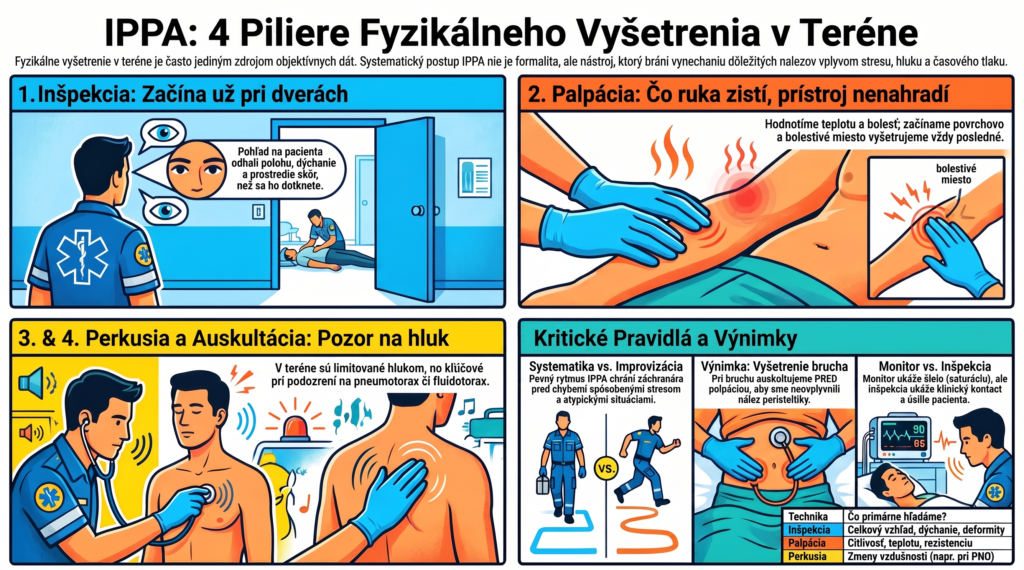
Inspection is the most underrated step of the physical exam, because it doesn’t seem like an “active” activity. In reality it begins before the paramedic even touches the patient — at entering the room, at the first glimpse through the car door at a traffic accident.
Overall appearance — body position (a forced position, orthopnea), facial expression (grimace, anxiety, apathy), habitus.
Skin color and condition — cyanosis, pallor, jaundice, sweating, rash, scars.
Breathing — rate, symmetry of chest movement, use of accessory respiratory muscles, paradoxical breathing.
Environment — medications on the nightstand, an odor in the room (acetone, alcohol, urine), signs of vomiting, disorder suggesting neglect.
Obvious deformities — limb asymmetry, swelling, bruising, wounds, surgical scars.
The paramedic focuses exclusively on the monitor (SpO₂, BP, ECG) and skips the visual assessment of the patient as a whole. The monitor shows a number — inspection shows context. A patient with 94% saturation sitting leaning forward using accessory muscles is clinically a different case than a patient with the same saturation lying calmly. Only a look, not a device, gives you this distinction.
2. Palpation — what a hand finds, no device replaces
Palpation follows inspection and provides information that visual examination and the monitor can’t capture — skin temperature, tissue consistency, the presence of tenderness and its exact location, muscular resistance, crepitus.
Superficial palpation — light pressure, maps tenderness, temperature, surface resistances. Always first, never start directly with deep palpation.
Deep palpation — firmer pressure, assesses organs, resistances at depth, exact pain localization. Performed only after superficial palpation, and never as the first touch on a tender site.
Principle: palpate the tender site last
If the patient reports pain in a specific area (e.g., the right lower abdominal quadrant), that area is examined last. The reason is simple — a pain reaction and involuntary muscle guarding (défense musculaire) after the first touch can skew the finding during subsequent palpation of surrounding areas and prevent comparison.
3. Percussion — limited, but not useless
Percussion (tapping) is among the less-used techniques in prehospital care, and reasonably so — noise in a moving ambulance, on the street, or in a crowded apartment practically makes it impossible to distinguish subtle differences between a clear (resonant) and dull percussion sound. Nonetheless, it has its place, particularly in a quiet environment (the patient’s room before transport) and for specific indications.
Suspected pneumothorax — hyperresonant (tympanic) percussion on the affected side, though with low sensitivity amid ambient noise.
Suspected larger pleural effusion — dull percussion basally.
Abdominal distension — distinguishing gas (tympanic percussion) from fluid/ascites (dull percussion), though clinical significance for acute field decision-making is limited.
4. Auscultation — the technique most vulnerable in the field
Auscultation with a stethoscope is the technique most prone to distortion by the surrounding environment. Engine noise on a call, body vibration while driving, street traffic noise — all of this significantly reduces the reliability of an auscultatory finding. That’s exactly why this series devotes separate installments to auscultation technique (VYS-04 lungs, VYS-06 heart), which also cover the method’s limits and when an auscultatory finding can’t be relied upon.
Performing a physical examination of a patient is among the professional work activities a paramedic carries out independently, within the scope corresponding to their education, based on § 33 of Slovak Government Regulation No. 296/2010 Coll. on professional competence for the practice of a healthcare profession. The scope of practice in the emergency medical service is further specified by Decree of the Slovak Ministry of Health No. 321/2005 Coll. on the scope of practice in certain healthcare professions.
Source: Slovak Government Regulation No. 296/2010 Coll., § 33; Decree of the Slovak Ministry of Health No. 321/2005 Coll.Order as a clinical tool, not a formality
The point of following the IPPA order isn’t ritual — it’s protection against artifacts of one’s own examination. Palpation before auscultation can change bowel peristalsis or trigger reflexive muscle tension, which then skews the auscultatory or percussion finding. It’s equally true that hasty palpation of a tender site without prior inspection can cause a paramedic to overlook a visible deformity or wound that a systematic approach would have caught first.
What the next installment covers
Installment VYS-02 covers how a physical examination in the field differs from one in the hospital — which steps are commonly skipped, why, and when this shortening is clinically justified versus when it already poses a risk of overlooking a serious finding.
- VYS-01 — Inspection, Palpation, Percussion, Auscultation: The Four Pillars of Physical Examination (this article)
- VYS-02 — Physical Examination in the Field vs. the Hospital
- VYS-03 — Head and Neck Examination
- VYS-04 — Lung Auscultation
- VYS-05 — Chest Examination
- VYS-06 — Heart Auscultation
- VYS-07 — Abdominal Examination
- VYS-08 — Peritoneal Signs and Acute Abdomen
- VYS-09 — Examination of the Limbs and Peripheral Circulation
- VYS-10 — Neurological Examination in the Field
- VYS-11 — The Skin as a Diagnostic Tool
- VYS-12 — Examining the Pediatric Patient
- VYS-13 — Examining the Geriatric Patient
- VYS-14 — From Examination to Decision
- Bickley LS, Szilagyi PG, Hoffman RM. Bates’ Guide to Physical Examination and History Taking. 13th ed. Wolters Kluwer, 2021.
- Slovak Government Regulation No. 296/2010 Coll. on professional competence for the practice of a healthcare profession — § 33, performance of a paramedic’s work activities.
- Decree of the Slovak Ministry of Health No. 321/2005 Coll. on the scope of practice in certain healthcare professions.
- Slovak Act No. 578/2004 Coll. on Healthcare Providers, Healthcare Professionals, and Professional Organizations in Healthcare.
- National Association of EMTs (NAEMT). PHTLS — Prehospital Trauma Life Support. 10th ed., 2023 — chapter on the secondary survey.