In the prehospital emergency medicine (EMS) environment, the line between success and failure is often clearly defined by clinical protocols. But the line between “a standard response” and “clinical excellence” is far more subtle. While a standard approach (“good”) focuses on following algorithms and technically correct execution of tasks, an excellent approach (“great”) lies in optimizing physiological detail and strategic management of micro-decisions. This article examines why exactly these small nuances are the key to a critical patient’s survival.
1. The “good vs. great” paradigm in emergency medicine
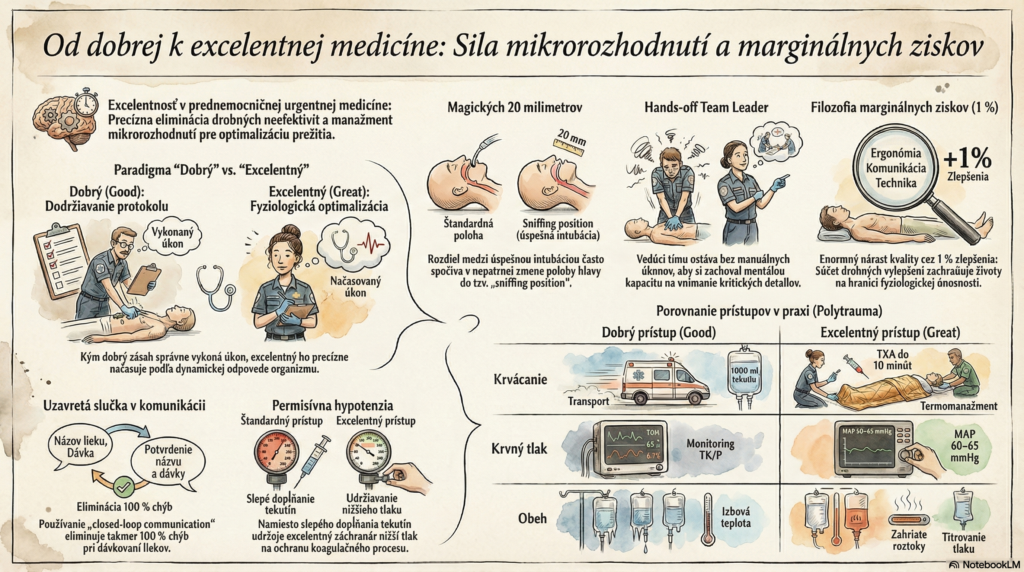
Most EMS teams operate in “correctly performed procedure” mode. If the patient has a tension pneumothorax, they decompress it. If the patient is in shock, they give fluids. That’s good medicine. Excellent medicine, however, asks the question: “Is this intervention timed and performed with regard to the body’s immediate dynamic response?”
The difference between a good and a great response is not whether the procedure is performed, but how and when it’s performed. Excellence in our field does not mean heroics — it means the precise elimination of small inefficiencies that, added together, make a significant difference in tissue perfusion and the patient’s neurological outcome.
2. Discussion of micro-decisions: seconds and millimeters
Micro-decisions are cognitive processes running in the background of the main algorithm. They are details that protocols (e.g., official Slovak Ministry of Health guidance) often don’t specify, but that an experienced paramedic recognizes as critical.
Position optimization and airway physiology
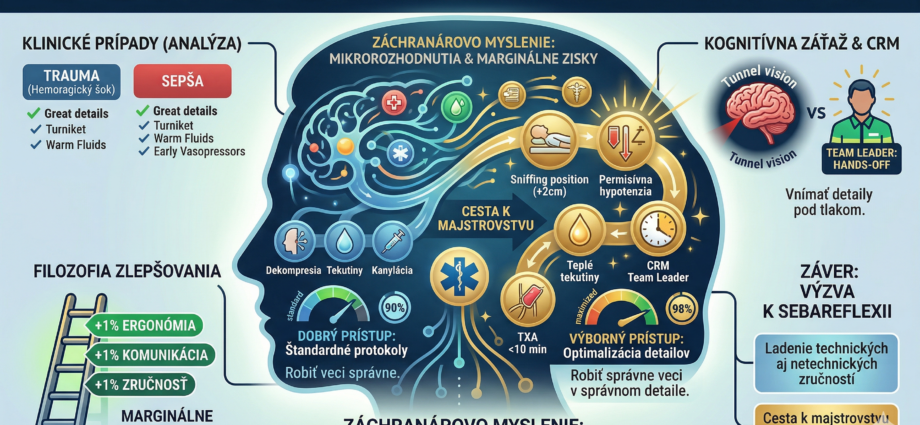
In airway management, simply “tilting the head back” is not enough. The difference between a difficult intubation and a successful First Pass Success often comes down to a 2-centimeter change in head position into the so-called sniffing position, or padding under the shoulder blades in children. Another micro-decision here is the choice of preoxygenation method: it’s not just about placing a mask, but ensuring a proper seal and using PEEP (positive end-expiratory pressure) in patients with a pulmonary shunt, before laryngoscopy even begins.
Hemodynamics: more than just a “bolus”
In circulatory resuscitation, a “good” response settles for giving crystalloids. An “excellent” response also considers the temperature of the fluids (prevention of the trauma triad of death) and precise pressure titration. Instead of blindly administering fluid until normotension is reached, the excellent paramedic aims for permissive hypotension in uncontrolled hemorrhage, protecting the fragile clotting process.
Cognitive load and perception of detail
Why do these details so often slip through the cracks? The answer is cognitive load. Under high stress, so-called cognitive fixation (tunnel vision) sets in. The paramedic focuses on the technical execution of a task (e.g., starting an IV), losing the ability to notice subtle changes in the capnography waveform or the patient’s muscle tone. Excellent teams eliminate this phenomenon by using crew resource management (CRM) principles, where the team leader stays “hands-off” in order to preserve mental capacity precisely for these micro-decisions.
3. Clinical cases: analysis of the detail
Case A: Polytrauma (hemorrhagic shock)
- Good approach: Stop massive hemorrhage, transport, give 1000 ml of crystalloids, monitor BP/HR.
- Excellent approach: Immediate tourniquet application with precise time recorded, administration of tranexamic acid (TXA) within 10 minutes of contact (per the CRASH-2 trial), active thermal management (preventing hypothermia), maintaining mean arterial pressure (MAP) at 60–65 mmHg to preserve cerebral perfusion without exacerbating hemorrhage, and early trauma center notification with a precise blood-loss estimate.
Case B: Septic shock with hypotension
- Good approach: Take a history, give oxygen, administer fluids, transport.
- Excellent approach: Identify the source of infection, give early fluids (30 ml/kg) while monitoring dynamic parameters (e.g., capillary refill time, inferior vena cava status via ultrasound if available), and above all, early initiation of vasopressors (norepinephrine) if the patient doesn’t respond to the initial bolus, to prevent prolonged organ hypoperfusion.
4. The “marginal gains” philosophy
The concept of marginal gains, known from elite sport, holds that if you improve every aspect of your work by 1%, the overall increase in quality will be enormous. In EMS, this means:
- Ambulance ergonomics: Organizing equipment so you save 5 seconds searching for a supply.
- Communication: Using closed-loop communication, which eliminates virtually all medication dosing errors.
- Technical skill: Improving IV cannulation success from 90% to 98%.
The sum of these “percentage points” is ultimately what saves a life in cases at the edge of physiological tolerance.
5. Conclusion: the path to mastery
The difference between a good and a great paramedic is not a title or years worked, but a willingness to continually subject one’s own actions to critical analysis. Excellence is a state of mind in which the paramedic never accepts “good enough” as the final destination.
I challenge you to self-reflect after every call. Don’t just ask: “Did I follow the protocol?” Ask: “Did I optimize the patient’s position? Was my medication timing ideal given their hemodynamics? Could I have reduced the team’s cognitive load through better communication?” True mastery in emergency medicine hides in millimeters and seconds. Be the crew for whom detail is a priority.
Sources and recommended reading:
- Slovak Ministry of Health guidance on the provision of prehospital emergency healthcare (current version).
- ERC Guidelines 2021/2025: Standards for resuscitation and emergency medicine.
- Syed, M. (2015): Black Box Thinking (the concept of marginal gains and learning from mistakes).
- CRASH-2 Trial Collaborators: Effects of tranexamic acid on death, vascular occlusive events, and blood transfusion in trauma patients with significant haemorrhage. Lancet.
- Reason, J. (2000): Human error: models and management. BMJ.