In the prehospital emergency care environment, speed is often glorified as the primary marker of quality. But for the experienced clinician, speed is not the goal — it is a byproduct of efficiency. The true enemy of a paramedic in a critical case is not only time, but cognitive fixation — a phenomenon in which the brain, under the pressure of stress hormones, stops perceiving its surroundings and locks onto a single, often incorrect, point. This article examines the concept of “5 extra seconds” — a deliberate cognitive pause that separates automatic, reactive action from strategic clinical management.
1. Cognitive fixation and the limits of the human factor
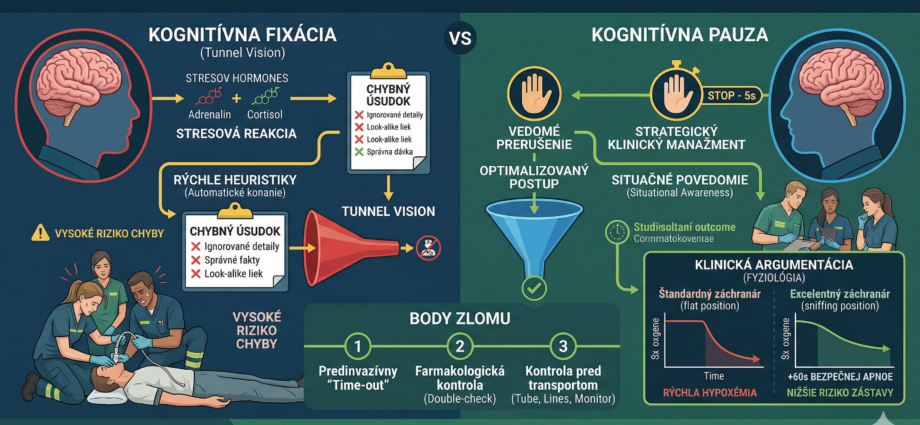
Under acute stress (activation of the hypothalamic-pituitary-adrenal axis), the human brain switches into so-called heuristic processing. These are mental shortcuts that let us decide quickly, but at the cost of losing detail. In emergency medicine, this often leads to “tunnel vision.”
Cognitive fixation causes a paramedic to ignore discrepancies in the clinical picture. For example, if a team fixates on a diagnosis of tension pneumothorax, they may overlook signs of cardiac tamponade, since both conditions share similar symptoms (hypotension, jugular venous distension). The cognitive pause is a mechanism that forcibly interrupts this automatic cycle and compels the prefrontal cortex to reassess the situation through situational awareness.
2. Breaking points: where 5 seconds changes the patient’s trajectory
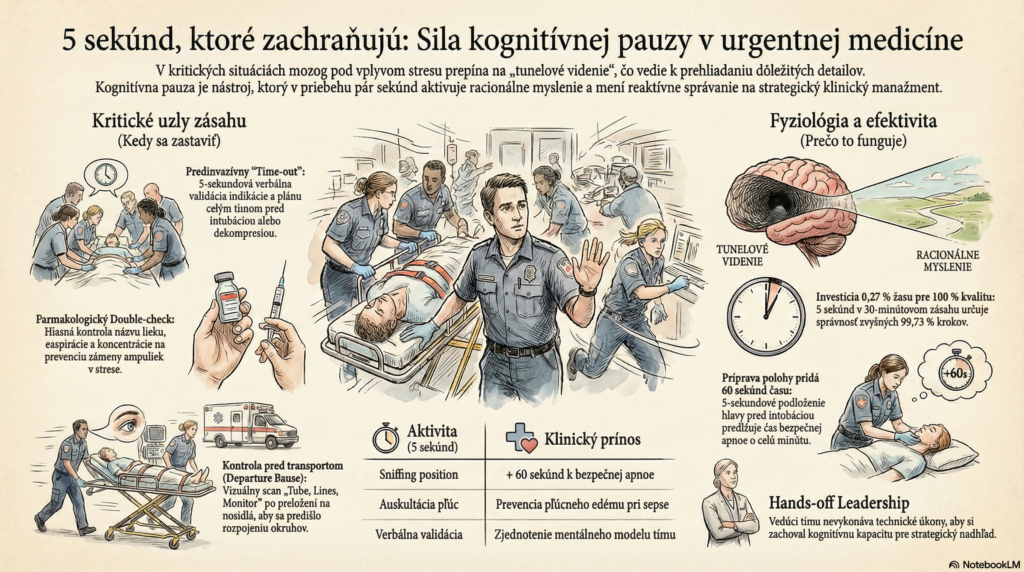
In a dynamic response, there are critical junctures where the probability of error is highest. We identify three moments where a deliberate stop is essential.
I. The pre-procedural “time-out”
Before a paramedic performs a needle decompression of the chest or begins rapid sequence intubation (RSI), a 5-second verbal validation must take place.
- Mechanism: The team leader states out loud: “We’re intubating, indication is GCS 6, equipment is ready, backup plan is an LMA. Does the team agree?”
- Purpose: This moment eliminates indication errors and ensures the whole team is mentally aligned (a shared mental model).
II. Pharmacological verification (double-check)
Administering medications in prehospital care is a high-risk process. 5 seconds spent checking the ampule and dose is not wasted time.
- Mechanism: Look at the ampule, say the drug name out loud, check expiration and concentration.
- Purpose: Preventing look-alike/sound-alike errors, which are statistically more common in the poorly lit environment of an ambulance or at night.
III. The pre-transport check (“the departure pause”)
The moment the patient is moved onto the stretcher and ready for transport is, paradoxically, the most common point for a circuit to disconnect or IV access to be lost.
- Mechanism: A 5-second head-to-toe visual scan — “tube, lines, monitor.”
- Purpose: Confirming airway patency after handling, and securing cables and tubing before moving through a tight space.
3. Clinical rationale and physiological consequences
Why insist on detail when the patient is bleeding? Because physiology doesn’t forgive.
Take positioning optimization before intubation as an example. A “good” paramedic intubates the patient in whatever position they found them. An “excellent” paramedic sacrifices 5–10 seconds to pad the head into the sniffing position or a head-elevated position (ear-to-sternal-notch).
- Physiological impact: This position increases functional residual capacity (FRC) of the lungs and extends the safe apnea time. Those 5 seconds of preparation can add 60 seconds to the time before oxygen saturation drops below the critical threshold of SpO2 < 90%. This drastically reduces the risk of peri-intubation cardiac arrest from hypoxemia and acidosis.
Similarly, when giving fluids to a septic patient: 5 seconds spent auscultating the lungs before each bolus can prevent iatrogenic pulmonary edema in a patient with limited cardiac reserve. Here the pause is not hesitation — it is precise titration of the intervention.
4. Implementation: building a culture of safety
Introducing a cognitive pause into a team accustomed to “adrenaline sprints” requires a paradigm shift in crew resource management (CRM).
- Normalizing the pause: The team leader must state clearly that pausing to verify is not a sign of uncertainty, but a sign of professionalism.
- Standardized phrasing: Using clear commands such as “pause, checkpoint” or “hands off, reassessing the situation.”
- Hands-off leadership: The team leader must not be the one performing technical tasks. If they’re the one starting an IV, they lose the ability to take a cognitive pause, because their working memory is consumed by the motor task.
Conclusion: an investment that pays off
Five seconds within the context of a 30-minute call is just 0.27% of the time. Yet it’s the most important 0.27%, because it determines the correctness of the remaining 99.73%. The cognitive pause is an insurance policy against human error — something every one of us carries, regardless of years of experience.
I encourage you, at the moment of highest tension during your next critical call, to deliberately slow down. Take a breath, look around, and check your assumptions. Those 5 seconds aren’t about you — they’re your patient’s last line of defense.
Sources:
- Reason, J. (1990): Human Error. Cambridge University Press. (A foundational work on error in complex systems.)
- Fan, M. et al. (2020): Cognitive aid for emergencies. British Journal of Anaesthesia.
- Hick, J. L. (2005): The cognitive pause: A necessary step for patient safety. Academic Emergency Medicine.
- Slovak Chamber of Paramedics: Methodological recommendations for CRM in prehospital care.