In emergency medicine, the patient history is considered one of the fundamental pillars of the diagnostic process. Yet we operate on an unspoken assumption that the information a patient provides is factually correct and complete. An experienced paramedic knows that the phenomenon of an “unreliable historical source” is not merely a technical complication, but a complex psychological state. A patient who, consciously or unconsciously, misleads is not an enemy of the system; they are a person in crisis whose communication barriers are often a defense mechanism. Understanding why a patient won’t tell us the truth is the key to deciphering their true clinical condition.
1. Introduction: the problem of unreliable history-taking in an emergency
In prehospital care, we’re often limited by time and a lack of objective data (medical records, lab results). We depend on what the patient tells us. If that source is contaminated by lies or omission, the entire diagnostic cascade can be sent in the wrong direction.
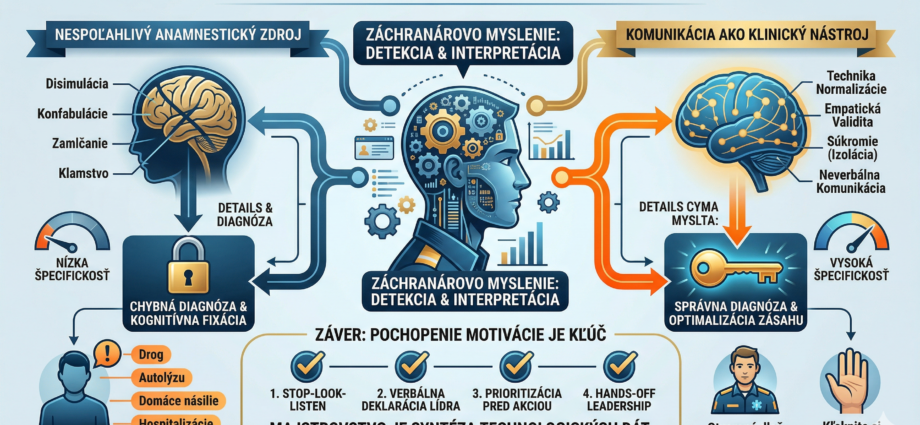
An unreliable history in emergency medicine doesn’t just mean “lying.” It spans a spectrum — from dissimulation (downplaying symptoms), through confabulation (creating false memories in the setting of cognitive impairment), all the way to outright concealment of critical information (substance use, a suicide attempt). For the paramedic, identifying these barriers is just as important as identifying a pathological waveform on the monitor.
2. Discussion: psychological barriers and motives for deception
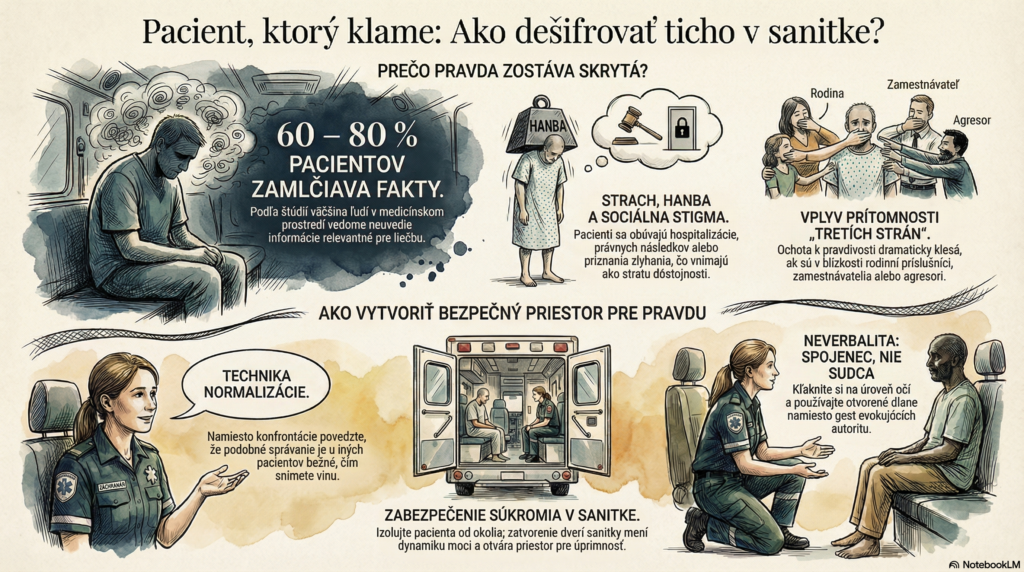
Why would someone in a life-threatening situation lie to the person who came to help them? Crisis psychology identifies several key determinants.
Fear, shame, and social stigma
Fear is ubiquitous in emergency medicine. A patient may fear hospitalization, loss of control over their life, or legal consequences (especially in intoxication cases or violent crimes). Shame plays a dominant role in topics such as domestic violence, sexual health, or psychiatric illness. Admitting a suicide attempt means, for many, admitting total failure — something at odds with their effort to preserve dignity in front of a stranger in uniform.
The drive to avoid repercussions
Illicit substance use is a classic example where fear of legal consequences (though often unfounded with respect to paramedics) outweighs the need for an accurate diagnosis. A patient may see the paramedic as an extension of state authority rather than as a caregiver.
Environmental influence and the presence of “third parties”
A patient’s willingness to be truthful drops dramatically in the presence of family members, partners, or employers. If the cause of a collapse is domestic violence, the victim will never confirm the truth in front of the abuser standing at the ambulance door. Similarly, a teenager won’t admit drug use in front of their parents. Social pressure to conform is stronger in a crisis than the instinct of self-preservation.
3. Theoretical framework: deception in medicine and the ethics of questioning
Research in medical psychology indicates that up to 60–80% of patients have at some point withheld information that could be relevant to their treatment (Levy et al., 2018). In emergency medicine we encounter the concept of “psychological reactance” — if a patient feels their freedom or integrity is threatened (for instance, by an authoritative approach from the paramedic), they respond with resistance, which manifests as non-cooperation or deception.
Studies on crisis communication emphasize that patients in shock or acute stress process information in a limited way. Their answers can be affected by cognitive overload. In such moments, the patient isn’t lying deliberately — their brain simply selects the easiest path to ending the stressful stimulus (the question), leading to answers like “I don’t know” or “I’m fine.”
4. Detection and strategies: how to read between the lines
The paramedic’s role is not to be a detective, but an empathetic analyst. If we sense a discrepancy between the clinical picture (e.g., miosis, bradypnea) and the history (“I haven’t taken anything”), we must change our communication strategy.
The normalization technique
Instead of direct confrontation (“You’re lying to me, I can see you injected something”), use normalization:
- “You know, a lot of people who feel this sick have taken something beforehand — medication, or something else. It only matters to us so we can give you the right antidote and not make a mistake. What happened in your case?” This technique lifts the burden of guilt and stigma off the patient.
Empathetic validation and privacy
If you suspect a sensitive topic (domestic violence, drugs), isolate the patient. Create space in the ambulance without family present. Say: “We need to do this part of the exam in private, please wait outside.” The moment the ambulance doors close, the power dynamic shifts, and the patient often opens up.
Non-verbal communication: an open palm, not a pointed finger
A raised finger or crossed arms evoke authority and judgment. An open palm, eye contact at the same level (kneel down next to the patient), and a calm tone of voice signal safety. A patient is more likely to tell the truth to someone they perceive as an ally, not a judge. Watch for mismatches between verbal and non-verbal expression — if a patient says nothing hurts but has clenched fists and tachycardia, their body is telling the truth their mouth denies.
5. Conclusion: motivation as the key to diagnosis
Understanding the motivation that drives a patient to withhold the truth is a critical diagnostic skill for a paramedic. A lie in the history is not a personal affront to the paramedic’s professionalism, but a clinical symptom of fear, shame, or trauma.
If we can identify the communication barrier, we can also work around it. Our goal isn’t to force a confession, but to create an environment in which the truth is safer than the lie. Ultimately, a paramedic who can read between the lines not only reaches a more accurate diagnosis, but also provides a higher standard of humane care. Remember that behind every “no” in a history there may be a quiet cry for help — one that just needs the right question and a safe space to answer it.
References:
- Levy, A. G., et al. (2018). Prevalence of and Factors Associated With Patient Nondisclosure of Medically Relevant Information to Clinicians. JAMA Network Open.
- Silverman, J., Kurtz, S., & Draper, J. (2013). Skills for Communicating with Patients. Radcliffe Publishing.
- Croskerry, P. (2009). A Universal Model of Diagnostic Reasoning. Academic Medicine.
- Adler, R. B., & Proctor, R. F. (2017). Looking Out, Looking In. Cengage Learning.
- Slovak Chamber of Paramedics (2022). Code of Ethics for Healthcare Workers and Communication in Crisis Situations.