In emergency medicine we often focus on the linear relationship of “paramedic – patient.” But the reality of prehospital practice is almost always trilateral. The presence of family members creates a complex interactive triangle that can be either a catalyst or a critical brake on the success of a response. The family isn’t just scenery at the scene; it’s a dynamic element that can, in a matter of seconds, turn the informational value of a history into cognitive noise — or the reverse. As professionals, we must treat communication with family as a clinical procedure requiring the same precision as central line placement.
1. Introduction: family as an integral part of the clinical picture
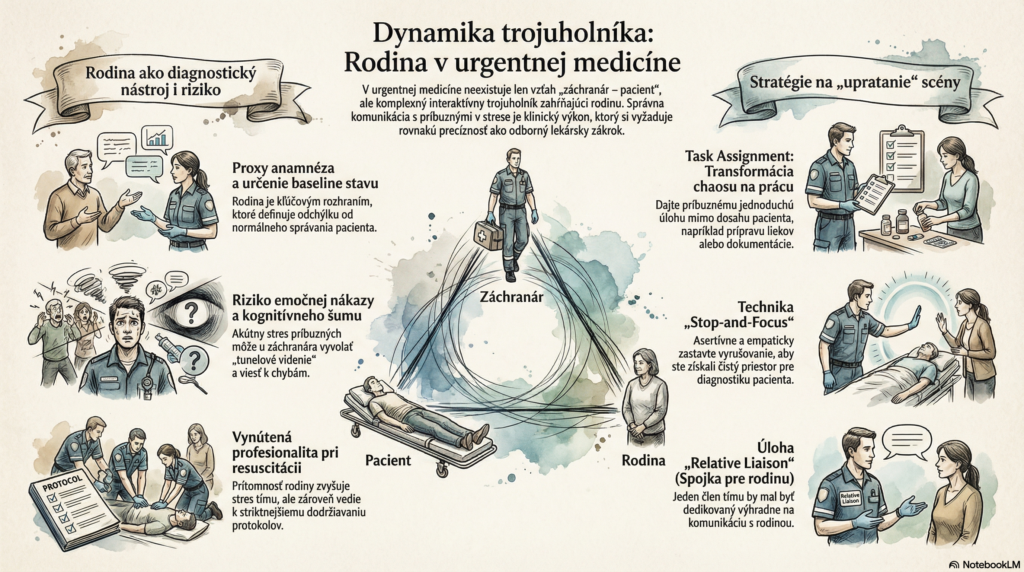
The success of a response in a home setting or in public often depends on the paramedic’s ability to manage the emotional field around the patient. Family represents the patient’s primary social and biological context. In situations where the patient cannot communicate (unconscious, in shock, a pediatric patient, or a geriatric patient with dementia), family becomes our exclusive diagnostic interface.
Conflict arises the moment the paramedic’s need for clean, structured data collides with an acute stress reaction from relatives. This article examines how to turn family from a factor of chaos into a key diagnostic asset.
2. Discussion: family as an asset — the proxy history and baseline
In many cases, family is the only source that lets us reconstruct events before our arrival.
Techniques for effective elicitation (the proxy history)
A proxy history (obtained from a third party) is prone to distortion by emotion. An effective paramedic must therefore use the “grounding the questions” technique. Instead of leading questions like “Was he feeling sick already this morning?” — which a stressed relative will confirm without thinking — we use open-ended but time-bounded questions:
- “When exactly did you first notice a change in his behavior?”
- “What was he doing right before he collapsed?”
Identifying the “baseline” state
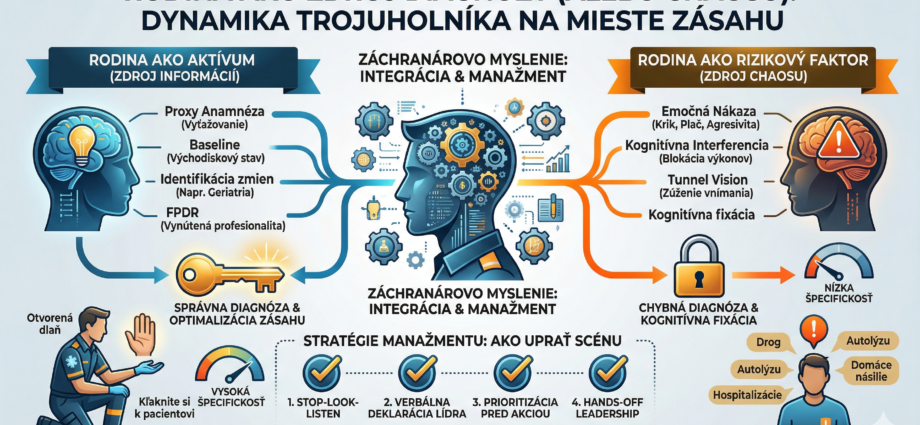
The greatest clinical value of family is defining the patient’s baseline. For a paramedic seeing the patient for the first time, an elderly patient’s confusion might look like acute stroke. But a relative is the one who can say: “This isn’t his usual dementia — today he didn’t recognize us for the first time, and his voice sounds different.” This information about a change from normal is critical for correctly directing the patient (e.g., to a stroke center).
3. Discussion: family as a risk factor — emotional contagion and cognitive interference
Acute family stress generates a high level of cognitive noise. If the paramedic cannot filter it out, a phenomenon known as emotional contagion occurs.
Cognitive decision-making under pressure
Shouting, crying, or aggression from relatives triggers the paramedic’s sympathetic nervous system, narrowing their perception (tunnel vision). In this environment, the paramedic more easily falls prey to cognitive fixation — making medication dosing errors or skipping steps in the ABCDE algorithm, because they subconsciously feel a need to “do something fast” to calm the surroundings, not the patient.
The interference phenomenon
Interference occurs when the family’s effort to help physically blocks access to the patient or verbally talks over the paramedic’s communication with the patient. A relative who holds the patient’s hand during IV placement, or who keeps answering for a patient who is able to speak, destroys the clarity of the diagnostic process.
4. Theoretical framework: CRM and family presence during resuscitation (FPDR)
The concept of crew resource management (CRM) teaches that bystanders are part of the scene’s resources. Studies on family presence during resuscitation (FPDR) show a dual effect:
- For the family: Presence during procedures (when managed) reduces the risk of post-traumatic stress disorder and eases the grieving process, because they see that everything possible was done for the patient.
- For the team: Family presence increases team stress, but also leads to “enforced professionalism.” Team members pay closer attention to communication and protocol adherence, because they are under direct observation.
The key CRM principle here is distribution of attention. If the team has at least two members, one should be dedicated to family communication (a “relative liaison”), freeing up the leader’s cognitive capacity for diagnosis.
5. Management strategies: how to “clean up” the scene
Family management must not be reactive, but proactive. Here are concrete tools:
Task assignment
The best way to eliminate chaos caused by a relative is to give them a job. The task must be simple, safe, and must require leaving the patient’s immediate vicinity:
- “I need you to go to the door and move furniture out of the way so we can get the stretcher through, and gather up all the medications and documents he takes.” This channels emotional energy into a useful activity and frees up working space for the paramedic.
The deliberate redirection technique
If family is talking over the communication, use the “stop-and-focus” technique:
- “Mr. Novak, I understand you’re scared, but right now I need to hear from your father. Please stay quiet for a moment, I’ll ask you for more details right after.” This instruction must be assertive but empathetic. It clearly defines the boundaries of the diagnostic space.
Isolating the scene
In extreme cases, if family physically obstructs treatment, isolation is necessary. One team member takes the relative to another room under the pretext of recording information. It’s a strategic move to protect the team’s cognitive capacity.
6. Conclusion: family as a partner, not an obstacle
Understanding family as both a source of information and an emotional risk is the mark of a mature professional. The diagnostic triangle requires us to view family as a care partner — one that nevertheless needs guidance. If we can “clean up” the family’s emotions in the first minute and give them meaningful tasks, we gain access to the most valuable database of patient information available. Remember: a family that feels part of the solution generates information; a family that feels excluded and ignored generates chaos.
References:
- European Resuscitation Council (2021). Guidelines for Resuscitation: Ethics of resuscitation and end-of-life decisions.
- Goldberger, Z. D., et al. (2015). Family Presence During Resuscitation: A Qualitative Analysis From a National Registry. Circulation: Cardiovascular Quality and Outcomes.
- Brindley, P. G., & Fanning, R. M. (2013). Crew Resource Management and Teamwork in Anesthesia. In: Patient Safety in Anesthesia. Elsevier.
- Silverman, J., Kurtz, S., & Draper, J. (2013). Skills for Communicating with Patients. Radcliffe Publishing.
- Crisis Psychology for Paramedics (2022). Methodological Handbook for Working with Relatives on Scene. Slovak Chamber of Paramedics.