1. The conceptual framework of the “golden moment” in emergency medicine
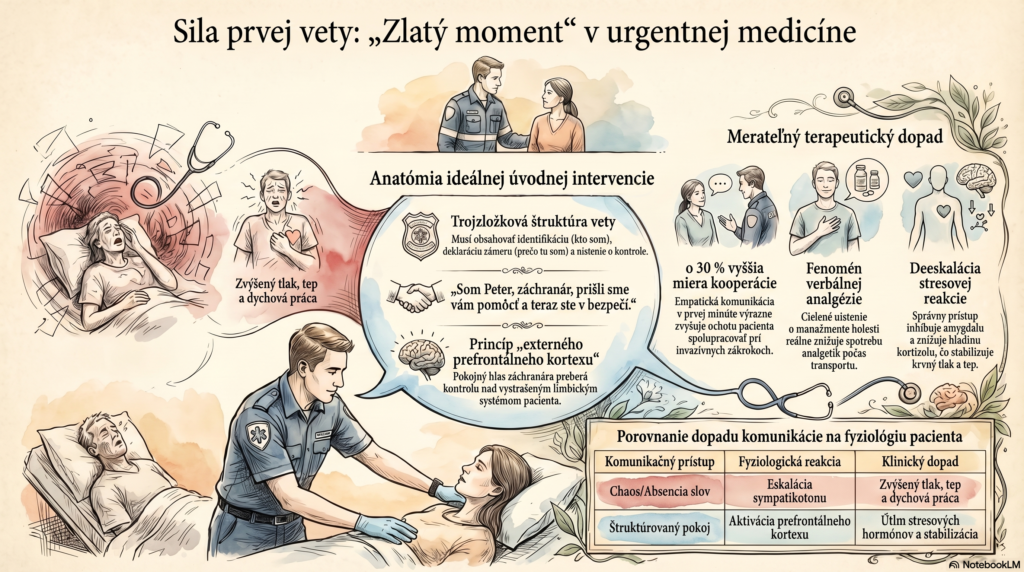
In prehospital emergency care, the initial phase of patient contact represents a critical time window known as the “golden moment.” These are the first seconds of eye and verbal contact immediately after the EMS crew arrives on scene. In this brief window, when the patient is in a state of extreme vulnerability, a therapeutic alliance is formed and a process of stress de-escalation begins.
A paramedic’s verbal opening is not a social nicety, but a full-fledged act of “verbal securing” of the patient, serving to frame the situation and clearly define roles. This act is an integral part of the resuscitation algorithm and must run in parallel with the clinical exam and technical tasks.
A patient in crisis subconsciously evaluates two fundamental variables that determine their degree of cooperation:
- Safety: Subjective sense of protection from immediate threat.
- Competence: The paramedic’s professional authority and ability to maintain control of the situation.
An absence of structured communication or a chaotic approach leads to escalation of the body’s sympathetic response. This psychological framework directly determines biological function and the subsequent stability of vital signs.
2. Neurobiological and physiological mechanisms of verbal intervention
Communication in emergency medicine represents a tool of direct biological stabilization. There is a causal link between psychological state and vital functions, in which verbal expression acts as a regulator of physiological processes.
In a state of acute threat, activation of the amygdala dominates, triggering the fight-or-flight response. This activation triggers a massive release of cortisol and epinephrine. Targeted verbal intervention, however, activates the prefrontal cortex. The key mechanism is the patient’s perception of the paramedic’s competence and external authority; if the patient assesses that the threat is under the control of an external force, the prefrontal cortex sends inhibitory signals to the limbic system, dampening amygdala activity.
A breakdown in communication leads to measurable worsening of parameters:
- Tachycardia (increased heart rate).
- Hypertension (elevated blood pressure).
- Increased work of breathing.
We define this process as external emotional regulation. The paramedic takes on the role of the patient’s “substitute prefrontal cortex,” suppressing the pathophysiological impact of stress — critical especially in cardiac and trauma cases. These changes then correlate with pain perception and reduce the need for aggressive pharmacological support.
3. Methodology of verbal analgesia and pain management
The strategic goal of verbal analgesia is a targeted reduction of anticipatory anxiety, thereby reducing the overall pharmacological burden during transport. Pain intensity is directly modulated by the patient’s psychological state.
The mechanism draws on the gate-control theory, according to which psychological factors act as modulators of painful stimuli passing into the CNS. Verbal analgesia is not suggestion in the sense of hypnosis, but rational reassurance that dampens the emotional component of pain.
In practice, clear verbal commitments are used: “We’re going to do everything we can to make you more comfortable.” Such a statement at the start of contact suppresses anticipated anxiety. Empathetic communication in the first 60 seconds increases patient cooperation with invasive procedures (e.g., IV placement, intubation) by 30%. Success depends on the precise linguistic structure of the opening sentence.
4. The structural anatomy of the therapeutic verbal opening
As a stressed patient’s cognitive capacity declines, communication must be linear, brief, and predictable.
4.1 Components of the “ideal sentence”
- Identification (who I am): “Hello, I’m [name], a paramedic.” Stating a name serves to humanize the technical environment and removes the barrier between the “uniform” and the patient.
- Declaration of intent (why I’m here): “We’re here to help you.” A direct appeal to the survival instinct.
- Reassurance of control (what’s happening): “You’re safe now, we’re going to take care of you.” Reduces isolation and fear.
4.2 Analysis of communication approaches
| Approach | Indication | Characteristics |
|---|---|---|
| Authoritative | Immediate threat to life (massive trauma, resuscitation). | Priority is immediate compliance and technical stabilization. |
| Partnership-based | Internal medicine conditions, psychological crises. | Building an alliance, using inclusive plural language (“we,” “together”). |
4.3 Model scenarios
- Geriatric patient: “Hello, [name], I’m paramedic [name], I’m here with my colleagues to help you with your breathing. We’re right here with you now.”
- Trauma patient: “Hello, I’m a paramedic, you’re safe now, we’re going to take care of you. What hurts the most right now?”
- Pediatric patient: “Hi, I’m [name] and I’m a paramedic. I wear this shirt/uniform because I help kids feel better. We’re going to work together now, okay?”
5. Tactical self-regulation and team communication (SBAR, SAFETI, PACE)
A paramedic’s self-regulation is a defense against “emotional flooding” and “tunnel vision.” Effective performance requires a synthesis of explicit knowledge (theory, routines) and tacit knowledge, which includes intuition, perceptual skill (what to focus on), and mental models (understanding the dynamics of the situation).
5.1 Cognitive protection mechanisms
- Attention management: Focusing on a task (e.g., starting an IV) as a tool for directing attention away from overwhelming emotions.
- Emotional distance: Adopting the role of a protocol-guided professional, increasing psychological distance from the trauma.
- Cognitive reframing: Viewing mistakes as part of the learning process and accepting the limits of medicine.
5.2 Standardized models
- SBAR: Standardizes information exchange, reducing the team’s cognitive load.
- SAFETI: Prioritizes Safety and Affect regulation.
- PACE: Ensures graduated communication and clarity when escalating risk.
5.3 Psychological safety and hierarchy
Hierarchy within a team can be a barrier to safety. If there’s fear of retaliation or of undermining a superior’s authority, critical interventions are delayed and safety risks go unnoticed. Psychological safety allows a team member to openly admit a mistake without fear of judgment.
6. Legal and ethical framework in the Slovak context
Psycholinguistic intervention is a mandatory part of the professional practice of healthcare workers in Slovakia.
Legal basis: The obligation to treat patients with respect and empathy is set out in Slovak Act No. 578/2004 Coll., and specifically its Code of Ethics (§ 2), contained in Annex No. 4 to that Act.
Professional accountability: Communication failure is the most common trigger for complaints, even when the clinical procedure itself was lege artis. Professional communication is therefore also legal protection for the paramedic.
Final standards of professionalism:
- Establishing eye-level contact (when safe to do so).
- Using a lower voice register (subconsciously perceived as safer).
- Avoiding negative framing: Instead of “Don’t worry, you’re not going to die,” use reassurance about stability: “We’re right here with you, we’re doing everything to keep you stable.”
References
- Watzlawick, P., Bavelas, J. B., & Jackson, D. D. (2011). Pragmatics of Human Communication: Interactional Patterns, Pathologies, and Paradoxes. (A classic work on how communication shapes behavior.)
- Jensen, H. I., & Foss, B. (2020). Communication in Pre-hospital Emergency Care: A Systematic Review. Journal of Clinical Nursing. doi:10.1111/jocn.15342.
- Vymětal, Š. (2007). Crisis Communication and Crisis Management. Grada Publishing. (Focused on crisis psychology in the Central European context.)
- Adler, R. B., & Proctor, R. F. (2017). Looking Out, Looking In. Cengage Learning.
- Act No. 578/2004 Coll. on healthcare providers, healthcare workers, and professional healthcare organizations (Slovak Republic), as amended.