In Slovak prehospital practice, hypertension is one of the most common reasons for a call. For a paramedic, however, it’s a diagnostic trap — high blood pressure can be the primary cause of symptoms, but it can also be a secondary compensatory response to another, more serious process.
1. INTRODUCTION – A REALISTIC SCENARIO
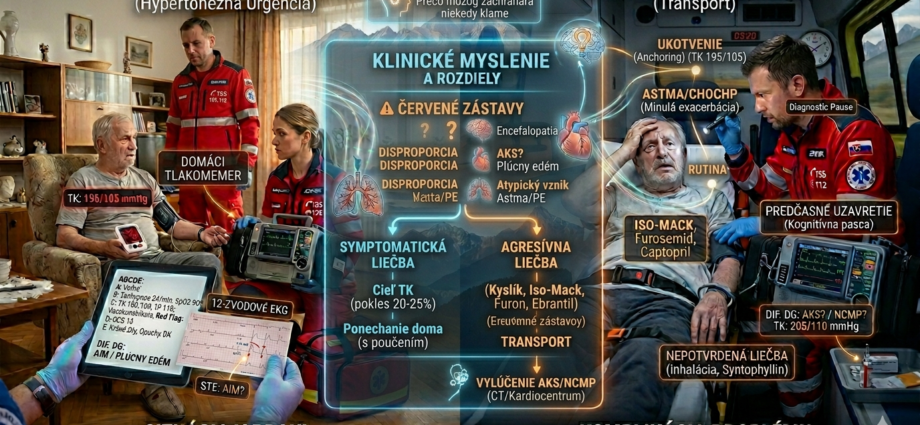
Dispatch: Basic ambulance, 18:30, male, 58 years old, “headache, high blood pressure.” On scene: The patient is sitting in the living room, holding the back of his neck. He reports measuring his BP at 195/105 mmHg. He feels “off” and reports mild nausea. He regularly takes a three-drug antihypertensive combination, taken this morning as usual. Objective findings: Alert and conversational, no obvious neurological deficit. BP: 200/110 mmHg, HR: 92/min, SpO2: 97% (room air), Glucose: 6.4 mmol/l. Atmosphere: The patient is anxious, family is demanding immediate medication to “bring the pressure down.” The paramedic reaches for a box of captopril.
2. CLINICAL ANALYSIS OF THE SITUATION (ABCDE)
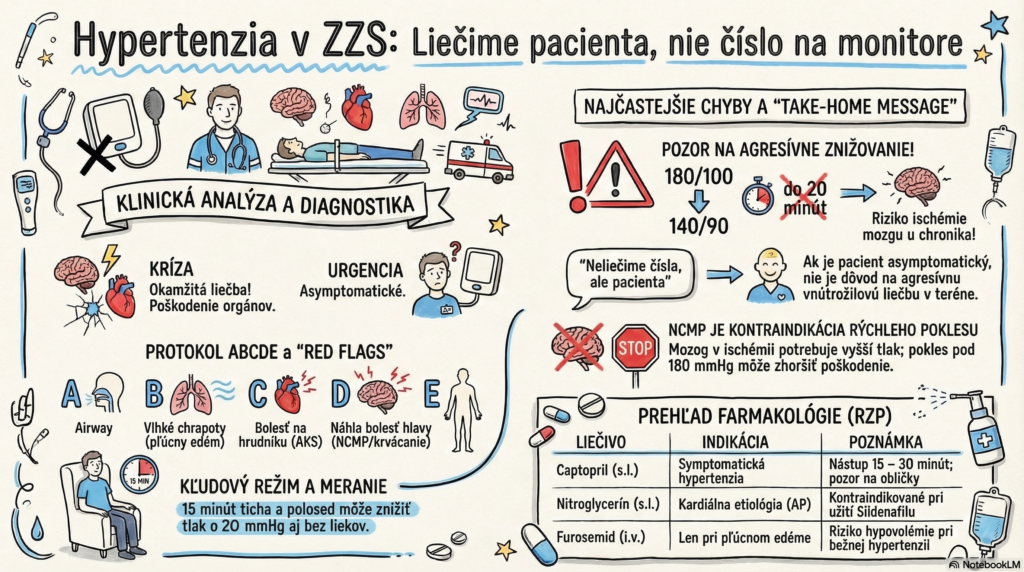
With hypertension, it’s essential to distinguish a hypertensive emergency (an urgent condition with organ damage) from hypertensive urgency (high blood pressure without symptoms of organ damage).
- A (Airway): Patent.
- B (Breathing): Is auscultation clear? Watch for crackles — pulmonary edema can begin precisely with hypertension.
- C (Circulation): BP 200/110 mmHg. Is this pressure causing the headache, or did the headache (e.g., from subarachnoid hemorrhage) cause this pressure?
- D (Disability): GCS 15. Any meningeal signs? Is speech clear? Any subtle facial asymmetry? Red flag: Any new neurological symptom makes a BP of 200/110 a secondary problem.
- E (Exposure): Is there chest pain or pain between the shoulder blades? (Aortic dissection.)
Most commonly underestimated: The history of symptom onset. If the headache came on suddenly (“like a thunderclap”), the blood pressure becomes a secondary concern.
3. THE MOST COMMON ERRORS IN PRACTICE
- Aggressive blood pressure lowering: Trying to get the patient down to 140/90 mmHg within 20 minutes. In a chronic hypertensive patient, this can lead to cerebral hypoperfusion and iatrogenic stroke.
- Anchoring: Fixating on the number on the cuff. “The pressure is high, I need to bring it down,” instead of looking for the cause (pain, stress, urinary retention, a CNS process).
- Skipping the 12-lead ECG: Treating hypertension as an isolated problem without ruling out ACS or strained left-ventricular hypertrophy.
- Environmental pressure: Giving in to family urgency. “Do something, his blood vessel is going to burst!”
4. DECISION POINTS (CRITICAL THINKING)
The paramedic must answer the question: Is organ failure threatening right here, right now?
- Transport: If there’s chest pain, dyspnea, a neurological deficit, visual disturbance, or eclampsia (in pregnancy).
- Treat in the field: Only for symptomatic hypertension (headache, nausea) without signs of stroke/ACS. The goal is a decrease of 20–25% over hours, not minutes.
- Leave at home: Risky at pressures above 180/110 mmHg without the option for follow-up. If the patient is asymptomatic, adjusting chronic medication through their regular physician is enough (though in Slovak EMS practice we often end up substituting for after-hours primary care).
5. A PRACTICAL APPROACH FOR BASIC AMBULANCE CREWS
- Rest and quiet: 15 minutes of quiet and a semi-recumbent position can lower blood pressure by 20 mmHg without any medication.
- Repeat measurement: The first reading is almost always elevated due to stress from the ambulance’s arrival.
- Differential diagnosis (ruling out target-organ involvement):
- Brain (stroke, encephalopathy).
- Heart (ACS, pulmonary edema).
- Vessels (aortic dissection).
- Kidneys (acute failure).
6. PHARMACOLOGICAL CONSIDERATIONS
Within basic-crew scope of practice (always per current standards and protocols):
- Captopril: 12.5–25 mg SL/PO (onset 15–30 min). Caution: Contraindicated with known renal artery stenosis or a history of angioedema.
- Nitroglycerin: 0.4 mg SL (spray). Indicated only when a cardiac cause is suspected (angina, pulmonary edema). Contraindication: PDE-5 inhibitors (sildenafil) within the last 24 hours.
- Furosemide: 20–40 mg IV. Only for pulmonary edema (crackles present). Not a drug for “routine” hypertension (risk of hypovolemia and electrolyte disturbance).
- Urapidil: (Within the scope of advanced/physician-staffed crews.) The drug of choice for hypertensive emergencies due to its predictable effect without reflex tachycardia.
7. TAKE-HOME MESSAGE
- We don’t treat numbers, we treat patients. If BP is 200/100 and the patient is asymptomatic, there’s no reason for aggressive IV treatment in the field.
- Stroke is a contraindication for rapidly lowering blood pressure. An ischemic brain needs higher cerebral perfusion pressure (CPP). Dropping BP below 180 mmHg in ischemic stroke can enlarge the penumbra.
- Headache + high blood pressure = caution. Always rule out meningeal irritation and focal findings.
- ECG is the standard. Every case of hypertension with systolic pressure above 180 warrants at least one 12-lead recording.
8. BONUS – “HOW THIS COULD GO WRONG”
Alternative scenario: In our scenario, the crew gives the patient 25 mg of sublingual captopril, and when the pressure doesn’t drop after 10 minutes, adds another 25 mg. The pressure falls to 140/85. The patient suddenly starts slurring his words and his right arm goes weak. Reality: The patient actually had an evolving stroke. By aggressively lowering the pressure, the crew wiped out the collateral circulation that was keeping brain tissue alive. Consequence: A permanent neurological deficit that could have been minimal with a more conservative approach.