The geriatric patient represents the greatest diagnostic challenge for a basic ambulance crew. A mechanism of injury that wouldn’t leave a bruise on a young person can trigger a cascade leading to multi-organ failure in an elderly patient. In the Slovak EMS system, these calls are often dismissed as “social” cases — a dangerous cognitive error.
1. INTRODUCTION – A REALISTIC SCENARIO
Dispatch: Basic ambulance, 14:20, female, 82 years old, “fell at home, can’t get up.” On scene: The patient is sitting in an armchair, helped there by her son. She reports her slippers “slipped” in the kitchen an hour ago. She reports only mild pain in the left flank and lower ribs. Objective findings: Alert, oriented (GCS 15). Skin pale but dry. BP: 130/80 mmHg, HR: 95/min, SpO2: 94% (room air), Glucose: 6.2 mmol/l. History: Atrial fibrillation (on apixaban), hypertension, mild cognitive impairment. Crew’s assessment: “Skeleton seems intact, circulation is stable.” The patient firmly refuses transport, wants to stay home. Her son is uncertain.
2. CLINICAL ANALYSIS OF THE SITUATION (ABCDE)
In elderly patients, physiological reserves are minimal and compensatory mechanisms can be misleading.
- A (Airway): Patent, but watch for increased aspiration risk due to pain and limited mobility.
- B (Breathing): Rib fractures are often clinically “silent” in the elderly. Shallow breathing from pain leads to rapidly developing hypostatic pneumonia. Red flag: SpO2 dropping below 95% in a non-COPD patient after a fall.
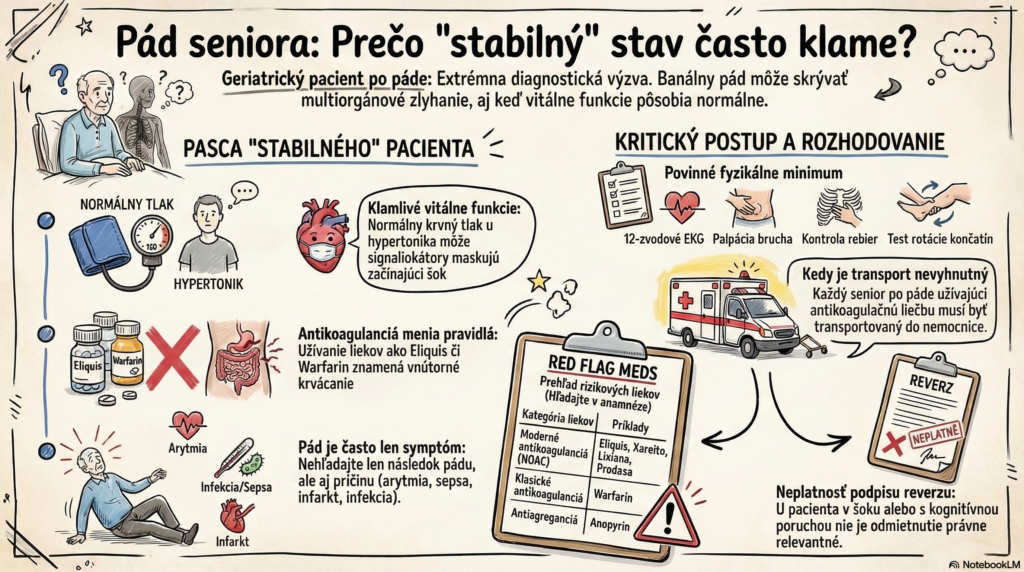
- C (Circulation): A BP of 130/80 mmHg can, in a chronic hypertensive patient (normally 170/90), be a sign of early shock. Key factor: Apixaban (an anticoagulant) + fall = internal hemorrhage (spleen, retroperitoneum) until proven otherwise.
- D (Disability): Even mild confusion can be a sign of intracranial hemorrhage (subdural hematoma), not just dementia.
- E (Exposure): Assessing pelvic stability and abdominal palpation are critical. Elderly patients have a reduced pain threshold — an absence of guarding doesn’t rule out organ rupture.
3. THE MOST COMMON ERRORS IN PRACTICE
- False reassurance: Normal-looking vital signs in a geriatric patient on beta-blockers (masking tachycardia).
- Anchoring: Fixating on “she slipped.” A fall is often secondary (syncope from arrhythmia, MI, urinary tract infection/sepsis).
- Confirmation bias: Looking for reasons to leave the patient at home (family pressure, “the ER is full”).
- Neglecting anticoagulation history: Underestimating the risk of occult bleeding in patients on NOACs/warfarin.
4. DECISION POINTS (CRITICAL THINKING)
Clinical reasoning must override operational routine:
- When transport is non-negotiable: Any elderly fall patient with a history of anticoagulant therapy. Any fall with unexplained etiology (a non-mechanical fall).
- Refusal of transport: In a patient with cognitive impairment or suspected cerebral hypoperfusion (shock), a refusal is not legally valid (they lack capacity to make that decision in that moment).
- Hidden mortality: A femoral neck fracture is not just an orthopedic problem, but a metabolic catastrophe. 30-day mortality in the elderly is extreme.
5. A PRACTICAL APPROACH FOR BASIC AMBULANCE CREWS
- Ruling out syncope: A 12-lead ECG is mandatory for every elderly fall.
- Physical exam minimum: Check limb length and rotation (hip), palpate the lower ribs, check for abdominal tenderness to percussion.
- Medication history: Look for apixaban, rivaroxaban, edoxaban, dabigatran, aspirin.
- Orthostatic test: If the patient becomes dizzy or heart rate rises by 20/min upon sitting up or standing, transport is necessary.
6. PHARMACOLOGICAL CONSIDERATIONS
- Analgesics: Use opioids cautiously (risk of respiratory depression and delirium). We prefer paracetamol 1 g IV.
- Fluids: Cautious rehydration with crystalloids (250 ml boluses); watch for heart failure and pulmonary edema.
- Contraindications: NSAIDs are unsuitable in elderly patients at risk of renal failure and bleeding.
7. TAKE-HOME MESSAGE
- Triage in the elderly is deceptive: Stable vital signs do not mean the absence of significant injury.
- A fall is a symptom: Look for the cause (arrhythmia, sepsis, medication), not just the consequence.
- Anticoagulants change the rules: Any head or trunk injury in a patient on a NOAC must be seen by a physician with access to CT imaging.
- Rib pain in the elderly = imaging: Prevention of respiratory failure.
8. BONUS – “HOW THIS COULD GO WRONG”
Error scenario: The crew accommodates the patient and lets her sign a refusal of transport, staying home. Six hours later, her son finds her unconscious, pale, and sweating. On arrival, the ambulance crew finds a BP of 70/40 mmHg and a rigid abdomen. Reality: The patient had a subcapsular splenic hematoma that ruptured a few hours later (a delayed, two-stage rupture). Anticoagulant therapy prevented spontaneous hemostasis. Consequence: Death in the emergency department. Forensic follow-up: the paramedic underestimated the risk posed by anticoagulant therapy and failed to question the patient’s capacity to sign a refusal given suspected evolving shock.