Introduction Amiodarone is a key class III antiarrhythmic that dominates advanced life support (ALS) algorithms for shockable rhythms and in the management of broad-spectrum tachyarrhythmias. Its uniqueness lies in its ability to affect multiple types of ion channels, making it a versatile but complex tool that requires caution due to its hemodynamic side effects (particularly hypotension).
1. Drug Identification
- Active substance: Amiodaroni hydrochloridum.
- Trade names in Slovakia: Amiodarone Kalceks, Cordarone, Sedacoron.
- ATC classification: C01BD01 (Antiarrhythmics, class III).
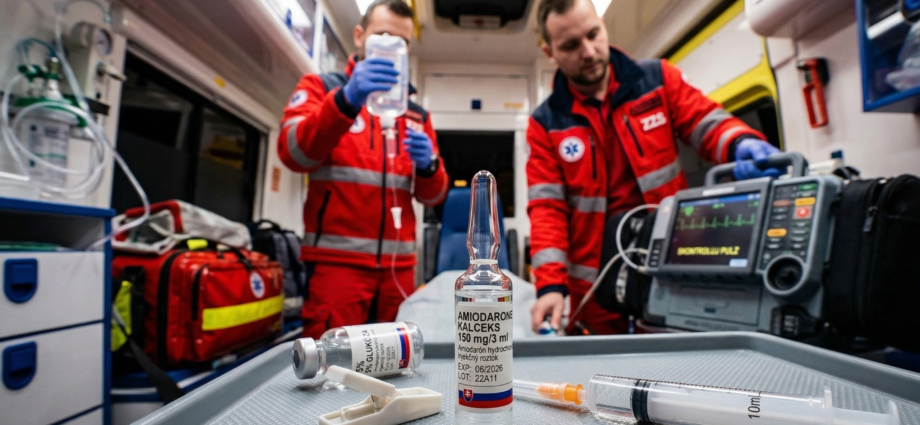
- Dosage form in EMS: Injection solution 150 mg/3 ml.
- Pharmacological group: Class III antiarrhythmic (potassium channel inhibitor), though it also displays class I, II, and IV properties.
2. Mechanism of Action (Pharmacodynamics) Amiodarone prolongs the myocardial action potential and refractory period:
- Class III (main effect): Blockade of potassium channels (delayed rectifier), leading to prolonged repolarization (QT prolongation).
- Class I: Blockade of fast sodium channels (reduced rate of depolarization).
- Class II: Non-competitive antagonism of alpha and beta receptors (antisympathetic effect).
- Class IV: Blockade of L-type calcium channels, which slows AV nodal conduction.
- Vascular effect: Produces peripheral vasodilation and reduces coronary resistance.
3. Hemodynamic Effects – IN DETAIL
- SVR (systemic vascular resistance): Decreases (vasodilation), especially with rapid bolus administration (due to the polysorbate 80 solvent in older formulations).
- Preload: Mild decrease due to venodilation.
- Afterload: Decreases secondary to reduced SVR.
- Contractility: Negative inotropic effect (more pronounced in patients with pre-existing heart failure).
- Coronary perfusion: Improves due to coronary artery vasodilation.
Destabilization risks:
- Critical hypotension: The most common complication with IV administration in conscious patients.
- Bradycardia and AV block: A risk in patients with sick sinus syndrome or when combined with beta-blockers.
4. Pharmacokinetics (from a Paramedic’s Perspective)
- Routes of administration: IV (exclusively, in EMS), and IO during resuscitation.
- Onset of action: Almost immediate with IV administration (effect on electrophysiology), though the full antiarrhythmic effect may require a cumulative dose.
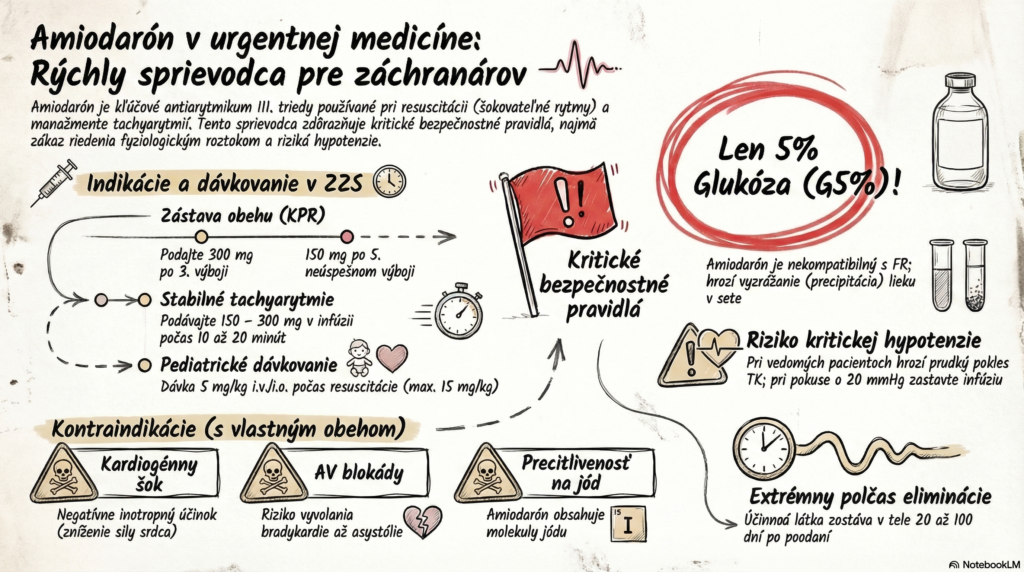
- Half-life: Extremely long (20 to 100 days). This figure is irrelevant to termination of effect during the acute EMS phase, but matters for subsequent toxicity.
- Metabolism: Hepatic (CYP3A4). Eliminated via bile and feces.
5. Indications in Prehospital Practice
- Cardiac arrest (CPR): Refractory ventricular fibrillation (VF) and pulseless ventricular tachycardia (pVT) after the 3rd unsuccessful shock.
- Stable ventricular tachycardia (VT): In a hemodynamically stable patient (after other procedures fail, or as first-line).
- Atrial fibrillation (tachyarrhythmia): Rate control or pharmacological cardioversion (especially in patients with reduced left ventricular ejection fraction).
6. Dosing in EMS
- CPR (adult): Initial dose 300 mg IV/IO (diluted in 20 ml of 5% dextrose or undiluted). Second dose 150 mg IV/IO after the 5th shock.
- Tachyarrhythmias (adult with a pulse): 150 to 300 mg infused (typically in 100 ml of 5% dextrose) over 10 to 20 minutes.
- Pediatrics (CPR): 5 mg/kg IV/IO (may be repeated up to a maximum of 15 mg/kg).
- Scope of practice: Physician (RLP). A basic-crew paramedic (RZP) assists and administers it during CPR per ERC algorithms, under supervision or per protocol.
7. Contraindications
- Absolute during CPR: None exist.
- Relative (patient with a pulse): Cardiogenic shock, severe hypotension, 2nd- and 3rd-degree AV block (without a pacemaker), known iodine hypersensitivity.
8. Adverse Effects
- Acute: Hypotension, bradycardia, asystole, phlebitis at the injection site (high pH of the solution).
- ECG changes: QT prolongation (risk of Torsades de Pointes — rare, but possible).
9. Drug Interactions in EMS
- Beta-blockers / calcium channel blockers: Additive effect slowing AV conduction and negative inotropy.
- QT-prolonging drugs: (e.g., certain antipsychotics, antihistamines) — increase the risk of proarrhythmic effect.
10. Specifics in Emergency Medicine
- Dilution: Amiodarone is incompatible with normal saline — there is a risk of precipitation. Infusions must be prepared exclusively in 5% dextrose (D5W). During CPR (rapid bolus), it can be given undiluted if immediately flushed.
- Monitoring: Continuous BP and ECG monitoring (QRS width and QT interval) is essential during administration to a patient with a pulse.
11. Red Flags
- Precipitation: If you see cloudiness in the syringe or infusion set after contact with normal saline, do not administer the solution.
- Hypotension: If systolic BP drops by more than 20 mmHg during the infusion, slow or stop it.
- Torsades de Pointes: If this specific polymorphic VT appears after administration, amiodarone is contraindicated (use magnesium instead).
12. Antidote
- None exists. Overdose (bradycardia) is managed with atropine, glucagon, or temporary pacing. Hypotension is managed with fluid therapy and vasopressors (norepinephrine).
13. Practical Field Scenario Situation: A 65-year-old man with sudden palpitations and shortness of breath. ECG shows monomorphic ventricular tachycardia, HR 160. BP 110/70 (relatively hemodynamically stable). Status: Patient conscious, diaphoretic, no signs of pulmonary edema. Decision-making:
- Prepare amiodarone 300 mg in 100 ml D5W.
- Administer as a slow infusion over 20 minutes.
- Continuous monitoring of consciousness and BP. Hemodynamic rationale: Since the patient is stable, we choose the pharmacological approach over synchronized cardioversion. We must be prepared for a drop in BP.
Conclusion Amiodarone remains a cornerstone of ventricular arrhythmia treatment. In the EMS setting, correct administration — particularly choice of solvent and infusion rate — is decisive for therapeutic success without inducing iatrogenic shock.
14. Practical Summary – 5 Key Points
- Dextrose only: Never use normal saline for the infusion.
- CPR timing: Give after the 3rd unsuccessful shock (300 mg) and after the 5th shock (150 mg).
- Watch the BP: In a conscious patient, always administer slowly — sharp hypotension is a risk.
- Versatility: Effective against both supraventricular and ventricular arrhythmias.
- Watch the QT: Amiodarone prolongs repolarization — monitor for ECG changes.
Professional Sources and Literature:
- Slovak Ministry of Health guidance on the provision of prehospital emergency healthcare.
- ERC Guidelines 2021 (Adult Advanced Life Support).
- SmPC – Cordarone / Amiodarone Kalceks.
- Dobiáš, V. et al.: Emergency Healthcare. Osveta, 2021.