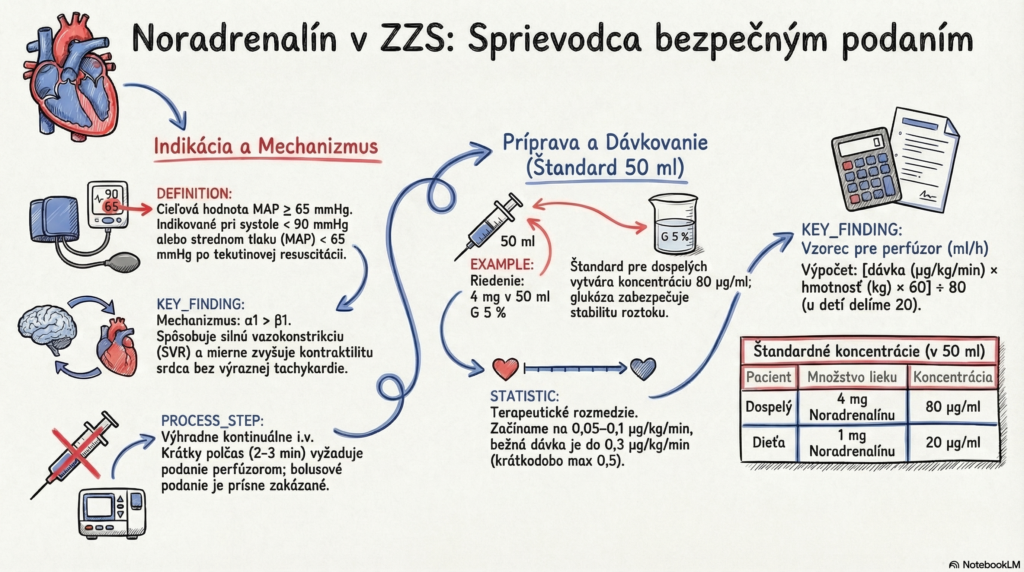
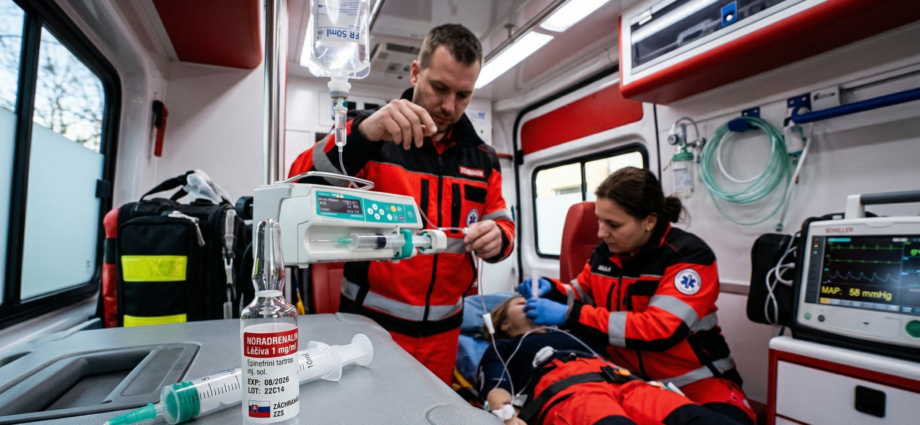
Introduction Norepinephrine is now the first-line drug for treating septic shock and other shock states associated with critical loss of vascular tone (vasoplegia). In emergency medicine it is a key tool for reaching a target mean arterial pressure (MAP) in patients for whom initial fluid resuscitation has failed. Precise infusion-based dosing is an essential standard of safe prehospital care.
1. Drug Identification
- Active substance: Norepinephrini tartras.
- Trade names in Slovakia: Noradrenalin Léčiva, Noradrenaline Kalceks.
- ATC classification: C01CA03 (Adrenergic and dopaminergic agents).
- Dosage form in EMS: Injection solution 1 mg/1 ml or 5 mg/5 ml.
- Pharmacological group: Direct sympathomimetic, strong α1 agonist and mild β1 agonist.
2. Mechanism of Action (Pharmacodynamics) Norepinephrine acts selectively on adrenergic receptors:
- α1 effect (dominant): Produces strong vasoconstriction of both arterioles and venules, increasing systemic vascular resistance.
- β1 effect (moderate): Has a positive inotropic effect on the myocardium (increases contractile force), but its effect on heart rate (chronotropy) is often offset in clinical practice by reflex bradycardia due to the rise in blood pressure.
- Effect on organs: Increases perfusion pressure to vital organs, though at extreme doses it can reduce splanchnic and renal blood flow.
3. Hemodynamic Effects – IN DETAIL
- SVR (systemic vascular resistance): Dramatic increase (the main effect).
- Preload: Increases due to venoconstriction, which shifts blood from the venous system toward the heart.
- Afterload: Marked increase, placing demands on left ventricular work.
- Contractility: Mild increase via β1 stimulation.
- Coronary perfusion: Improves secondarily due to the rise in diastolic blood pressure and increased perfusion pressure.
Destabilization risks:
- Cardiogenic shock: If primary pump (left ventricular) failure is present, a sharp rise in afterload (SVR) from norepinephrine can definitively exhaust the myocardium and reduce cardiac output.
- Limb ischemia: At massive doses and with centralization, critical peripheral ischemia is a risk.
4. Pharmacokinetics (from a Paramedic’s Perspective)
- Routes of administration: Exclusively IV (ideally into a large vein or a central line) or IO.
- Onset of action: Immediate (within 30 seconds to 1 minute once it reaches the central circulation).
- Half-life: Very short (1–2 minutes). Requires continuous administration.
- Elimination: Rapid enzymatic breakdown in the liver and tissues (MAO, COMT).
5. Indications in Prehospital Practice
- Septic shock: Gold standard for vasoplegia unresponsive to fluids.
- Neurogenic shock: With loss of sympathetic tone (spinal cord injury).
- Anaphylactic shock: As a second-line infusion if epinephrine boluses fail to maintain MAP.
- Post-ROSC hypotension: Blood pressure stabilization after successful resuscitation.
- Overdose of vasodilating drugs: (e.g., calcium channel blockers).
6. Dosing in EMS
- Adult: Starting dose 0.05 µg/kg/min, titrated to MAP (target MAP > 65 mmHg). Standard dilution: 5 mg (5 ml) in 50 ml normal saline (concentration 0.1 mg/ml).
- Pediatrics: 0.05–0.1 µg/kg/min, strictly titrated to age-appropriate blood pressure norms.
- Scope of practice: A physician (RLP) indicates and sets the infusion rate; a basic-crew paramedic (RZP) assists with preparation and monitors the patient (administering norepinephrine within Slovak RZP crews is tied to physician presence or specific critical-patient transfer protocols).
7. Contraindications
- Absolute: Hypotension caused by hypovolemia (without prior volume replacement).
- Relative: Mesenteric vascular thrombosis (risk of bowel infarction), severe lower-limb ischemia.
8. Adverse Effects
- Cardiovascular: Bradycardia (reflex), arrhythmias (rarer than with epinephrine), hypertension.
- Respiratory system: Possible pulmonary congestion with left ventricular failure.
- Local: Tissue necrosis with extravasation.
9. Drug Interactions in EMS
- Antidepressants (TCAs, MAOIs): Extreme potentiation of the vasopressor effect (risk of hypertensive crisis).
- Halothane anesthetics: Increased risk of arrhythmias.
10. Specifics in Emergency Medicine
- Monitoring: Invasive blood pressure monitoring (if available) or NIBP at 2–3 minute intervals.
- Error #1: Administering into a thin peripheral vein on the back of the hand (high necrosis risk).
- Error #2: An “empty pump” — an unprepared replacement syringe at low volumes can cause a sudden pressure crash.
11. Red Flags
- Extravasation: Norepinephrine is a potent venoconstrictor. Paravenous administration causes ischemic necrosis of skin and subcutaneous tissue. If it occurs, immediately apply a vasodilator (if available) or local heat.
- Empty tank: Never start norepinephrine until the patient has at least partial intravascular volume replacement (crystalloids).
- Finger ischemia: Pallor progressing to a bluish/purple discoloration of acral body parts signals too high a dose and critical vasoconstriction.
12. Antidote
- Specific: Phentolamine (an alpha-blocker), not available in the EMS setting.
- Symptomatic: Immediate discontinuation of the infusion, administration of nitrates.
13. Practical Field Scenario Situation: A 70-year-old female patient, febrile, with a history of urosepsis. BP 70/40, HR 120, skin warm and mottled. Status: Qualitative disturbance of consciousness, anuria. After 1000 ml of crystalloids, BP remains 75/45. Decision-making:
- Indication for a vasopressor – norepinephrine.
- Prepare a 5 mg/50 ml dilution.
- Start the infusion at 0.1 µg/kg/min via syringe pump. Hemodynamic rationale: The patient is in septic (distributive) shock. The goal is to restore vascular tone and reach a MAP of 65 mmHg to ensure renal and cerebral perfusion.
Conclusion Norepinephrine is the cornerstone of hemodynamic stabilization in shock states with vasodilation. Its administration requires technical precision (syringe pump) and continuous monitoring to avoid iatrogenic harm from extreme vasoconstriction.
14. Practical Summary – 5 Key Points
- Sepsis first line: The number-one drug of choice for septic shock.
- Volume first: Don’t start norepinephrine on “empty vessels” (fluids first).
- Large vein: Necrosis risk is real — look for the largest available peripheral vein (antecubital fossa).
- MAP 65: The goal isn’t hypertension, but the minimum mean pressure needed for organ perfusion.
- Continuity: The short half-life demands constant attention to IV line patency and the syringe pump’s status.
Professional Sources and Literature:
- Slovak Ministry of Health guidance on the management of sepsis.
- SmPC – Noradrenalin Léčiva.
- Surviving Sepsis Campaign Guidelines 2021.
- Dobiáš, V.: Emergency Healthcare. Osveta, 2021.