Introduction Epinephrine (adrenaline) is a key, life-saving drug in emergency medicine and prehospital emergency care, with a nonlinear pharmacodynamic profile. As an endogenous catecholamine, it is indispensable in advanced life support (ALS) algorithms and in the treatment of anaphylactic shock. Field administration requires precise knowledge of receptor affinity, since dosing or administration errors can lead to fatal hemodynamic complications.
1. Drug Identification
- Active substance: Epinephrini hydrochloridum.
- Trade names in Slovakia: Adrenalin Centriva, Adrenalin Bradex, EpiPen (auto-injector).
- ATC classification: C01CA24 (Adrenergic and dopaminergic agents).
- Dosage form in EMS: Injection solution 1 mg/1 ml (concentration 1:1000).
- Pharmacological group: Direct sympathomimetic, non-selective α and β receptor agonist.
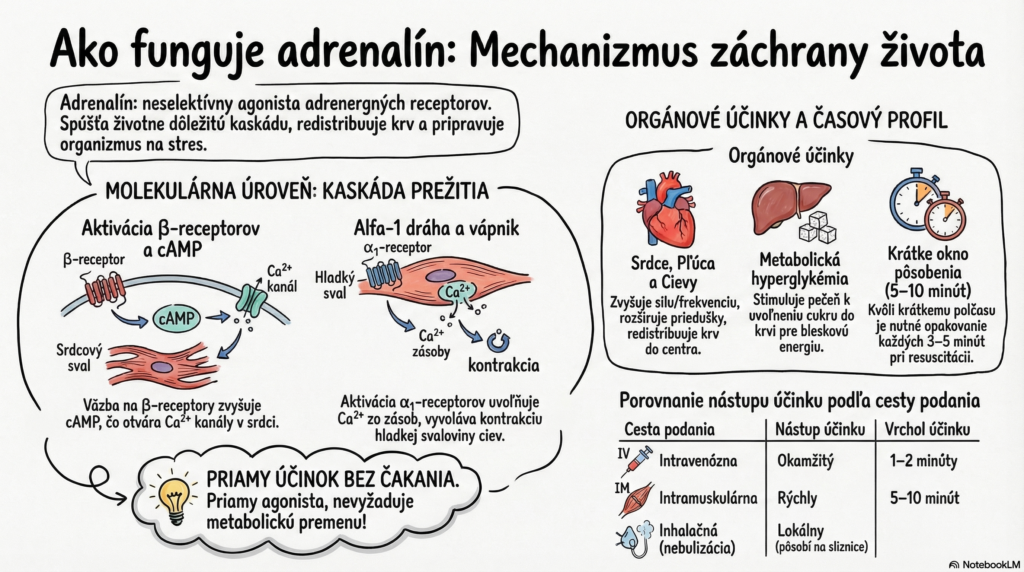
2. Mechanism of Action (Pharmacodynamics) Epinephrine stimulates adrenergic receptors with dose-dependent effects:
- β1 effect: Positive inotropic (force), chronotropic (rate), dromotropic (conduction), and bathmotropic (excitability) effects on the myocardium.
- β2 effect: Relaxation of bronchial smooth muscle, mast cell stabilization, and peripheral vasodilation at low doses.
- α1 effect: Massive arteriolar vasoconstriction, increased systemic blood pressure, and reduced mucosal edema.
- Metabolism: Increases glycogenolysis and lipolysis, inhibits insulin secretion (common iatrogenic hyperglycemia).
3. Hemodynamic Effects – IN DETAIL
- SVR (systemic vascular resistance): Rises significantly with bolus administration (α1 dominance).
- Preload: Increases due to venoconstriction, improving venous return.
- Afterload: Rises markedly, dramatically increasing myocardial work and oxygen consumption (MVO2).
- Contractility: Strong stimulation of inotropy via β1 receptors.
- Coronary perfusion: During CPR, the key factor is the rise in aortic diastolic pressure, which drives coronary perfusion pressure.
Destabilization risks:
- Myocardial ischemia: An extreme rise in MVO2 in a patient with coronary artery disease can trigger an infarction or malignant arrhythmias.
- Critical hypertension: Risk of intracranial hemorrhage with inappropriate indication or rapid bolus in a conscious patient.
4. Pharmacokinetics (from a Paramedic’s Perspective)
- Routes of administration: IV (in centralized circulation), IM (preferred for anaphylaxis – vastus lateralis muscle), IO (alternative to IV during CPR), nebulization (local, for laryngitis).
- Onset of action: IV/IO – almost immediate (< 1 min); IM – 5 to 10 min.
- Half-life: 2–3 minutes. Rapid inactivation in the liver and endothelium (MAO and COMT enzymes).
- Elimination: Renal, as metabolites.
5. Indications in Prehospital Practice
- Cardiac arrest (CPR): VF/pVT (after the 3rd shock), PEA/asystole (immediately).
- Anaphylaxis: Respiratory or circulatory failure (systemic reaction).
- Critical bradycardia: Refractory to atropine and transcutaneous pacing.
- Septic/cardiogenic shock: If norepinephrine therapy fails.
- Upper airway obstruction: Inhaled (nebulized) for severe croup/laryngitis.
6. Dosing in EMS
- CPR (adult): 1 mg IV/IO every 3–5 minutes.
- Anaphylaxis (adult): 0.5 mg IM (undiluted 1:1000).
- Pediatrics (CPR): 0.01 mg/kg IV/IO (from a 1:10,000 dilution).
- Continuous (shock): 0.05–0.5 µg/kg/min (strictly via syringe pump).
- Scope of practice: Physician-staffed crews (RLP) administer without restriction; basic-crew paramedics (RZP) administer for anaphylaxis and during CPR per ERC algorithms and current Slovak Ministry of Health guidance.
7. Contraindications
- Absolute: None exist for vital indications (CPR, anaphylaxis).
- Relative: Decompensated hypertension, hyperthyroidism, pheochromocytoma, advanced coronary artery disease, concurrent non-selective β-blocker therapy.
8. Adverse Effects
- Cardiovascular: Malignant arrhythmias, extreme tachycardia, myocardial ischemia.
- CNS: Tremor, marked anxiety, headache, risk of intracranial hemorrhage.
- Local: Vasoconstrictive necrosis with paravenous administration (extravasation).
9. Drug Interactions in EMS
- β-blockers: Risk of unopposed α-stimulation (severe hypertension and reflex bradycardia).
- Tricyclic antidepressants: Potentiation of the arrhythmogenic effect of catecholamines.
- Inhalational anesthetics: Increase myocardial sensitivity to epinephrine-induced arrhythmias.
10. Specifics in Emergency Medicine
- Monitoring: ECG, blood pressure, and SpO2 are mandatory during administration.
- Error #1: IV bolus for anaphylaxis with preserved circulation (high risk of iatrogenic ventricular fibrillation).
- Error #2: Mixing up concentrations during preparation (always visually confirm 1:1,000 vs. 1:10,000).
11. Red Flags
- Extravasation: Leakage outside the vein poses an immediate risk of tissue necrosis.
- Paradoxical reaction: Patients on β-blockers may develop extreme hypertension.
- Pavor mortis: A subjective sense of impending doom in a conscious patient (a sign of rapid distribution).
- Resistance in acidosis: At pH < 7.1, epinephrine’s effectiveness drops sharply; ventilation becomes the priority.
- Hyperglycemia: Expect a marked rise in blood glucose in diabetics after resuscitation.
12. Antidote No specific antidote exists. For iatrogenic overdose, treatment is symptomatic (short-acting α-blockers or nitrates to reduce afterload).
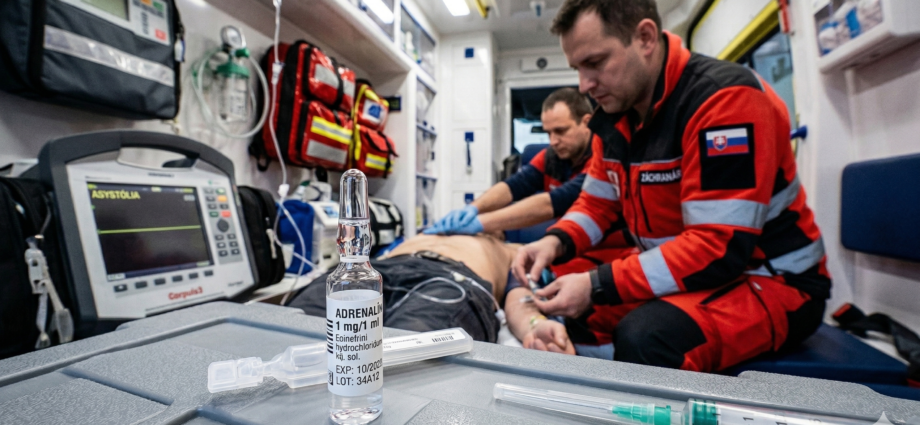
13. Practical Field Scenario Situation: A 45-year-old man collapses after a wasp sting, unconscious, with agonal breathing. Status: No palpable pulse, asystole on the monitor, generalized edema. Decision-making:
- Immediate start of CPR (chest compressions).
- Administer epinephrine 1 mg IV (immediately, PEA/asystole protocol).
- Simultaneous aggressive fluid therapy (1000 ml crystalloid bolus). Hemodynamic rationale: The combination of distributive shock followed by arrest requires immediate α-stimulation to restore coronary and cerebral perfusion pressure.
Conclusion Epinephrine remains the “gold standard” of emergency pharmacology. Its effectiveness is directly proportional to how early it is given (especially in non-shockable rhythms and anaphylaxis) and to correct administration technique. In a critical situation, the paramedic must rapidly weigh risk against benefit, and in life-threatening states, epinephrine’s hemodynamic benefits should always take priority.
14. Practical Summary – 5 Key Points
- Anaphylaxis = IM: Injecting into the thigh is safer and faster than searching for a vein.
- CPR asystole: Give epinephrine IMMEDIATELY once access is secured.
- Dilution: Always double-check, especially in pediatric patients.
- Short half-life: The effect wears off within 3 minutes, requiring repeat doses.
- Monitoring: Never administer catecholamines without monitoring vital signs.
Professional Sources and Literature:
- Slovak Ministry of Health guidance on the provision of prehospital emergency healthcare.
- SmPC (Summary of Product Characteristics) – Epinephrine.
- Dobiáš, V. et al.: Emergency Healthcare. Osveta, 2021.
- European Resuscitation Council (ERC) Guidelines 2021.
- Katzung, B. G.: Basic and Clinical Pharmacology.