
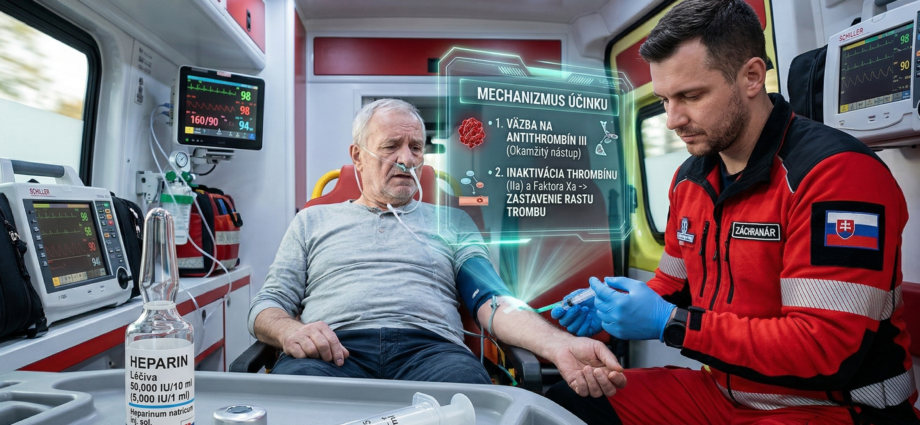
Introduction Heparin (unfractionated heparin, UFH) is a fast-acting anticoagulant used in EMS to prevent clot progression and maintain vessel patency during acute thromboembolic events. Its main advantage in the acute phase is an immediate onset of action after IV administration and the ability to rapidly reverse it with a specific antidote in case of bleeding complications.
1. Drug Identification
- Active substance: Heparinum natricum.
- Trade names in Slovakia: Heparin Léčiva.
- ATC classification: B01AB01 (Heparin group).
- Dosage form in EMS: Injection solution 5,000 IU/1 ml (10 ml vial = 50,000 IU).
- Pharmacological group: Direct anticoagulant.
2. Mechanism of Action (Pharmacodynamics) Heparin has no direct enzymatic activity on its own; it acts as a cofactor:
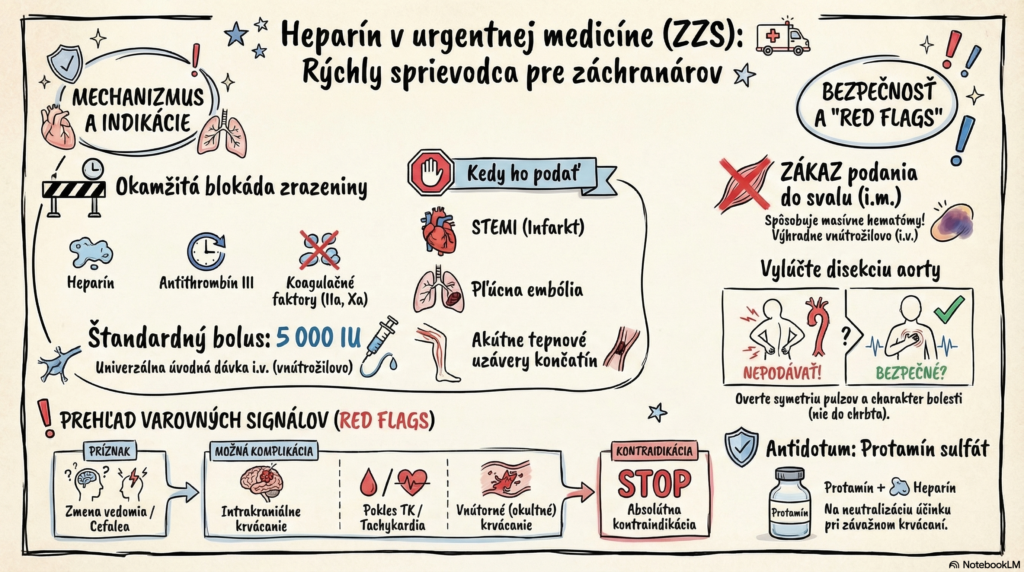
- Binding to antithrombin III (ATIII): Heparin binds ATIII and changes its conformation, accelerating its ability to inactivate key coagulation factors a thousandfold.
- Inactivation of thrombin (IIa) and factor Xa: This is the key step that halts the conversion of fibrinogen to fibrin, blocking clot formation and growth.
- Inhibition of other factors: Also affects factors IXa, XIa, and XIIa.
- Platelet interaction: At high doses, may inhibit platelet aggregation.
3. Hemodynamic Effects – IN DETAIL
- SVR, preload, afterload: No direct effect on hemodynamic parameters.
- Contractility: No direct effect.
- Blood viscosity: Mild reduction in blood viscosity at high doses, which theoretically improves microcirculatory rheology.
- Destabilization risk: Indirect risk related to hemorrhagic complications (e.g., CNS or GI bleeding), which can lead to hypovolemic shock.
4. Pharmacokinetics (from a Paramedic’s Perspective)
- Routes of administration: IV (the gold standard for ACS/PE), SC (prophylaxis only, not used in EMS). IM administration is forbidden (risk of massive hematomas).
- Onset of action: Immediate after an IV bolus.
- Half-life: 60–90 minutes (dose-dependent).
- Metabolism: Breakdown in the reticuloendothelial system and liver (heparinase). Elimination: renal.
5. Indications in Prehospital Practice
- Acute coronary syndrome (STEMI): As part of reperfusion therapy before transport to a PCI center.
- NSTEMI / unstable angina: In high-risk patients.
- Pulmonary embolism (PE): With clinical suspicion, whether hemodynamically stable or unstable, to halt clot progression.
- Acute peripheral arterial occlusion: Preventing clot apposition in an ischemic limb.
6. Dosing in EMS
- STEMI: Standard bolus of 5,000 IU IV (current ESC/Slovak Cardiology Society guidelines sometimes prefer 70–100 IU/kg).
- Pulmonary embolism: Bolus of 5,000–10,000 IU IV.
- Titration: aPTT is not monitored in the field; a single loading bolus is given.
- Scope of practice: Physician (RLP). A basic-crew paramedic (RZP) administers it per delegated competencies/protocols (in Slovakia, typically for STEMI after consultation with a cardiac center).
7. Contraindications
- Absolute: Active clinically significant bleeding, suspected aortic dissection, suspected intracranial hemorrhage (head trauma, stroke), severe uncorrected hypertension (> 200/110 mmHg).
- Relative: Recent surgery, peptic ulcer disease, history of HIT (heparin-induced thrombocytopenia).
8. Adverse Effects
- Hemorrhagic: Bleeding from puncture sites and mucous membranes, hematuria, serious internal bleeding.
- Immune: HIT (rare in the acute phase; manifests after 5–10 days).
- Other: Allergic reaction (rare).
9. Drug Interactions in EMS
- Antiplatelet agents (aspirin, ticagrelor, clopidogrel): Synergistic effect on hemostasis (increases bleeding risk, which is desired but risky in ACS treatment).
- Thrombolytics: Massive potentiation of bleeding.
- NSAIDs: Increase the risk of gastrointestinal bleeding.
10. Specifics in Emergency Medicine
- Monitoring: Clinical observation for signs of bleeding, BP monitoring (prevention of hypertensive bleeding).
- Error #1: Giving heparin with aortic dissection (can be fatal).
- Error #2: IM administration — leads to painful, extensive muscle hematomas that preclude further treatment.
11. Red Flags
- Sudden headache / altered consciousness: After heparin administration, may signal developing intracranial hemorrhage.
- Sudden drop in BP / tachycardia: A sign of internal bleeding (e.g., retroperitoneal).
- Hematoma at the IV site: Monitor the cannula’s stability and the surrounding puncture site.
12. Antidote
- Protamine sulfate: 1 mg of protamine neutralizes approximately 100 IU of heparin. Given as a slow IV infusion (rarely carried in EMS; within a physician’s scope of practice).
13. Practical Field Scenario Situation: A 58-year-old man with severe burning retrosternal pain lasting 30 minutes. Status: BP 150/90, HR 85, ECG: ST elevation in II, III, aVF (inferior infarction). Decision-making:
- Aspirin 250 mg PO (chewed).
- Heparin 5,000 IU IV bolus.
- Ticagrelor (Brilique) 180 mg PO.
- Consult with the PCI center, follow transport directives. Hemodynamic rationale: Heparin does not affect BP, but prevents the thrombus growing in the posterior interventricular artery. For an inferior infarction, we monitor BP due to the risk of RV failure, where bleeding could complicate resuscitation.
14. Practical Summary – 5 Key Points
- Always IV: Heparin never goes into muscle, full stop.
- Rule out dissection: Before administering, confirm the pain doesn’t radiate to the back and that pulses are symmetric in the upper/lower limbs.
- STEMI standard: 5,000 units is the universal “paramedic” bolus.
- Smooth transport: Field administration saves time for the subsequent PCI center procedure.
- Bleeding: If the patient is bleeding, heparin is an absolute no.
Professional Literature for Heparin Léčiva
1. Slovak Ministry of Health guidance on prehospital emergency care for acute coronary syndrome and pulmonary embolism.
2. SmPC (Summary of Product Characteristics) – Heparin Léčiva, registration no. 16/0698/69-S.
3. ESC Guidelines 2023 for the management of acute coronary syndromes.
4. ESC Guidelines 2019 for the diagnosis and management of acute pulmonary embolism.
5. Bultas, J.: Pharmacotherapy of Thromboembolic Conditions. Maxdorf, 2019.
6. Dobiáš, V. et al.: Emergency Healthcare. Osveta, 2021.