Introduction
Trombex (clopidogrel) is an irreversible platelet aggregation inhibitor belonging to the thienopyridine class. In emergency medicine it is a fixed part of dual antiplatelet therapy (DAPT) protocols. Although it has a slower onset than newer molecules (ticagrelor) due to the need for hepatic metabolic activation, it remains a key drug for patients with contraindications to newer agents or in specific cardiology indications (e.g., planned fibrinolysis).
1. Drug Identification
• Active substance: Clopidogrelum (as the hydrogen sulfate salt).
• Trade names in Slovakia: Trombex, Plavix, Zyllt, Egistrozol.
• ATC classification: B01AC04 (Platelet aggregation inhibitors excluding heparin).
• Dosage form in EMS: Tablets, 75 mg or 300 mg.
• Pharmacological group: Antiplatelet agent, P2Y12 receptor inhibitor.
2. Mechanism of Action (Pharmacodynamics)
Clopidogrel acts as a “prodrug,” meaning it requires biotransformation:
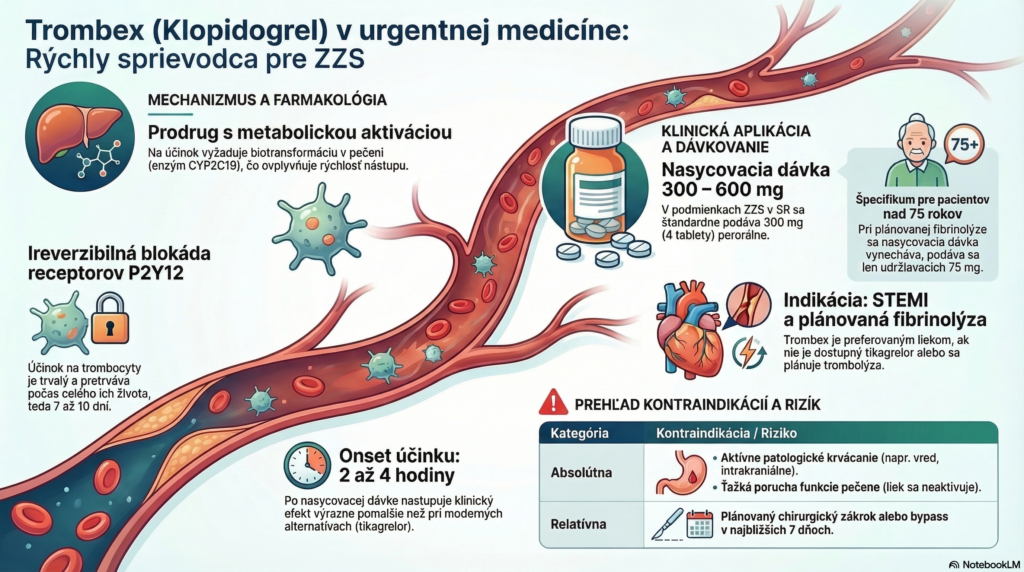
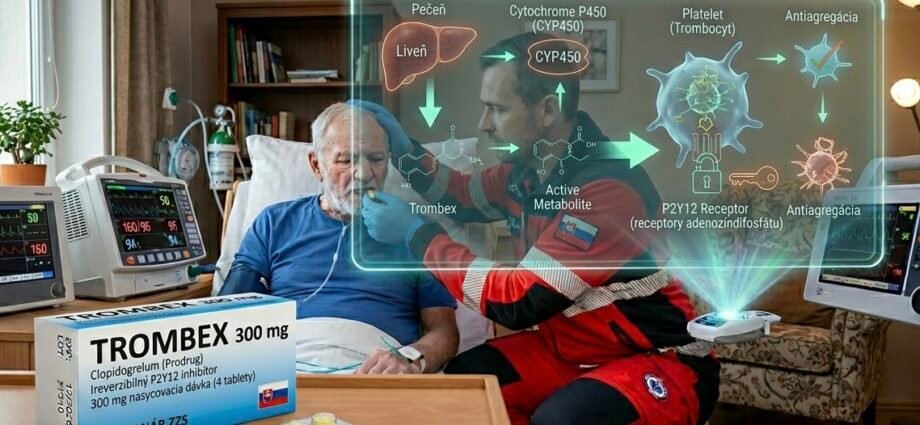
• Metabolic activation: Approximately 15% of the ingested dose is converted in the liver (via cytochrome P450, particularly CYP2C19) into an active thiol metabolite.
• Irreversible P2Y12 blockade: The active metabolite selectively and irreversibly binds the platelet-surface adenosine diphosphate (ADP) receptor P2Y12.
• Inhibition of aggregation: This mechanism blocks activation of the GP IIb/IIIa glycoprotein complex, preventing fibrinogen binding and subsequent platelet aggregation.
• Duration of effect: Since binding is irreversible, the effect persists for the entire lifespan of the platelet (7–10 days).
3. Hemodynamic Effects – IN DETAIL
• SVR, preload, afterload: No direct effect on systemic hemodynamic parameters.
• Contractility: No direct effect.
• Effect on perfusion: Reduces the risk of coronary microthrombosis, indirectly protecting myocardial microcirculation.
• Destabilization risk: The main risk is hemorrhagic, especially if urgent surgery becomes necessary (e.g., aortic dissection misdiagnosed as ACS).
4. Pharmacokinetics (from a Paramedic’s Perspective)
• Route of administration: Oral (PO). Unlike ticagrelor, crushing is not routinely recommended in EMS — the loading dose is what matters.
• Onset of action: After a loading dose of 300–600 mg, clinically significant inhibition is reached in 2 to 4 hours. (Note: markedly slower onset than Brilique/ticagrelor.)
• Peak effect: Approximately 6 hours after a loading dose.
• Metabolism: Hepatic (CYP450). There are “non-responders” (approximately 5–15% of the population) who, due to CYP2C19 genetic polymorphism, cannot effectively activate the drug.
5. Indications in Prehospital Practice
1. STEMI: If ticagrelor/prasugrel is not indicated or unavailable.
2. NSTEMI / unstable angina: Part of the loading dose for cardiac chest pain.
3. Planned fibrinolysis: In STEMI patients where primary PCI is unavailable (clopidogrel is the preferred P2Y12 inhibitor in this case).
4. Ischemic stroke: (Long-term treatment; in EMS, only for specific transfers.)
6. Dosing in EMS
• Loading dose: 300 mg to 600 mg PO (in Slovakia, typically 300 mg, i.e., four 75 mg tablets).
• Elderly patients (> 75 years): For planned thrombolysis, a maintenance dose of 75 mg is given without a loading bolus (to prevent CNS bleeding).
• Scope of practice: Physician (RLP). A basic-crew paramedic (RZP) per the current ACS protocol, after a 12-lead ECG.
7. Contraindications
• Absolute: Active pathological bleeding (ulcer, intracranial), severe hepatic impairment.
• Relative: Planned CABG surgery within the next 7 days, drug hypersensitivity.
8. Adverse Effects
• Bleeding manifestations: Hematomas, epistaxis, gastrointestinal bleeding.
• Hematologic: Rare thrombotic thrombocytopenic purpura (TTP) — manifests later.
• Other: Nausea, dyspepsia.
9. Drug Interactions in EMS
• Proton pump inhibitors (omeprazole): May reduce clopidogrel’s effectiveness by competing for the CYP2C19 enzyme. (Of little significance for a single EMS dose.)
• Aspirin, heparin: Desired synergy in ACS therapy, but increased bleeding risk.
10. Specifics in Emergency Medicine
• Error #1: Giving the low dose (75 mg) instead of the loading dose (300 mg) to an acute patient.
• Error #2: Omitting the dose for a STEMI patient headed to a PCI center (loses time needed for platelet inhibition to take hold).
• Differential diagnosis: Always verify the pain isn’t traumatic in origin or associated with dissection.
11. Red Flags
1. Slow onset: Don’t expect an immediate effect during transport; the key benefit shows up on the catheterization table.
2. GI bleeding: If the patient has a history of melena, giving antiplatelet agents must be weighed with extreme caution.
3. Resuscitation: If the patient arrests during transport and requires prolonged CPR, prior antiplatelet therapy increases the risk of traumatic bleeding (e.g., rib fractures).
12. Antidote
• None exists. The effect wears off only as new platelets are formed. For massive bleeding, platelet transfusion is indicated (though circulating active metabolite may partially block those too).
13. Practical Field Scenario
Situation: A 62-year-old man with inferior STEMI (II, III, aVF), time to PCI 45 minutes.
Status: Stable, BP 130/80. The patient has a contraindication to Brilique (history of ischemic stroke).
Decision-making:
1. Aspirin 250 mg PO (chewed).
2. Trombex (clopidogrel) 300 mg PO (4 tablets).
3. Heparin 5,000 IU IV.
Hemodynamic rationale: Since Brilique can’t be given due to a prior stroke (high risk of hemorrhagic transformation), we choose the safer Trombex as the second pillar of DAPT.
14. Practical Summary – 5 Key Points
1. Loading dose: Always give the full prescribed dose at once (typically 300 mg).
2. Backup option: If you don’t have Brilique, Trombex is your second choice for ACS.
3. The liver is key: Be aware the drug won’t work well in a patient with severe hepatic failure.
4. Caution over 75: Don’t give a loading dose to elderly patients undergoing planned thrombolysis.
5. Bleeding: If you see signs of bleeding, hold the antiplatelet agent.
Professional Sources and Literature:
1. Slovak Ministry of Health guidance No. 05241/2024 on reperfusion therapy for STEMI patients.
2. SmPC (Summary of Product Characteristics) – Trombex 75 mg, registration no. 16/0101/08-S.
3. ESC Guidelines 2023 for the management of acute coronary syndromes.
4. Dobiáš, V. et al.: Emergency Healthcare. Osveta, 2021.
5. Lüllmann, H. et al.: Pharmacology and Toxicology. Grada, 2014. (Chapter: Platelet aggregation inhibitors.)
6. COMMIT and CLARITY trials: Key clinical studies confirming the benefit of clopidogrel in ACS.