Introduction
Brilique (ticagrelor) is a direct-acting, reversible P2Y12 platelet receptor antagonist. In the prehospital care of STEMI or high-risk NSTEMI patients, it has replaced older clopidogrel in many protocols thanks to a faster onset and stronger inhibition of aggregation. Field administration (so-called “pretreatment”) is key to minimizing thrombotic burden before the actual procedure at the PCI center.
1. Drug Identification
• Active substance: Ticagrelor.
• Trade names in Slovakia: Brilique.
• ATC classification: B01AC24 (Platelet aggregation inhibitors excluding heparin).
• Dosage form in EMS: Tablets, 90 mg.
• Pharmacological group: Antiplatelet agent, selective and reversible P2Y12 receptor antagonist.
2. Mechanism of Action (Pharmacodynamics)
Ticagrelor works differently than thienopyridines (clopidogrel, prasugrel):
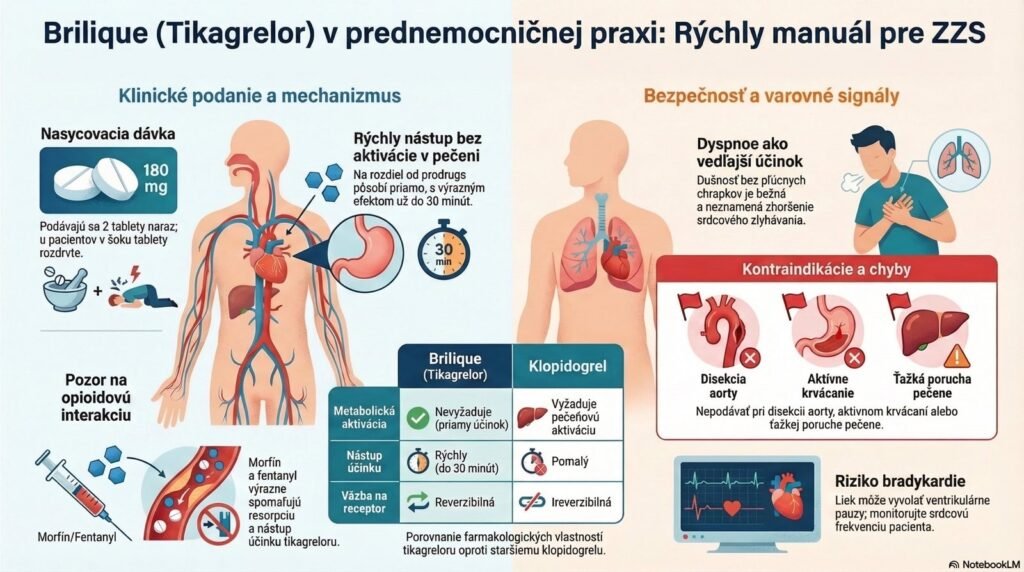
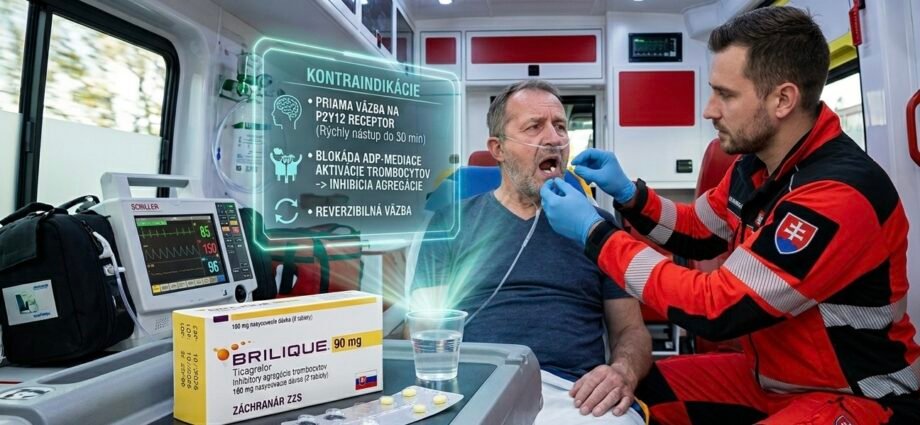
• Direct binding: Does not require hepatic metabolic activation (it’s not a prodrug), giving it a faster onset.
• P2Y12 antagonism: Binds to a different site on the P2Y12 receptor than ADP (adenosine diphosphate), blocking the signaling pathway leading to activation of the GP IIb/IIIa complex and subsequent platelet aggregation.
• Reversibility: Binding is reversible, though inhibition is nearly total in the acute phase.
• Adenosine effect: Ticagrelor raises local levels of endogenous adenosine (by inhibiting the ENT-1 transporter), which can produce additional vasodilation and cardioprotection, but also side effects (dyspnea).
3. Hemodynamic Effects – IN DETAIL
• SVR, preload, afterload: No direct effect on systemic hemodynamics.
• Contractility: No direct effect.
• Coronary microcirculation: The adenosine-mediated effect can mildly increase coronary flow, which is desirable in ACS.
• Destabilization risk: The main risk is hemorrhagic instability with uncontrolled bleeding.
4. Pharmacokinetics (from a Paramedic’s Perspective)
• Route of administration: Oral (PO). For patients in shock or with nausea, tablets can be crushed and given with water (speeds absorption).
• Onset of action: Significant platelet inhibition occurs within 30 minutes of the loading dose.
• Peak effect: 1.5 to 2.5 hours.
• Duration of effect: After discontinuation, platelet function recovery takes 3 to 5 days (shorter than with clopidogrel).
5. Indications in Prehospital Practice
1. STEMI: As part of dual antiplatelet therapy (with aspirin) before primary PCI.
2. NSTEMI: In high-risk patients (after consultation with a cardiac center).
3. Acute coronary syndrome: Where an early invasive strategy is planned.
6. Dosing in EMS
• Loading dose: 180 mg PO (two 90 mg tablets) at once.
• Administration: Chewed or swallowed; crushed if needed.
• Scope of practice: Physician (RLP). A basic-crew paramedic (RZP) administers per the ACS protocol after ECG confirmation, often after a phone consultation with the PCI center.
7. Contraindications
• Absolute: Active pathological bleeding (e.g., intracranial, gastrointestinal), history of intracranial hemorrhage, severe hepatic impairment.
• Relative: Concurrent oral anticoagulant therapy (warfarin, NOACs), planned urgent surgery (e.g., CABG bypass, if anatomy is known), bradycardia (risk of sinus pauses).
8. Adverse Effects
• Hemorrhagic: Bleeding (epistaxis, hematuria, gastrointestinal).
• Respiratory: Dyspnea (shortness of breath) — occurs in approximately 10–15% of patients, usually mild and transient (adenosine effect), but can be confusing in EMS when diagnosing pulmonary edema.
• Arrhythmogenic: Ventricular pauses and bradycardia (rare).
9. Drug Interactions in EMS
• Aspirin: Desired synergy in ACS treatment.
• Heparin: Synergy in anticoagulant/antiplatelet action.
• Opioids (morphine, fentanyl): Caution! Opioids slow gastric emptying and thereby significantly delay absorption and onset of ticagrelor. For severe pain, crushing the tablets is recommended.
10. Specifics in Emergency Medicine
• Monitoring: Watch for consciousness changes (risk of CNS bleeding) and breathing.
• Error #1: Giving ticagrelor when aortic dissection is suspected (precludes urgent surgical intervention).
• Error #2: Omitting the dose in a STEMI patient out of fear of bleeding (increases risk of stent re-occlusion).
11. Red Flags
1. Sudden dyspnea without pulmonary crackles: Likely a drug side effect, not worsening heart failure.
2. Uncontrolled bradycardia: Ticagrelor can potentiate conduction disturbances.
3. Bleeding from multiple sites: An immediate signal for caution with further anticoagulant therapy.
12. Antidote
• No specific antidote is routinely available (a monoclonal antibody, bentracimab, exists but is not carried in EMS kits). For bleeding: platelet transfusion, though circulating ticagrelor can also block the new platelets.
13. Practical Field Scenario
Situation: A 52-year-old man with severe chest pressure and cold sweat. ECG: ST elevation in V1–V6.
Status: Stabilized, BP 140/90, HR 75.
Decision-making:
1. Aspirin 250 mg PO (chewed).
2. Brilique 180 mg PO (2 tablets).
3. Heparin 5,000 IU IV.
4. Transport to the PCI center.
Hemodynamic rationale: The patient is stable; rapid administration of Brilique ensures platelet inhibition before reaching the catheterization table, reducing the risk of a “no-reflow” phenomenon.
14. Practical Summary – 5 Key Points
1. 180 mg loading dose: Always 2 tablets to start.
2. Faster than clopidogrel: Prefer Brilique for STEMI where local protocol allows.
3. Opioids slow it down: If giving morphine, consider crushing the Brilique tablets.
4. Dyspnea is a known side effect: Don’t be alarmed if the patient complains of shortness of breath without crackles after administration.
5. Don’t drink much water: A small sip is enough, to avoid increasing the risk of vomiting.
Professional Literature for Brilique (Ticagrelor)
1. Slovak Ministry of Health guidance No. 05241/2024 on reperfusion therapy for STEMI patients.
2. SmPC (Summary of Product Characteristics) – Brilique 90 mg, EU registration no. EU/1/10/655/001-011.
3. PLATO Study Investigators: Ticagrelor versus Clopidogrel in Patients with Acute Coronary Syndromes. NEJM, 2009.
4. ESC Guidelines 2023 for the management of acute coronary syndromes.
5. Katzung, B. G.: Basic and Clinical Pharmacology. Grada, 2015. (Chapter: Drugs used in disorders of coagulation.)
6. Špinar, J. et al.: Cardiology. Galén, 2021.