Introduction
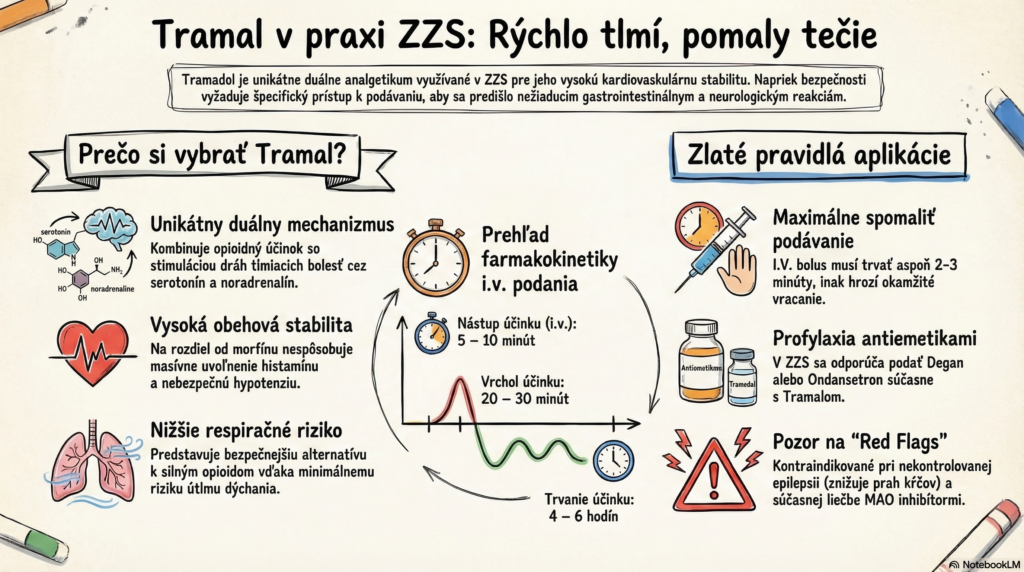
Tramadol is a centrally acting analgesic with a dual mechanism of action. In prehospital care it is used mainly for moderately severe acute pain. Its advantage is a lower risk of respiratory depression compared to strong opioids, but its administration is associated with a high incidence of nausea and vomiting, which in EMS often requires prophylactic administration of antiemetics.
1. Drug Identification
• Active substance: Tramadoli hydrochloridum.
• Trade names in Slovakia: Tramal, Tramadol Kalceks, Mabron.
• ATC classification: N02AX02 (Other opioids).
• Dosage form in EMS: Injection solution 100 mg/2 ml.
• Pharmacological group: Analgesic, opioid.
2. Mechanism of Action (Pharmacodynamics)
Tramadol has a unique dual effect:
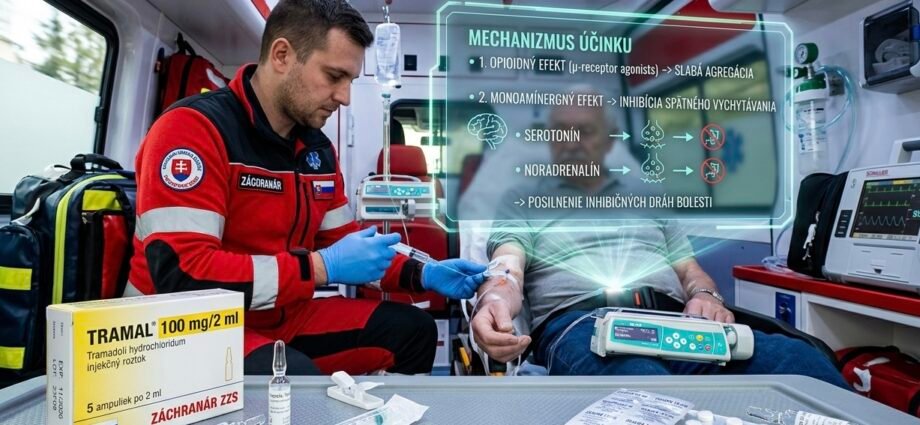
• Opioid component: Weak agonist at mu-opioid receptors (potency approximately 1/10 to 1/6 that of morphine).
• Non-opioid (monoaminergic) component: Inhibits reuptake of norepinephrine and stimulates serotonin release at spinal synapses, strengthening descending inhibitory pain pathways.
• Synergy: Both components act synergistically, increasing the analgesic effect with lower opioid receptor activation.
3. Hemodynamic Effects – IN DETAIL
• BP and HR: At therapeutic doses, usually does not cause significant circulatory changes.
• Cardiovascular stability: Unlike morphine, it does not cause massive histamine release, so hypotension risk is minimal.
• Destabilization risk: Hypotension can occur secondary to massive vomiting (vasovagal reaction) or when combined with other CNS depressants.
4. Pharmacokinetics (from a Paramedic’s Perspective)
• Routes of administration: IV (slowly!), IM, SC, PO (in EMS, most commonly IV).
• Onset of action: IV administration: 5–10 minutes.
• Peak effect: 20–30 minutes.
• Duration of effect: 4–6 hours.
• Metabolism: Hepatic (CYP2D6 enzyme). One metabolite (O-desmethyltramadol) is more analgesically active than the parent compound itself.
5. Indications in Prehospital Practice
1. Moderate to severe acute pain: Trauma, fractures, spinal pain.
2. Postoperative pain: During secondary transports.
3. Cancer pain: Acute breakthrough pain in the field.
6. Dosing in EMS
• Adult: Usually 50–100 mg IV (i.e., 1–2 ml).
• Administration rate: Very important! Must be given slowly (at least 2–3 minutes) or as a short infusion. Rapid administration almost immediately triggers vomiting.
• Maximum dose: 400 mg/24h.
• Scope of practice: Physician (RLP). A basic-crew paramedic (RZP) per current protocols (a commonly used analgesic within paramedic scope of practice in Slovakia).
7. Contraindications
• Absolute: Acute intoxication with alcohol, hypnotics, or other opioids. Concurrent MAOI therapy (within the last 14 days). Uncontrolled epilepsy.
• Relative: Head injuries with raised intracranial pressure (can mask the clinical picture), history of seizures.
8. Adverse Effects
• Gastrointestinal: Nausea and vomiting (very common — up to 30% of patients with rapid administration).
• Neurological: Dizziness, drowsiness, sweating. At high doses or in predisposed individuals, lowers the seizure threshold.
• Respiratory: Respiratory depression is rare but possible with overdose.
9. Drug Interactions in EMS
• Serotonin syndrome: Risk when combined with antidepressants (SSRIs, SNRIs).
• Antiemetics: In EMS, prophylactic antiemetic administration (e.g., metoclopramide or ondansetron) is recommended before or together with IV tramadol.
• Benzodiazepines: Increase CNS depression.
10. Specifics in Emergency Medicine
• Error #1: Rapid bolus. The patient will “return” their lunch to your ambulance before the drug even starts working.
• Error #2: Administration during seizures. Tramadol can worsen the course of an epileptic seizure.
• Combined analgesia: Tramadol + paracetamol (or metamizole) is a highly effective “multimodal” combination in EMS.
11. Red Flags
1. Sudden muscle rigidity / hyperthermia: Suspect serotonin syndrome (if the patient takes antidepressants).
2. Seizures: If a grand mal seizure occurs after administration, diazepam must be given.
3. Miosis: Constricted pupils signal an opioid effect, but with tramadol they are less pronounced than with morphine.
12. Antidote
• Naloxone: Reverses the opioid effect (respiratory depression), but does not affect the monoaminergic component of the effect and may not prevent seizures.
13. Practical Field Scenario
Situation: A 50-year-old man, fall from stairs, suspected forearm fracture. VAS 7/10.
Status: Stable, no consciousness disturbance, BP 140/85.
Decision-making:
1. Secure IV access.
2. Metoclopramide 10 mg IV (nausea prevention).
3. Tramal 100 mg in 100 ml normal saline (slow infusion).
4. Immobilize the limb.
Hemodynamic rationale: Tramadol maintains circulatory stability. Infusion administration minimizes vomiting risk during transport over rough terrain.
14. Practical Summary – 5 Key Points
1. Slowly and with an antiemetic: The golden rule for administering Tramal in EMS.
2. Careful with epileptics: Tramadol lowers the seizure threshold.
3. Dual effect: Acts not only on receptors but also on serotonin and norepinephrine pathways.
4. Respiratory-safe: Much lower apnea risk than fentanyl.
5. Don’t combine with MAOIs: Risk of fatal interactions.
Professional Sources and Literature:
1. SmPC (Summary of Product Characteristics) – Tramal injection solution 100 mg/2 ml.
2. Slovak Ministry of Health guidance on pain management in EMS.
3. Dobiáš, V. et al.: Emergency Healthcare. Osveta, 2021.
4. Lüllmann, H. et al.: Pharmacology and Toxicology. Grada, 2014. (Chapter: Opioid analgesics.)
5. ERC Guidelines 2021: Recommendations for post-resuscitation and trauma analgesia.