Introduction
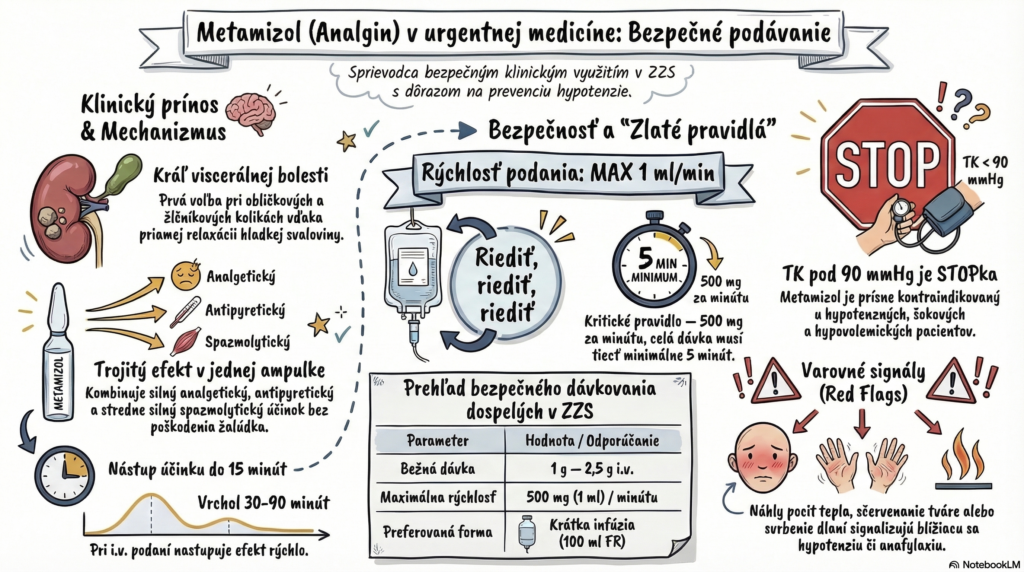
Metamizole is a pyrazolone derivative with a marked analgesic, antipyretic, and moderately strong spasmolytic effect. In prehospital care it is preferred for its high efficacy against visceral pain (colic) and its ability to reduce critical hyperpyrexia without significantly affecting the gastrointestinal mucosa or platelet aggregation (unlike non-steroidal anti-inflammatory drugs).
1. Drug Identification
• Active substance: Metamizolum natricum monohydricum.
• Trade names in Slovakia: Analgin, Novalgin, Metamizol Kalceks.
• ATC classification: N02BB02 (Pyrazolones).
• Dosage form in EMS: Injection solution 500 mg/1 ml (usually 1 g/2 ml or 2.5 g/5 ml per ampule).
• Pharmacological group: Non-opioid analgesic, antipyretic.
2. Mechanism of Action (Pharmacodynamics)
Metamizole’s mechanism of action is complex and not fully understood, involving both central and peripheral components:
• Inhibition of prostaglandin synthesis: Inhibits isoforms of the cyclooxygenase enzyme (COX-1, COX-2, and a presumed COX-3 in the CNS).
• Activation of the cannabinoid and opioid systems: Interaction with the periaqueductal gray matter in the brain, modulating pain transmission.
• Spasmolytic effect: Inhibits calcium release in smooth muscle, leading to relaxation (significant in biliary and renal colic).
• Antipyretic effect: Acts directly on the hypothalamic thermoregulatory center.
3. Hemodynamic Effects – IN DETAIL
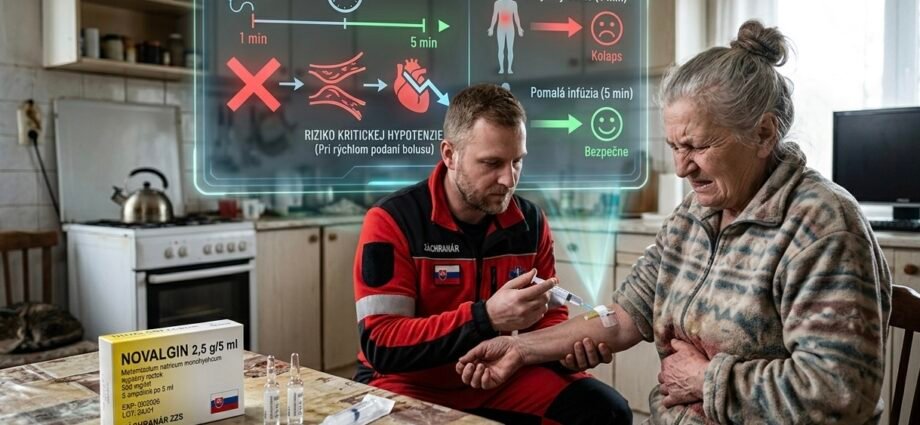
• Blood pressure: Risk of critical hypotension! Rapid IV administration can cause a sharp drop in systemic blood pressure without signs of anaphylaxis.
• SVR: Mild decrease due to relaxation of vascular smooth muscle.
• Heart rate: Reflex tachycardia can occur with a drop in pressure.
• Destabilization risk: Patients in shock states, with hypovolemia, or with pre-existing hypotension are extremely prone to collapse after metamizole administration.
4. Pharmacokinetics (from a Paramedic’s Perspective)
• Routes of administration: IV (slowly!), IM (painful, less common in EMS), PO (rare in EMS).
• Onset of action: IV administration: 5–15 minutes.
• Peak effect: 30–90 minutes.
• Duration of effect: 4–6 hours.
• Metabolism: Rapid hydrolysis in the stomach or plasma to an active metabolite (4-MAA), followed by hepatic oxidation. Elimination: renal (90%).
5. Indications in Prehospital Practice
1. Severe acute pain: Post-traumatic conditions, burns (often in combination).
2. Visceral pain: Renal colic, biliary colic (first-choice drug here due to its spasmolytic effect).
3. Cancer pain: Acute exacerbations.
4. Hyperpyrexia: Fever unresponsive to other antipyretics (e.g., in sepsis or CNS infections).
6. Dosing in EMS
• Adult: Standard dose 1 g to 2.5 g IV (i.e., 2 to 5 ml of solution).
• Administration rate: Critical! The maximum rate is 500 mg (1 ml) per minute. The full dose should run over at least 5 minutes, ideally as a short infusion (100 ml normal saline).
• Pediatrics: 10–20 mg/kg IV.
• Scope of practice: Physician (RLP). A basic-crew paramedic (RZP) per standard treatment protocols (in Slovakia often limited to lower doses or specific indications).
7. Contraindications
• Absolute: Pyrazolone hypersensitivity, bone marrow disorders (granulocytopenia), severe hypotension (BP < 90 mmHg), pregnancy (especially 1st and 3rd trimesters).
• Relative: Asthma (bronchospasm risk — “aspirin-exacerbated asthma”), patients with unstable circulation.
8. Adverse Effects
• Cardiovascular: Hypotension (rate-dependent).
• Immune: Anaphylactic shock (can occur at any point during administration), Stevens-Johnson syndrome (delayed reaction).
• Hematologic: Agranulocytosis (very rare with a single EMS dose).
• Respiratory: Bronchospasm in predisposed individuals.
9. Drug Interactions in EMS
• Cyclosporine: Metamizole reduces its plasma level.
• Alcohol: Potentiates the effect of both substances.
• Other analgesics: Additive analgesic effect (e.g., with opioids).
10. Specifics in Emergency Medicine
• Monitoring: Continuous BP and consciousness monitoring is required during IV administration.
• Error #1: “Pushing” the drug in. A rapid bolus of 2.5 g metamizole will almost certainly cause dizziness or collapse.
• Spasmolytic synergy: In EMS, it’s often combined with hyoscine butylbromide (Buscopan) or drotaverine (No-Spa) for colic.
11. Red Flags
1. Sudden warmth and facial flushing: Often precedes a critical drop in BP.
2. Itching palms / dyspnea: Stop administration immediately — developing anaphylaxis.
3. Mottled skin / tachycardia: Signs of developing shock after administration.
12. Antidote
• None exists. For overdose or hypotension: stop administration, position the patient, aggressive fluid resuscitation (crystalloids); for anaphylaxis, epinephrine.
13. Practical Field Scenario
Situation: A 40-year-old man with excruciating colicky pain in the right flank, radiating to the groin. Vomiting, restless.
Status: BP 150/90 (pain-related hypertension), HR 100.
Decision-making:
1. Diagnosis: Suspected nephrolithiasis (renal colic).
2. Metamizole 2.5 g in 100 ml normal saline (slowly over 10 minutes).
3. Add a spasmolytic (e.g., hyoscine butylbromide 20 mg IV).
Hemodynamic rationale: Metamizole relaxes ureteral spasm and suppresses pain. We monitor BP for overshoot into hypotension once the pain resolves.
14. Practical Summary – 5 Key Points
1. Slow means safe: Never give IV metamizole faster than 1 ml/min.
2. King of colic: The best drug for visceral pain in your kit.
3. BP below 90, stop: If the patient is hypotensive, metamizole is contraindicated.
4. Anaphylaxis: Be prepared for an allergic reaction even if the patient has never had one before.
5. Dilute, dilute, dilute: For maximum safety, always give it as an infusion, not a syringe push.
Professional Sources and Literature:
1. Slovak Ministry of Health guidance on pain management in emergency healthcare.
2. SmPC (Summary of Product Characteristics) – Analgin / Novalgin injection solution.
3. Dobiáš, V. et al.: Emergency Healthcare. Osveta, 2021.
4. Lüllmann, H. et al.: Pharmacology and Toxicology. Grada, 2014. (Chapter: Analgesics.)
5. EMA Review on Metamizole (2024): Updated safety recommendations regarding agranulocytosis risk.