An Older Adult’s Fall and “Just Lift Me Up”: Why a Lift Assist Call Is Not Trivial
An older person on the floor, no visible injury, asking “just get me up”. A new NAEMSP position statement and data on repeat calls show that these are exactly the calls where a crew most easily misses something.
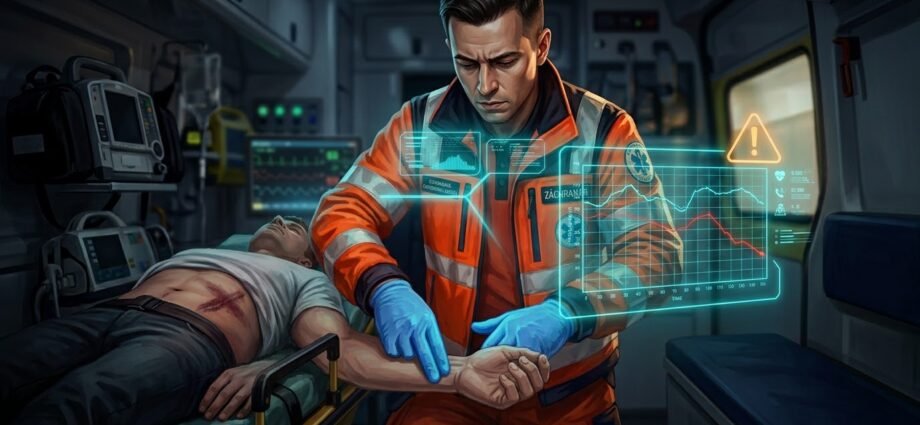
Every crew knows them: a call to an older person who has fallen at home and cannot get up alone. The patient is conscious, “nothing hurts”, and the family expects us to lift them and leave. In Anglo-American systems this call has its own name, the lift assist. In October 2026 the US National Association of EMS Physicians (NAEMSP) published a position statement saying it is a full patient encounter, not a technical favour. In the eighth part of Journal Club we look at the data behind the statement, what randomised trials say about referring older people after a fall, and what it means for a Slovak basic life support (RZP) crew.
Clinical Question (PICO)
At first sight an older adult’s fall is a low-acuity injury. In reality it may be the first sign of infection, dehydration, arrhythmia, stroke, adverse drug effects or a gradual loss of independence. A person who cannot get up from the floor is also at high risk of falling again. So the question is not whether to lift them, but what we need to assess before deciding what happens next [1].
P: older adults (65 years and over) after a fall perceived as low-acuity, including “lift assist” calls.
I: structured assessment by the EMS crew (cause of the fall, injuries, geriatric syndromes, home safety) and a decision on transport or non-transport with follow-up.
C: “just lifting” without a systematic assessment and without any further plan.
O: missed diagnoses, repeat calls, emergency department visits, hospital admissions, mortality, quality of care.
Methods
The appraised document is not a clinical trial. It is an NAEMSP position statement with a resource document, written by nine authors from US academic emergency medicine, public health and fire-based EMS (Dorsett et al.), published in October 2026 in Prehospital Emergency Care [1]. The resource document summarises the literature on falls in older adults and lift assist calls, and the statement derives recommendations for EMS systems from it. The level of evidence is therefore expert consensus built on a review of mostly observational data.
The full text of the statement was not available to us while preparing this article. We therefore take the recommendations from the published abstract and verified the underlying data in the original studies via PubMed. We added two randomised trials of paramedic assessment and referral of older people after a fall (SAFER 2, iPREFER) and international falls guidelines [2–13].
What the statement recommends
- Treat fall and “lift assist” calls as patient encounters that warrant assessment: look for medical causes, injuries and safety risks, and see them in the context of geriatric syndromes rather than as isolated minor events.
- Base transport decisions on a thorough assessment and a patient-centred discussion. Not every older adult who falls needs the emergency department; non-transport with referral to follow-up can be a safe alternative.
- Track assessment on these calls as a system-level quality measure.
- Ensure sustainable reimbursement for EMS assessment and care even when no transport occurs.
The authors also name the root of the problem: a system-level bias that, in their view, starts in initial education and is reinforced through dispatch, policy and protocols. The call is labelled non-medical and low-acuity from the start, and is assessed accordingly [1].
Results — the Data Behind the Statement
The lift assist literature comes mainly from North America and is observational. Even so, the picture is fairly consistent: a patient we “just lift” often comes back quickly, and not rarely with a more serious problem.
| Study | Sample | Key finding |
|---|---|---|
| Leggatt et al., 2017, Canada [2] | 804 calls | within 14 days 21 % ED visits, 11.6 % admissions, 1.1 % deaths; a missing vital sign in the record predicted admission |
| Cone et al., 2013, USA [3] | 1,087 calls | two thirds of calls went to one third of addresses; in repeat calls within 30 days almost half were medical complaints and transport was needed in 55.5 % |
| Schierholtz et al., 2019, Canada [4] | 1,121 calls | 32 % of individuals called more than once; mean call duration 43 minutes, 801 crew hours per year in total |
| Moore et al., 2025, USA [5] | 433 refusals | after refusing transport following a fall, 32.8 % called again in the same month; 71.1 % of them were transported, most then admitted |
| Barr et al., 2025, USA [6] | 116 patients | repeat callers had markedly higher odds of a 30-day ED visit (OR 17.2; 95 % CI 6.4–47.6); they more often took anticoagulants or antiplatelets and were non-ambulatory |
Two practical points follow. First, a patient left at home after a fall is not “done”: in some cohorts a third return within a month. Second, predicting who will return is hard. Apart from age, Moore et al. found no reliable predictor [5]. The recurring signal is the quality of assessment: in the Canadian study an incomplete record of vital signs was associated with a higher risk of admission [2]. This does not mean that measuring protects the patient. It may mean that with an incomplete assessment the crew more often misses something important.
Randomised trials: what structured assessment and referral achieve
SAFER 2 (England and Wales, cluster RCT, 25 stations, 4,655 analysed patients over 65 after a fall) tested a protocol under which paramedics assessed the patient and could refer them to a community falls service instead of the emergency department [7, 8]. The composite primary outcome (further emergency contact or death) did not differ. In both arms a third of patients had a further emergency contact or died within a month, and two thirds within six months. The intervention arm, however, had fewer further emergency calls, paramedics referred 8 % of patients (vs. 1 % in the control arm) and fewer patients were left at home without any further plan (22.6 % vs. 30.3 %). No adverse events were reported [8].
iPREFER (Sydney, RCT, 221 older adults not transported after a fall) compared a tailored multidisciplinary intervention with written advice [9]. By intention to treat, falls did not differ; patients who actually adhered to the recommendations fell about half as often (IRR 0.53; 95 % CI 0.32–0.87). At long-term follow-up with linked data, almost all participants called an ambulance again within three years and more than 40 % died [10]. A systematic review of 35 studies on community EMS fall-prevention programmes reports fewer ED visits, subsequent falls and lift assist calls, but the data are heterogeneous and mostly non-randomised [11].
Critical Appraisal
The statement correctly names a problem we know from the field and moves it from “extra service” to clinical decision-making. Its recommendations, however, are framed at system level and do not prescribe a specific assessment pathway for crews. No randomised trial shows that structured assessment on lift assist calls reduces mortality or admissions [1].
A clear, practical topic; authors from different EMS system types including fire-based EMS; links to geriatric syndromes and quality of care; emphasis on shared decision-making and safe alternatives to transport.
Level of evidence is expert opinion. Underlying studies are retrospective, single-agency, mostly from the USA and Canada, with varying definitions of lift assist. Part of the recommendations (reimbursement, payers) concerns the US system and transfers to Slovakia only partially.
Confounding and causality. High rates of repeat calls and admissions do not mean they were caused by the crew who left the patient at home. This is a frail population with high morbidity and mortality regardless of the crew’s decision, as the long-term iPREFER follow-up shows [10]. The data support the conclusion that a fall call is an opportunity to identify an at-risk patient, not that everyone must be transported.
Randomised evidence is modest. Neither SAFER 2 nor iPREFER improved the primary clinical outcome. They did show that paramedic assessment with referral is safe, slightly reduces repeat emergency calls, and that benefit depends on whether recommendations are actually carried out [8, 9]. In a system with no service to refer to, the intervention becomes simply a more thorough assessment and better documentation. That is still more than “just lifting”.
Transferability to Slovakia. In Slovakia there is no separate lift assist call category. For a fall in an older adult the dispatch centre sends an EMS crew, and the call is a healthcare intervention from the start. The problem, however, is not the category but how we perceive the call on scene. If we lift the patient and leave without vital signs, without asking why they fell and without a record, we behave exactly as the statement criticises.
Comparison With Slovak Practice and Legislation
Decree of the Slovak Ministry of Health No. 321/2005 Coll., § 3(1), lists among the independent activities of a paramedic: taking a basic history from the patient, relatives and witnesses (a), monitoring, assessing and recording vital signs (b), assessing health status and determining a working diagnosis (c), recording an ECG with a working diagnosis (n), a basic neurological examination with a working diagnosis of stroke (p), and positioning and immobilisation (an). The whole assessment of an older adult after a fall is therefore within the paramedic’s scope.
The decision to leave a person on scene or transport them to a healthcare facility is made independently by a paramedic with a bachelor’s degree in emergency care working as a member of an RZP crew, based on written authorisation from the provider’s professional representative (§ 3(3)(t) and § 3(5)). The decision must reflect the patient’s condition and the examinations and treatment performed.
Act No. 576/2004 Coll., § 6, requires the treating health professional to inform the patient about the purpose, nature, consequences and risks of care including the options available (para. 1). Informed consent can be withdrawn at any time (para. 8) and refusal is recorded in the medical documentation. In urgent care consent is not required if it cannot be obtained in time but can be presumed (para. 9(a)). Act No. 579/2004 Coll. governs emergency medical services, RZP crews and dispatch centres.
Decree No. 321/2005 Coll. as in force from 1 January 2026 · Act No. 576/2004 Coll. as in force from 1 August 2026 · Act No. 579/2004 Coll.
No standard procedure. We could not find a Slovak Ministry of Health standard diagnostic and therapeutic procedure on prehospital care of an older adult after a fall, non-transport decisions or referral after a fall on standardnepostupy.sk (as of 20 October 2026). Nor are we aware of a national pathway through which an RZP crew could refer a patient directly to a falls prevention service, as the SAFER 2 protocol allowed. Crews therefore rely on the decree, the provider’s internal procedures and international guidance.
International guidance. The 2022 World Guidelines for Falls Prevention recommend opportunistic case finding for falls risk and, for high-risk older adults, a comprehensive multifactorial assessment with a personalised intervention plan [12]. In 2025 the UK’s NICE replaced the older CG161 with the new guideline NG249 on falls assessment and prevention [13]. Neither is an RZP protocol, but both show that a fall should trigger further assessment. The EMS crew is often the only clinician who sees the patient in their own home.
Refusal of transport. If the patient refuses transport, the crew must explain the risks clearly and record this in the documentation. With suspected delirium, acute cognitive change or another condition that prevents the patient from understanding the consequences of their decision, this is not an ordinary refusal. Consultation with a physician according to the provider’s internal procedures, or requesting an advanced life support (RLP) crew through the dispatch centre, is then appropriate.
What to Take Into the Field
Within the RZP scope, a “just lift me up” call is not a special category. It is a full assessment of an older adult built around four questions: why did they fall, what did they injure, how long were they on the floor, and are they safe at home.
Abnormal vital signs or a change from usual status; suspected syncope, arrhythmia, stroke or infection; head injury on anticoagulant or antiplatelet therapy; hip pain and limited movement or inability to walk as usual; a long lie with signs of hypothermia, dehydration or muscle breakdown; acute confusion; a patient who will have no one at home and cannot call for help.
If the condition exceeds RZP scope or is unclear, the crew consults a physician according to the provider’s internal procedures and, as needed, requests an RLP crew through the dispatch centre. At hospital handover, report the mechanism and suspected cause of the fall, time on the floor, vital signs, medication and pre-fall functional status.
Call: an 84-year-old woman fell in the bathroom; her son cannot lift her. On scene she is conscious, oriented, “nothing hurts”, she just wants to go to bed.
Assessment: BP 98/60, HR 112 irregular, temperature 38.1 °C, SpO₂ 93 %. According to her son she had been on the floor for about four hours. She takes an anticoagulant. Unsteady on walking, “normally walks on her own with a stick”.
Crew’s conclusion: the fall is not the cause but a symptom. Suspected infection with tachycardia, a long lie and anticoagulation. Transport to hospital, ECG recorded, handover including time on the floor and medication. “Just lifting” here would have meant walking away from a septic patient.
“Patient lifted, no injuries, refused transport.”
“Fall in the bathroom after slipping, no preceding dizziness, palpitations or chest pain; on the floor about 20 min. GCS 15, BP 142/84, HR 76 regular, RR 16, SpO₂ 97 %, temp 36.6 °C, glucose 6.4 mmol/l. No head injury, no anticoagulation, symmetrical leg movement, walking with frame as usual. Daughter at home, phone within reach. Informed of risks and warning signs, advised GP review; agrees to remain at home.”
Practical Implications for the Paramedic
1. In 2026 NAEMSP recommends treating every call to an older adult’s fall, including “lift assist”, as a full patient encounter with a systematic assessment.
2. Observational data show high rates of repeat calls, ED visits and admissions after non-transport; incomplete vital signs in the record were associated with worse outcomes.
3. Randomised trials (SAFER 2, iPREFER) did not improve the primary outcome, but paramedic assessment with referral was safe and slightly reduced repeat emergency calls.
4. In Slovakia the whole assessment is within the paramedic’s scope (Decree 321/2005, § 3(1)(a), (b), (c), (n), (p)); the decision to leave a patient on scene is made by a bachelor-level paramedic with written authorisation (§ 3(3)(t)).
5. We found no Slovak standard procedure on this topic. Why did they fall, what did they injure, how long were they down, are they safe at home — and write it all down.
- JC-01 Supraglottic Airway Devices vs. Endotracheal Intubation in OHCA
- JC-02 POCUS and eFAST in Hemorrhagic Shock
- JC-03 Epinephrine in OHCA
- JC-04 Interprofessional Tension in the EMS System
- JC-05 Suspected STEMI in the Field
- JC-06 Birth in the Ambulance and the Newborn’s First Minutes
- JC-07 Supraglottic Airway vs. Intubation in OHCA: a New Meta-Analysis
- JC-08 An Older Adult’s Fall and “Just Lift Me Up”: the Lift Assist Call (this article)
- DORSETT, M., SU, T. W., FARCAS, A. M. et al. Prehospital Care of Older Adults Following Perceived Low-Acuity Falls and Related “Lift Assist” Encounters: An NAEMSP Position Statement and Resource Document. Prehospital Emergency Care. 2026, pp. 1–40. DOI: 10.1080/10903127.2026.2748380. PMID: 42873076.
- LEGGATT, L., VAN AARSEN, K., COLUMBUS, M. et al. Morbidity and Mortality Associated with Prehospital “Lift-assist” Calls. Prehospital Emergency Care. 2017, vol. 21, no. 5, pp. 556–562. DOI: 10.1080/10903127.2017.1308607. PMID: 28422537.
- CONE, D. C., AHERN, J., LEE, C. H. et al. A descriptive study of the “lift-assist” call. Prehospital Emergency Care. 2013, vol. 17, no. 1, pp. 51–56. DOI: 10.3109/10903127.2012.717168. PMID: 22971148.
- SCHIERHOLTZ, T., CARTER, D., KANE, A. et al. Impact of Lift Assist Calls on Paramedic Services: A Descriptive Study. Prehospital Emergency Care. 2019, vol. 23, no. 2, pp. 233–240. DOI: 10.1080/10903127.2018.1483454. PMID: 30118639.
- MOORE, E. A., SCHOENFELD, D. W., FRITZ, C. L. et al. Geriatric “lift-assist” EMS calls with transport refusal: Characteristics of short-term repeat calls and hospitalizations. American Journal of Emergency Medicine. 2025, vol. 95, pp. 77–82. DOI: 10.1016/j.ajem.2025.05.041. PMID: 40435545.
- BARR, J., SELMAN, K., HUNTER, K. et al. Refusal of Emergency Medical Transport After a Fall: Patient Characteristics and Outcomes of Repeat Callers. Western Journal of Emergency Medicine. 2025, vol. 26, no. 5, pp. 1291–1295. DOI: 10.5811/westjem.33524. PMID: 41192986.
- SNOOKS, H. A., ANTHONY, R., CHATTERS, R. et al. Paramedic Assessment of Older Adults After Falls, Including Community Care Referral Pathway: Cluster Randomized Trial. Annals of Emergency Medicine. 2017, vol. 70, no. 4, pp. 495–505.e28. DOI: 10.1016/j.annemergmed.2017.01.006. PMID: 28302422.
- SNOOKS, H. A., ANTHONY, R., CHATTERS, R. et al. Support and Assessment for Fall Emergency Referrals (SAFER) 2: a cluster randomised trial and systematic review of clinical effectiveness and cost-effectiveness of new protocols for emergency ambulance paramedics to assess older people following a fall with referral to community-based care when appropriate. Health Technology Assessment. 2017, vol. 21, no. 13, pp. 1–218. DOI: 10.3310/hta21130. PMID: 28397649.
- MIKOLAIZAK, A. S., LORD, S. R., TIEDEMANN, A. et al. A multidisciplinary intervention to prevent subsequent falls and health service use following fall-related paramedic care: a randomised controlled trial. Age and Ageing. 2017, vol. 46, no. 2, pp. 200–207. DOI: 10.1093/ageing/afw190. PMID: 28399219.
- MIKOLAIZAK, A. S., HARVEY, L., TOSON, B. et al. Linking health service utilisation and mortality data — unravelling what happens after fall-related paramedic care. Age and Ageing. 2022, vol. 51, no. 1, afab254. DOI: 10.1093/ageing/afab254. PMID: 35077557.
- FRIEND, T. H., THOMAS, H. M., ORDOOBADI, A. J. et al. Community emergency medical services approaches to fall prevention: a systematic review. Injury Prevention. 2024, vol. 30, no. 6, pp. 446–453. DOI: 10.1136/ip-2023-045110. PMID: 39038943.
- MONTERO-ODASSO, M., VAN DER VELDE, N., MARTIN, F. C. et al. World guidelines for falls prevention and management for older adults: a global initiative. Age and Ageing. 2022, vol. 51, no. 9, afac205. DOI: 10.1093/ageing/afac205. PMID: 36178003.
- NATIONAL INSTITUTE FOR HEALTH AND CARE EXCELLENCE. Falls: assessment and prevention in older people and in people 50 and over at higher risk. NICE guideline NG249 [online]. London: NICE, 2025 [cited 2026-10-20]. Available at: https://www.nice.org.uk/guidance/ng249
- Decree of the Ministry of Health of the Slovak Republic No. 321/2005 Coll. on the scope of practice in certain health professions, as in force from 1 January 2026 [online]. Slov-Lex [cited 2026-10-20]. Available at: https://www.slov-lex.sk/
- Act No. 576/2004 Coll. on healthcare and services related to the provision of healthcare, as amended [online]. Slov-Lex [cited 2026-10-20].
- Act No. 579/2004 Coll. on emergency medical services, as amended [online]. Slov-Lex [cited 2026-10-20].