Introduction
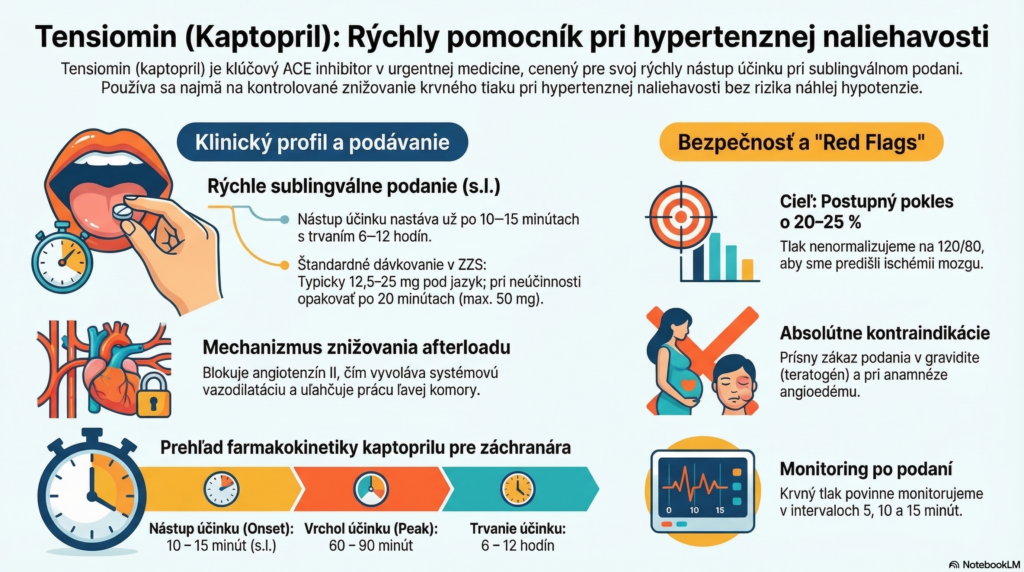
Tensiomin (captopril) was the first clinically used angiotensin-converting enzyme (ACE) inhibitor. In emergency medicine it is highly valued for its fast onset when given sublingually, making it well suited for treating hypertensive urgency. Unlike parenteral antihypertensives, it allows a controlled reduction in blood pressure without the risk of sudden hypotension.
1. Drug Identification
• Active substance: Captoprilum.
• Trade names in Slovakia: Tensiomin 12.5 mg / 25 mg / 50 mg.
• ATC classification: C09AA01 (ACE inhibitors, plain).
• Dosage form in EMS: Tablets (most commonly 12.5 mg or 25 mg).
• Pharmacological group: Antihypertensive, ACE inhibitor.
2. Mechanism of Action (Pharmacodynamics)
Captopril acts on the renin-angiotensin-aldosterone system (RAAS):
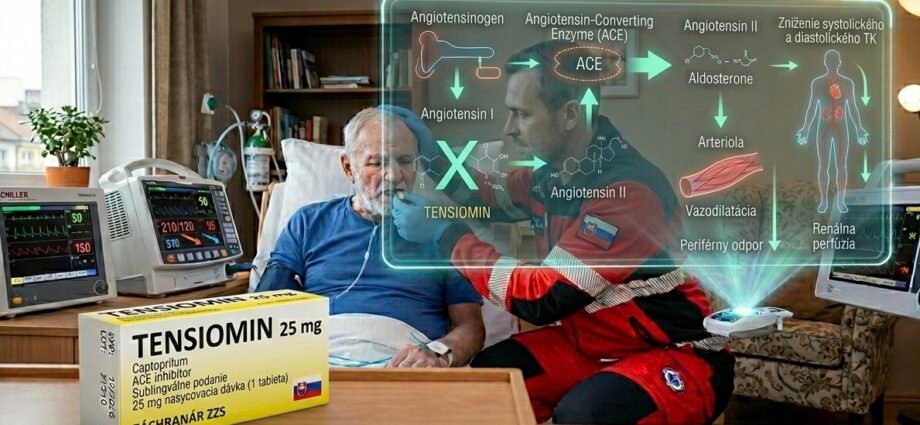
• ACE inhibition: Blocks the conversion of inactive angiotensin I into the potent vasoconstrictor angiotensin II.
• Reduced aldosterone levels: Leads to a mild reduction in sodium and water retention.
• Kallikrein-kinin system: Inhibits the breakdown of bradykinin (a potent vasodilator), which contributes to the antihypertensive effect but can cause a side effect — cough.
• Result: Systemic vasodilation (both arterial and venous) and reduced peripheral vascular resistance.
3. Hemodynamic Effects – IN DETAIL
• SVR (systemic vascular resistance): Marked decrease (the main effect).
• Preload: Mild decrease.
• Afterload: Marked decrease, easing left ventricular work.
• Heart rate: Usually remains stable (does not trigger reflex tachycardia like nifedipine).
• Renal perfusion: Improves due to dilation of the efferent arteriole in the nephron.
4. Pharmacokinetics (from a Paramedic’s Perspective)
• Route of administration: Sublingual (SL) for a fast effect; oral (PO) in less urgent conditions.
• Onset of action: With SL administration, 10 to 15 minutes.
• Peak effect: 60 to 90 minutes.
• Duration of effect: 6 to 12 hours.
• Metabolism: Partial hepatic metabolism. Elimination: more than 95% renal.
5. Indications in Prehospital Practice
1. Hypertensive urgency: Markedly elevated BP (often > 180/110 mmHg) without signs of acute organ damage, accompanied by headache or palpitations.
2. Hypertensive emergency: As adjunctive therapy (when IV urapidil or nitrates aren’t indicated).
3. Chronic heart failure: (Rare in EMS, more often used during interhospital transfers.)
6. Dosing in EMS
• Adult: Typically 12.5 mg to 25 mg SL (allow to dissolve under the tongue).
• Repeat dosing: If BP hasn’t dropped 15–20% after 20–30 minutes, the dose may be repeated (max. 50 mg).
• Scope of practice: Physician (RLP). A basic-crew paramedic (RZP) per standards for hypertensive states.
7. Contraindications
• Absolute: History of angioedema (from prior ACE inhibitor therapy), bilateral renal artery stenosis, pregnancy (teratogenic effect), lactation.
• Relative: Hyperkalemia (K+ > 5.5 mmol/l), hypotension, dehydration.
8. Adverse Effects
• Acute: Sharp hypotension (especially in patients on diuretics), dizziness, nausea.
• Specific: Angioedema (swelling of the lips, tongue, larynx — a life-threatening condition).
• Respiratory: Dry, irritating cough (rare in the acute EMS phase).
• Other: Dysgeusia (taste disturbance).
9. Drug Interactions in EMS
• Diuretics (furosemide): Can trigger “first-dose hypotension” due to volume depletion.
• NSAIDs: Can reduce captopril’s antihypertensive effect and increase the risk of kidney damage.
• Potassium-sparing diuretics: Risk of hyperkalemia.
10. Specifics in Emergency Medicine
• Monitoring: BP is measured at 5, 10, and 15 minutes after SL administration.
• Target pressure: In the field, we do not aim to normalize BP (e.g., to 120/80). The goal is a gradual reduction of 20–25% from the initial value, to avoid cerebral ischemia (penumbra in stroke).
• Error #1: Giving captopril when preeclampsia/eclampsia is suspected (ACE inhibitors are forbidden in pregnancy).
• Error #2: Lowering BP too aggressively in a patient with suspected stroke.
11. Red Flags
1. Facial/tongue swelling: If it appears after administration, treat immediately as anaphylaxis (epinephrine, hydrocortisone).
2. Anuria/oliguria: Can trigger acute failure in patients with known kidney disease.
3. Syncope: A sharp drop in BP in a dehydrated elderly patient.
12. Antidote
• None exists. For overdose/hypotension: Trendelenburg position and volume therapy (normal saline).
13. Practical Field Scenario
Situation: A 55-year-old man with severe headache, measured BP 210/120.
Status: Oriented, no neurological deficit, breathing clear, chest pain negative.
Decision-making:
1. Positioning (sitting), rest.
2. Tensiomin 25 mg SL (under the tongue).
3. Regular BP monitoring every 10 minutes.
Hemodynamic rationale: This is a hypertensive urgency. Captopril safely reduces afterload. If the patient had pulmonary edema, we would instead choose Isoket and furosemide.
14. Practical Summary – 5 Key Points
1. Sublingual is fast: The ideal route for a paramedic.
2. Don’t overshoot the target: Lower the pressure gradually, not to zero.
3. Watch for angioedema: Always ask whether the patient has ever had swelling from blood pressure medication.
4. Kidneys and pregnancy: The two big warnings for ACE inhibitors.
5. Rest: Always pair hypertension pharmacotherapy with rest for the patient.
Professional Sources and Literature:
1. Slovak Ministry of Health guidance on the management of hypertension in prehospital care.
2. SmPC (Summary of Product Characteristics) – Tensiomin 12.5 mg/25 mg, registration no. 58/0593/92-S.
3. ESC Guidelines 2024 for the management of arterial hypertension.
4. Dobiáš, V. et al.: Emergency Healthcare. Osveta, 2021.
5. Hofman, P.: Pharmacotherapy of Hypertensive Crises. Emergency Medicine, 2022.