Introduction No-Spa (drotaverine) is a potent myotropic spasmolytic, an isoquinoline derivative. In emergency medicine it’s highly valued for its ability to directly relax smooth muscle without anticholinergic side effects (unlike hyoscine butylbromide/Buscopan). It’s a key drug for conditions involving spasm of hollow organs in the gastrointestinal, urogenital, and biliary tracts.
1. Drug Identification
- Active substance: Drotaverini hydrochloridum.
- Trade name in Slovakia: No-Spa.
- ATC classification: A03AD02 (Drugs for functional gastrointestinal disorders).
- Dosage form in EMS: Injection solution 40 mg/2 ml.
- Pharmacological group: Myotropic spasmolytic.
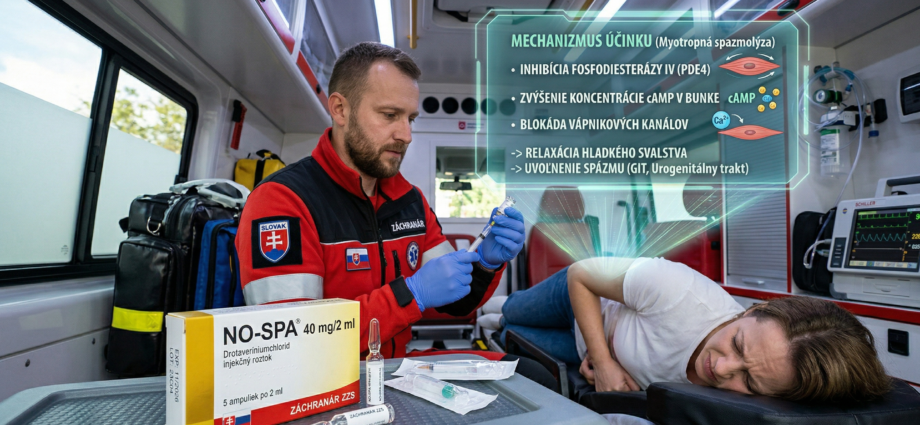
2. Mechanism of Action (Pharmacodynamics) Drotaverine acts directly on smooth muscle cells:
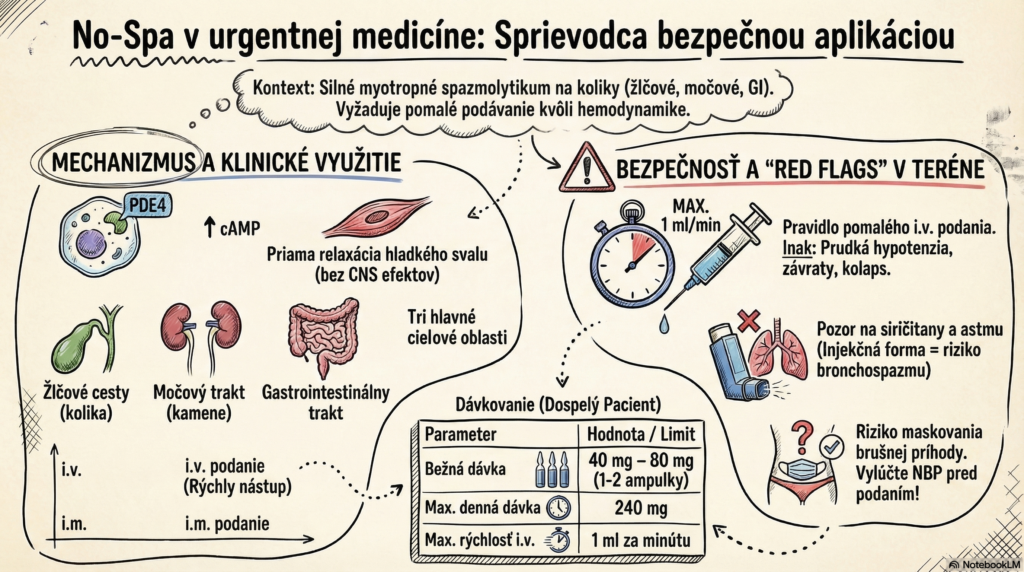
- Inhibition of phosphodiesterase IV (PDE4): This is the key mechanism. PDE4 inhibition raises intracellular concentration of cyclic adenosine monophosphate (cAMP).
- Calcium channel blockade: Elevated cAMP activates protein kinase, which then inhibits myosin light-chain kinase (MLCK).
- Result: Myosin dephosphorylation occurs, leading to smooth muscle relaxation, regardless of the type of innervation (neural or hormonal).
- Selectivity: PDE4 is dominant in the smooth muscle of the GI and urogenital tracts, which explains No-Spa’s high efficacy specifically in these areas.
3. Hemodynamic Effects – IN DETAIL
- Blood pressure: Hypotension risk! Drotaverine has a mild vasodilatory effect on vascular smooth muscle as well. Rapid IV administration can cause a drop in systemic pressure.
- Heart rate: Reflex tachycardia possible with a drop in BP.
- Destabilization risk: Caution in patients in shock or with critical aortic stenosis, where a fixed afterload cannot tolerate vasodilation.
4. Pharmacokinetics (from a Paramedic’s Perspective)
- Routes of administration: IV (slowly!), IM, PO (in EMS, primarily IV or IM).
- Onset of action: IV administration: 2–5 minutes; IM administration: 20–30 minutes.
- Peak effect: 30–60 minutes.
- Metabolism: Hepatic. Elimination: biliary and renal.
5. Indications in Prehospital Practice
- Spasms associated with biliary tract disease: Biliary colic, cholecystitis, cholangitis.
- Urinary tract spasms: Nephrolithiasis (renal colic), ureterolithiasis, cystitis.
- Gastrointestinal spasms: Spastic colitis, tenesmus, flatulence.
- Gynecological indications: Dysmenorrhea, threatened miscarriage (to relax a rigid cervix — rare in EMS).
6. Dosing in EMS
- Adult: Standard dose 40 mg to 80 mg (1 to 2 ampules).
- IV method: Must be given very slowly (max rate 1 ml/min) due to collapse risk.
- Maximum daily dose: 240 mg.
- Scope of practice: Physician (RLP). A basic-crew paramedic (RZP) per standards for visceral pain.
7. Contraindications
- Absolute: Severe renal, hepatic, or cardiac failure (low cardiac output), hypersensitivity to drug components (sulfites in the injectable form!), 2nd- and 3rd-degree AV block.
- Relative: Hypotension, children (the injectable form is not recommended for children under 18 in Slovakia due to a lack of studies).
8. Adverse Effects
- Cardiovascular: Hypotension, palpitations.
- Neurological: Dizziness, headache, insomnia.
- Gastrointestinal: Nausea, constipation (with long-term use).
- Immune: Allergic reactions (particularly due to sodium disulfite content in the ampule — bronchospasm risk in asthmatics).
9. Drug Interactions in EMS
- Levodopa: Drotaverine reduces levodopa’s antiparkinsonian effect (can worsen tremor and rigidity).
- Other spasmolytics (Buscopan): Additive relaxant effect.
- Analgesics (metamizole): A common and desired combination for colic.
10. Specifics in Emergency Medicine
- Error #1: Rapid IV bolus. Causes a vasovagal reaction, dizziness, and sharp hypotension.
- Error #2: Mistaking it for an analgesic. No-Spa doesn’t treat pain directly (like opioids do); it treats the cause (spasm). If spasm isn’t present (e.g., dull pain from inflammation), the effect will be minimal.
- Differential diagnosis: Before giving No-Spa for abdominal pain, always rule out an acute abdomen requiring surgical intervention.
11. Red Flags
- Arrhythmia: If palpitations or an irregular pulse appear after administration, check the ECG (risk of effect on the conduction system).
- Asthma attack: Due to sulfite content, No-Spa can trigger bronchospasm in hypersensitive patients.
- Collapse: The patient must not stand up abruptly from the stretcher after administration.
12. Antidote
- None exists. For overdose/hypotension: fluid resuscitation, monitoring of vital signs.
13. Practical Field Scenario Situation: A 35-year-old woman, excruciating pain in the right upper abdomen radiating under the shoulder blade, vomiting bile. Status: BP 110/70, HR 95, positive Murphy’s sign. Decision-making:
- Suspected biliary colic.
- Secure IV access.
- No-Spa 40 mg IV (slowly over 2 minutes).
- Metoclopramide 10 mg IV (against vomiting). Hemodynamic rationale: No-Spa relaxes the spasm of the gallbladder/biliary tract. We monitor BP to avoid dropping systolic pressure below 90 mmHg.
14. Practical Summary – 5 Key Points
- Myotropic effect: Acts directly on muscle, not through nerves (no dry mouth).
- Slowly IV: Prevention of collapse and hypotension.
- Sulfites: Watch out for allergic and asthmatic patients.
- Enhances analgesic effect: Combined with metamizole, works excellently for colic.
- Rule out acute abdomen: A spasmolytic can sometimes “mask” a clinical picture requiring a surgeon.
Professional Sources and Literature:
- SmPC (Summary of Product Characteristics) – No-Spa injection solution 40 mg/2 ml.
- Slovak Ministry of Health guidance on the management of acute visceral pain.
- Dobiáš, V. et al.: Emergency Healthcare. Osveta, 2021.
- Remedium 2026: Compendium medicamentorum.
- Pharmacology of Smooth Muscle: Studies on PDE4 inhibition by drotaverine (Journal of Clinical Pharmacology).