Introduction Penthrox, also known as the “green whistle,” is a volatile liquid analgesic from the halogenated hydrocarbon group. At sub-anesthetic concentrations it provides fast, effective analgesia while the patient remains fully conscious. For paramedics it’s an ideal tool for bridging the time until IV access is secured, or as definitive analgesia for short painful procedures (e.g., reduction, extrication).
1. Drug Identification
- Active substance: Methoxyfluranum.
- Trade name in Slovakia: Penthrox.
- ATC classification: N02BG09 (Other analgesics and antipyretics).
- Dosage form in EMS: Inhalation vapor (3 ml of liquid in a bottle, poured into a special hand-held inhaler).
- Pharmacological group: Non-opioid inhaled analgesic.
2. Mechanism of Action (Pharmacodynamics) The exact mechanism isn’t fully elucidated; a multimodal CNS effect is presumed:
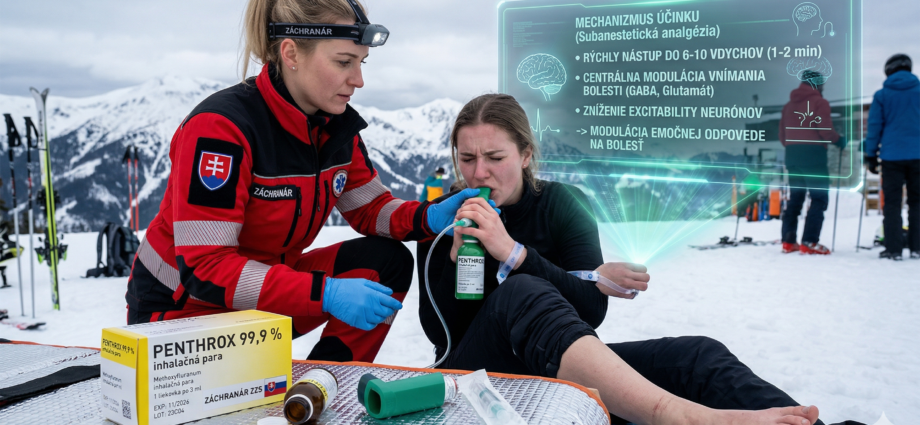
- Ion channel modulation: Affects GABA, glutamate, and glycine receptor activity.
- Reduced neuronal excitability: Raises the pain perception threshold and changes the emotional response to a painful stimulus.
- Sub-anesthetic effect: Unlike general anesthesia (where methoxyflurane was once used at high doses), at Penthrox’s low doses it induces only analgesia and mild sedation without loss of consciousness.
3. Hemodynamic Effects – IN DETAIL
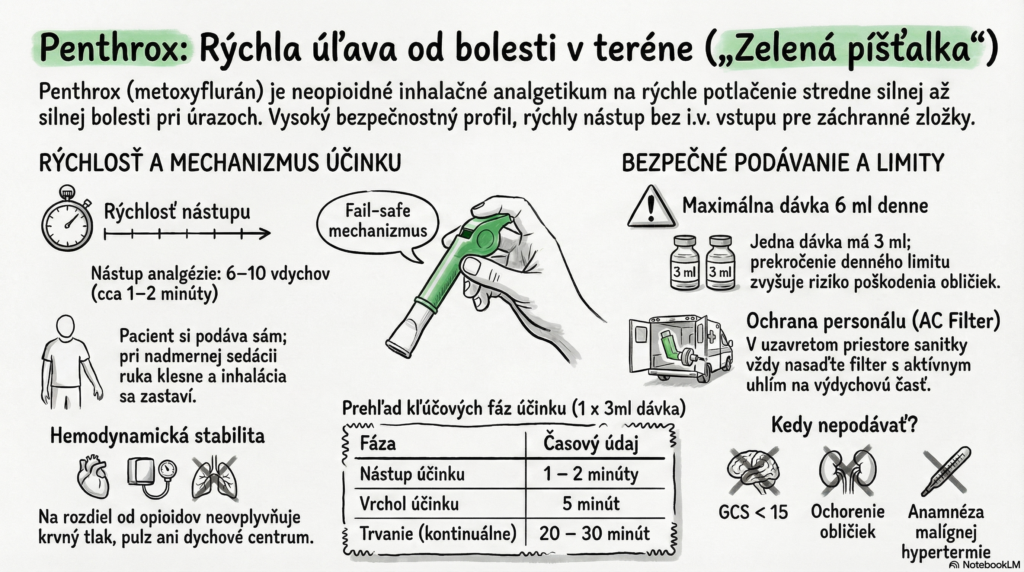
- Cardiovascular stability: Excellent. At recommended doses, has no significant effect on BP or HR.
- Minimal respiratory depression: Unlike opioids, does not inhibit the respiratory center at standard doses.
- Effect on the myocardium: Does not increase myocardial sensitivity to catecholamines (safe under stress).
4. Pharmacokinetics (from a Paramedic’s Perspective)
- Route of administration: Inhaled (the patient self-titrates intensity by inhaling through the device).
- Onset of action: Extremely fast, after 6–10 breaths (approximately 1–2 minutes).
- Peak effect: 5 minutes.
- Duration of effect: One 3 ml dose lasts about 20–30 minutes of continuous inhalation (up to an hour with intermittent inhalation).
- Metabolism: Hepatic (CYP450). Approximately 20% is metabolized; the rest is exhaled unchanged through the lungs.
5. Indications in Prehospital Practice
- Acute trauma: Fractures, dislocations, burns, soft-tissue injuries.
- Extrication: Enables analgesia even before IV access is secured in cramped spaces.
- Short painful procedures: Joint reduction, wound care, cannulation in needle-phobic patients.
- Transport: Pain relief during transport over rough terrain.
6. Dosing in EMS
- Adult: One bottle (3 ml) poured into the inhaler. If analgesia is insufficient, a second (3 ml) may be added.
- Maximum dose: 6 ml per day (nephrotoxicity risk if exceeded). Maximum weekly dose is 15 ml.
- Technique: The patient inhales through the mouthpiece. For a stronger effect, the dilutor hole (air-entrainment port) is covered.
- Scope of practice: Both physician (RLP) and basic-crew paramedic (RZP) — in Slovakia, Penthrox is often within paramedic scope of practice thanks to its high safety profile.
7. Contraindications
- Absolute: Hypersensitivity to halogenated anesthetics, history of malignant hyperthermia (in the patient or family), clinically significant kidney impairment, altered consciousness (GCS < 15), clinically unstable state (shock, severe respiratory failure).
- Relative: Age over 75 (caution regarding kidneys), pregnancy.
8. Adverse Effects
- Neurological: Dizziness, mild euphoria, drowsiness, a feeling of being tipsy.
- Gastrointestinal: Nausea (less common than with opioids).
- Local: Coughing on the first breaths (irritating scent — explain to the patient that a “fruity” smell is normal).
- Organ: At high doses, potential nephrotoxicity (unlikely in EMS with a 3–6 ml dose).
9. Drug Interactions in EMS
- Other CNS depressants (alcohol, opioids, benzodiazepines): Additive sedative effect (risk of deeper sedation).
- Nephrotoxic drugs (NSAIDs — e.g., Almiral): Theoretically increased renal risk (in practice, often combined if the patient is adequately hydrated).
10. Specifics in Emergency Medicine
- Error #1: Passive administration. The patient must hold the Penthrox device and inhale it themselves. If their hand drops due to sedation, they stop inhaling, which automatically prevents overdose (a built-in fail-safe mechanism).
- Error #2: Not using activated charcoal. An activated-carbon chamber (AC chamber) should be attached to the inhaler so exhaled methoxyflurane doesn’t build up in the ambulance and affect staff.
- Coaching: The key to success is explaining the technique: “Breathe deeply in through the mouthpiece, and breathe out into the device.”
11. Red Flags
- Sudden muscle rigidity and rising temperature: An extremely rare risk of malignant hyperthermia.
- Drop in GCS: If the patient stops responding, immediately remove the inhaler and give oxygen.
- Polyuria/oliguria: Should be monitored in hospital for renal injury risk.
12. Antidote
- None exists. After the inhaler is removed, effects quickly resolve (exhaled through the lungs). For malignant hyperthermia, dantrolene is the treatment of choice (in hospital).
13. Practical Field Scenario Situation: A 25-year-old skier on a slope, a fall, ankle deformity, VAS 9/10. Strong wind, difficult access. Status: Conscious, BP 125/80, screaming from pain. Decision-making:
- Prepare Penthrox (pour 3 ml into the inhaler, secure the wrist strap on the patient).
- Instruction: “Take 10 deep breaths.”
- Result: After 2 minutes, the patient reports relief and is able to cooperate with splinting.
- Transport to the ambulance, where IV access is then secured. Hemodynamic rationale: Penthrox allowed immediate analgesia in adverse conditions without the hypotension risk that opioid administration could cause in a cold environment.
14. Practical Summary – 5 Key Points
- The green whistle in under 2 minutes: The fastest route to needle-free analgesia.
- Self-administration: The patient is responsible for the depth of their own analgesia.
- Maximum 6 ml: Never exceed two doses per patient.
- Ask about kidneys and hyperthermia history: The two most important questions before administration.
- Use the filter: Protect yourself and your colleague from inhaling vapors in the ambulance.
Professional Sources and Literature:
- SmPC (Summary of Product Characteristics) – Penthrox 99.9% inhalation vapor.
- Slovak Ministry of Health guidance on the use of inhaled analgesics in EMS.
- Dobiáš, V. et al.: Emergency Healthcare. Osveta, 2021.
- Grindlay, J. & Babl, F. E.: Review of methoxyflurane (Penthrox) for the management of pain in children and adults in the emergency department. Emergency Medicine Australasia, 2016.
- National Model Clinical Guidelines (UK/Australia): Standards for prehospital methoxyflurane inhalation.