Introduction
Paracetamol (acetaminophen) is a unique analgesic that, unlike NSAIDs, shows no significant anti-inflammatory effect but stands out for its safety in patients at risk of bleeding, with asthma, or with stomach ulcers. In emergency medicine, the IV form (Paracetamol Kabi) is invaluable for its fast onset in postoperative pain, trauma, and febrile states.
1. Drug Identification
• Active substance: Paracetamolum.
• Trade names in Slovakia: Paracetamol Kabi (infusion), Medipyrin (tablets), Paralen (suppository/tablets), Panadol.
• ATC classification: N02BE01 (Other analgesics and antipyretics, anilides).
• Dosage form in EMS: Infusion solution 10 mg/ml (100 ml bottle = 1 g).
• Pharmacological group: Analgesic, antipyretic.
2. Mechanism of Action (Pharmacodynamics)
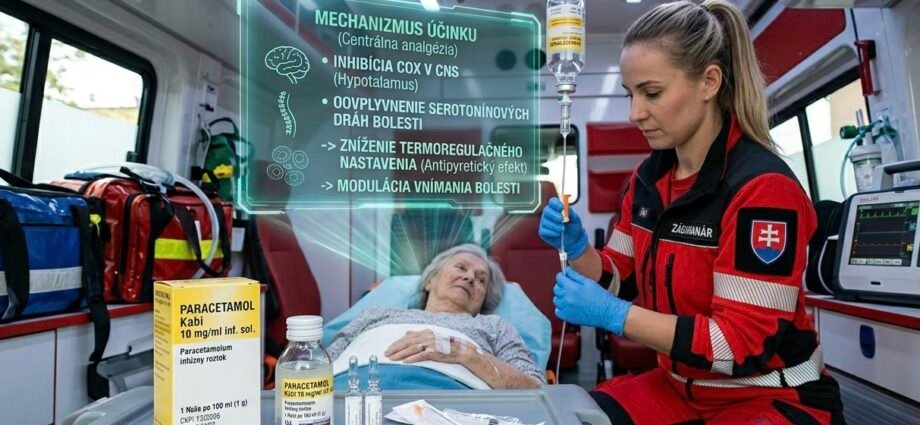
The mechanism isn’t fully elucidated; a combined central and peripheral effect is assumed:
• COX inhibition in the CNS: Selective inhibition of cyclooxygenase (sometimes called COX-3) in the brain and spinal cord is presumed.
• Effect on serotonergic pathways: Activates descending serotonergic inhibitory pain pathways.
• Indirect effect on cannabinoid receptors: The metabolite AM404 inhibits endocannabinoid reuptake.
• Antipyretic effect: Acts directly on the thermoregulatory center in the hypothalamus, increasing heat dissipation (vasodilation, sweating).
3. Hemodynamic Effects – IN DETAIL
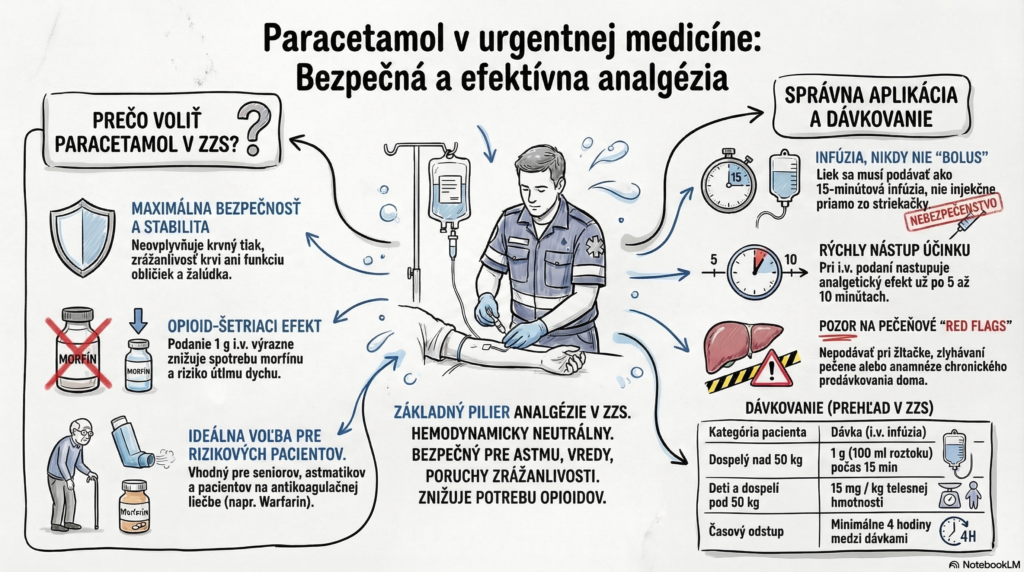
• BP and HR: Paracetamol is hemodynamically neutral. It does not cause hypotension (unlike metamizole) or hypertension (unlike NSAIDs).
• Effect on perfusion: Has no effect on renal perfusion or platelet aggregation, making it safe in polytrauma and pre-surgical states.
• Destabilization risk: Extremely low; in rare cases, mild hypotension can occur with very rapid IV infusion administration.
4. Pharmacokinetics (from a Paramedic’s Perspective)
• Routes of administration: IV (infusion), PO (tablets), PR (suppositories — particularly in pediatrics).
• Onset of action: IV infusion: 5–10 minutes; PO: 30–60 minutes.
• Peak effect: IV: 1 hour.
• Duration of effect: 4–6 hours.
• Metabolism: Primarily hepatic (glucuronidation and sulfation). A small fraction converts to the toxic metabolite NAPQI, which is neutralized by glutathione.
• Elimination: Renal.
5. Indications in Prehospital Practice
1. Mild to moderate pain: Trauma, headache, muscle pain.
2. Combined analgesia: As the base step of the “analgesic ladder” combined with opioids (potentiates their effect).
3. Hyperpyrexia: Fever above 38.5°C (particularly in children, to prevent febrile seizures).
4. NSAID contraindication: Patients with ulcers, asthma, renal failure, or on anticoagulant therapy.
6. Dosing in EMS
• Adult (> 50 kg): 1 g IV (100 ml infusion) over 15 minutes.
• Adult (< 50 kg) and children: 15 mg/kg per dose.
• Interval: At least 4 hours between doses.
• Scope of practice: Physician (RLP). A basic-crew paramedic (RZP) — paracetamol is often within core scope of practice in Slovakia for temperature and pain management.
7. Contraindications
• Absolute: Severe hepatocellular insufficiency (liver failure), known hypersensitivity.
• Relative: Alcoholism, chronic malnutrition (low glutathione reserves), severe renal insufficiency.
8. Adverse Effects
• Hepatotoxicity: With overdose (in EMS, nearly impossible with a single 1 g dose).
• Immune: Rare skin reactions (rash, urticaria), anaphylaxis (very rare).
• Local: Pain at the infusion site.
9. Drug Interactions in EMS
• Hepatic enzyme inducers (phenytoin, carbamazepine): Increase the risk of toxic metabolite formation.
• Alcohol: Acute intoxication increases liver damage risk.
10. Specifics in Emergency Medicine
• Error #1: “Pushing” it in. Paracetamol Kabi is intended as an infusion, not an IV bolus from a syringe.
• Error #2: Underestimating its effect. IV paracetamol is surprisingly effective and eliminates the need for opioids in many patients.
• Multimodal analgesia: Giving 1 g IV paracetamol significantly reduces morphine consumption (opioid-sparing effect).
11. Red Flags
1. Jaundice: If the patient shows signs of liver failure, do not give paracetamol.
2. History of chronic overdose: A patient who already took 10 tablets of Paralen at home must not receive an IV dose.
12. Antidote
• N-acetylcysteine (NAC): Given for overdose (usually not part of the EMS kit; administered in hospital).
13. Practical Field Scenario
Situation: A 70-year-old female patient, fall at home, suspected femoral neck fracture. VAS 8/10. History: anticoagulation (warfarin), bronchial asthma.
Status: Stable, pain increases with movement.
Decision-making:
1. Rule out NSAIDs (bleeding risk with the fracture + asthma).
2. Paracetamol 1 g IV infusion.
3. If pain persists, add small titrated doses of fentanyl.
Hemodynamic rationale: Paracetamol does not affect blood pressure or coagulation, which is key for a patient on warfarin heading to safe subsequent surgery.
14. Practical Summary – 5 Key Points
1. Safest choice: The ideal analgesic for seniors, asthmatics, and multimorbid patients.
2. 15 minutes: Standard infusion drip time.
3. Doesn’t harm the stomach or kidneys: Unlike Almiral.
4. Pediatric standard: First choice for febrile children.
5. Opioid-sparing effect: Reduces the need for strong analgesics and their adverse effects (respiratory depression).
Professional Sources and Literature:
1. SmPC (Summary of Product Characteristics) – Paracetamol Kabi 10 mg/ml infusion solution.
2. Slovak Ministry of Health guidance on pain treatment in children and adults.
3. Dobiáš, V. et al.: Emergency Healthcare. Osveta, 2021.
4. Remedium 2026: Compendium medicamentorum.
5. EMA Safety Update (2025): Recommendations for safe IV paracetamol dosing in low-body-weight individuals.