Introduction
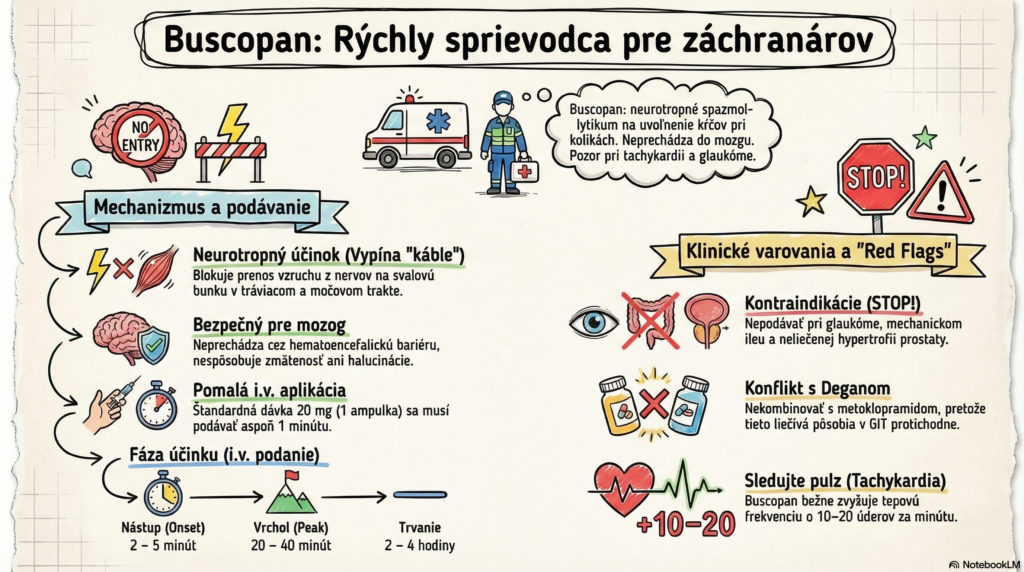
Buscopan (hyoscine butylbromide) is a semi-synthetic scopolamine derivative with a quaternary ammonium structure. In EMS it’s used as an effective spasmolytic for acute smooth muscle spasm. Its key property is that, due to its charge, it does not cross the blood-brain barrier, minimizing the central adverse effects (confusion, hallucinations) typical of atropine or pure scopolamine.
1. Drug Identification
- Active substance: Hyoscini butylbromidum.
- Trade name in Slovakia: Buscopan.
- ATC classification: A03BA01 (Belladonna alkaloids, quaternary ammonium compounds).
- Dosage form in EMS: Injection solution 20 mg/1 ml.
- Pharmacological group: Anticholinergic, neurotropic spasmolytic.
2. Mechanism of Action (Pharmacodynamics)
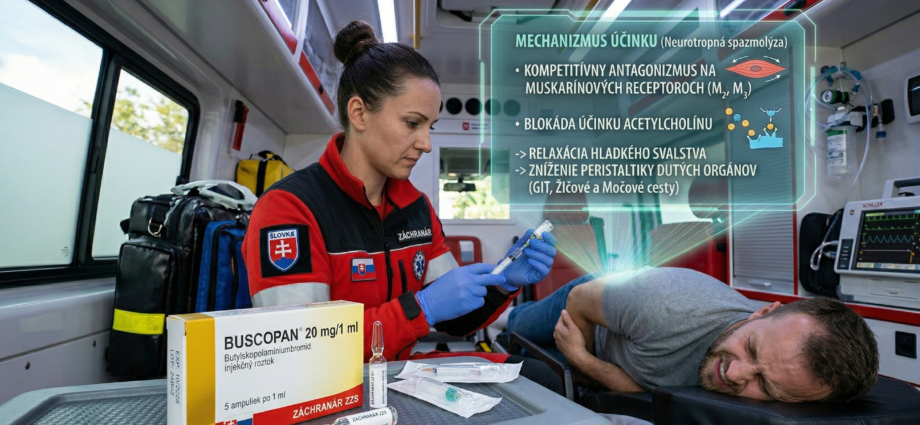
Buscopan acts as a competitive antagonist at muscarinic receptors:
- M-receptor blockade: Binds muscarinic receptors (M2, M3) in the smooth muscle of the digestive, biliary, and urinary tracts.
- Anticholinergic effect: Blocks the action of acetylcholine (the parasympathetic neurotransmitter), halting signal transmission from nerve endings to the muscle cell.
- Result: Rapid relaxation of tonic spasm (spasmolysis) and reduced motility (peristalsis) of hollow organs.
- Secretory effect: Reduces exocrine gland secretion (saliva, gastric juice).
3. Hemodynamic Effects – IN DETAIL
- Heart rate: Tachycardia. Blockade of M2 receptors in the myocardium (vagal effect) can raise heart rate.
- Blood pressure: Usually stable, but sensitive individuals may see a mild drop with IV administration.
- Intraocular pressure: May rise due to cycloplegia and mydriasis (risk in glaucoma).
4. Pharmacokinetics (from a Paramedic’s Perspective)
- Routes of administration: IV (slowly), IM, SC.
- Onset of action: IV administration: 2–5 minutes; IM administration: 10–20 minutes.
- Peak effect: 20–40 minutes.
- Duration of effect: 2–4 hours (shorter than No-Spa).
- Metabolism: Minimal hepatic metabolism. Elimination: primarily unchanged via the kidneys and stool.
5. Indications in Prehospital Practice
- Acute GI spasms: Gastric and duodenal cramps, functional bowel disorders.
- Biliary colic: Spasm of the gallbladder and biliary tract.
- Renal colic: Ureteral spasms.
- Endoscopic procedures: (Rare in EMS; used to suppress peristalsis before transfer.)
6. Dosing in EMS
- Adult: Standard dose 20 mg IV or IM (1 ampule).
- Maximum dose: 100 mg/24h.
- Method: Slow IV injection (at least 1 minute).
- Scope of practice: Physician (RLP). A basic-crew paramedic (RZP) per protocols for colicky pain.
7. Contraindications
- Absolute: Angle-closure glaucoma (blindness risk), myasthenia gravis, mechanical GI strictures (pyloric stenosis, ileus), megacolon, untreated prostatic hypertrophy with urinary retention.
- Relative: Tachycardia (> 100/min), unstable coronary artery disease (ischemia risk with tachycardia).
8. Adverse Effects
- Ocular: Accommodation disturbance (blurred vision), mydriasis.
- Cardiovascular: Tachycardia, palpitations.
- Gastrointestinal: Dry mouth (xerostomia), suppressed bowel motility.
- Other: Urinary retention (dysuria), reduced sweating.
9. Drug Interactions in EMS
- Antipsychotics, tricyclic antidepressants: Potentiate the anticholinergic effect (“red as a beet, dry as a bone” syndrome).
- Metoclopramide (Degan): Antagonism! Buscopan suppresses motility, metoclopramide speeds it up. Concurrent administration reduces the effectiveness of both (space them out if both are necessary).
10. Specifics in Emergency Medicine
- Error #1: Administration during tachycardia. If the patient’s HR is 120 from pain, Buscopan can push it to 150, straining the myocardium.
- Error #2: Administration in ileus. Stopping peristalsis with a mechanical obstruction worsens the patient’s condition.
- Differentiation: Unlike No-Spa, Buscopan acts “from above” (via the nerve signal). If pain is caused by direct muscle irritation from inflammation, No-Spa may be more effective.
11. Red Flags
- Sudden eye pain: Signals an acute glaucoma attack after administration.
- Urinary retention: The patient (particularly an elderly man) is unable to urinate after transport.
- Confusion: Though rare, a paradoxical reaction can occur in seniors.
12. Antidote
- Physostigmine: In hospital settings, for severe anticholinergic intoxication. In EMS: fluid therapy and management of arrhythmias.
13. Practical Field Scenario
Situation: A 42-year-old man, renal colic, HR 88, BP 140/90. VAS 8/10.
Status: In pain, no history of glaucoma.
Decision-making:
- Allergy history (negative).
- Buscopan 20 mg IV (slow bolus).
- Metamizole 2.5 g in 100 ml normal saline. Hemodynamic rationale: We watch HR. If it rises above 110, we withhold further anticholinergic doses.
14. Practical Summary – 5 Key Points
- Neurotropic effect: Switches off the “wires” (nerves) leading to the muscle.
- Watch the eyes and prostate: Always check these two diagnoses before administering.
- Tachycardia is common: Expect a pulse increase of 10–20 beats.
- Don’t combine with metoclopramide: These drugs work against each other in the GI tract.
- Doesn’t reach the brain: Safe regarding neuropsychiatric effects.
Professional Sources and Literature:
- SmPC (Summary of Product Characteristics) – Buscopan injection solution 20 mg/ml.
- Slovak Ministry of Health guidance on the diagnosis of acute abdomen.
- Dobiáš, V. et al.: Emergency Healthcare. Osveta, 2021.
- Lüllmann, H. et al.: Pharmacology and Toxicology. Grada, 2014. (Chapter: Parasympatholytics.)
- Katzung, B. G.: Basic and Clinical Pharmacology. Grada, 2015.