Introduction Flumazenil is an imidazobenzodiazepine derivative that acts as a specific competitive antagonist at benzodiazepine receptors in the central nervous system. It can quickly reverse the sedative, anxiolytic, and anticonvulsant effects of benzodiazepines (such as diazepam, midazolam, alprazolam).
1. Drug Identification
- Active substance: Flumazenilum.
- Trade names in Slovakia: Anexate, Flumazenil Pharmaselect.
- ATC classification: V03AB25 (Antidotes, flumazenil).
- Dosage form in EMS: Injection solution 0.5 mg/5 ml or 1 mg/10 ml.
- Pharmacological group: Benzodiazepine receptor antagonist.
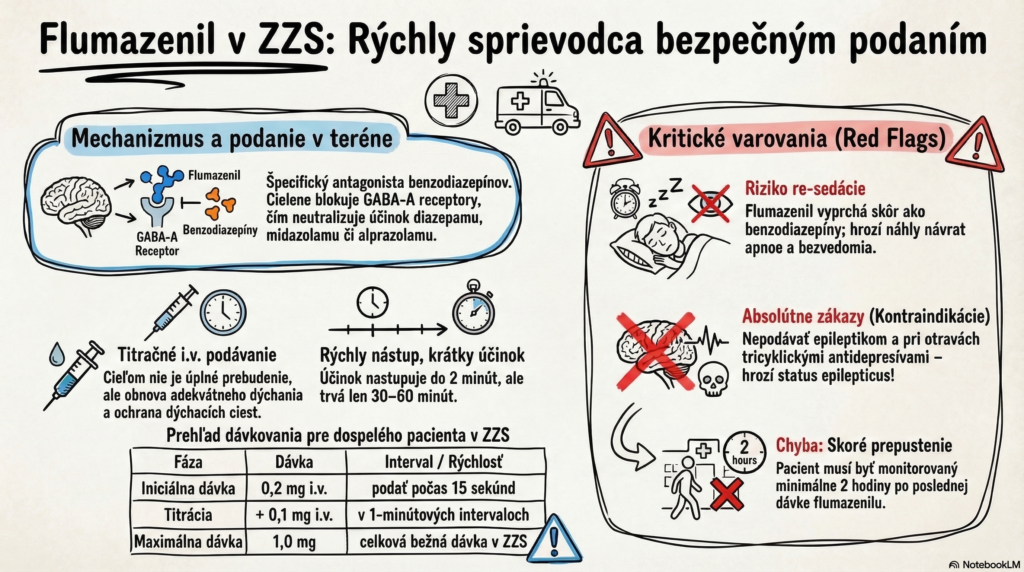
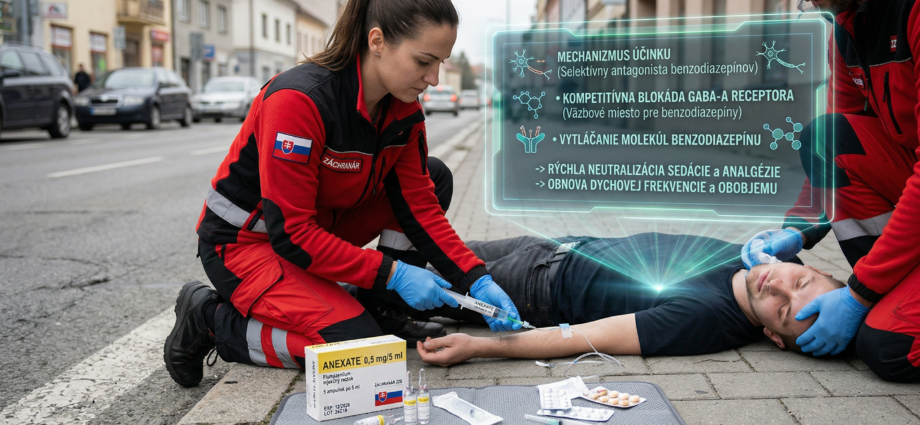
2. Mechanism of Action (Pharmacodynamics) Flumazenil specifically blocks the benzodiazepine binding site on the GABA-A receptor:
- Competitive blockade: Has a high affinity for the receptor, displacing benzodiazepine molecules.
- Neutralization of the effect: Flumazenil itself has almost no intrinsic activity (it’s a “pure” antagonist). Once it occupies the receptors, the chloride channels stop opening excessively and the neuron returns to its baseline excitability.
- Selectivity: Acts only on benzodiazepines. Has no effect on alcohol, barbiturates, or general anesthetics (e.g., propofol).
3. Hemodynamic Effects – IN DETAIL
- BP and HR: Usually stable. Abrupt awakening from deep sedation may cause a mild rise in BP and HR from the stress response and return of consciousness.
- Respiratory system: Restores respiratory rate and volume that were suppressed by benzodiazepines.
4. Pharmacokinetics (from a Paramedic’s Perspective)
- Route of administration: Exclusively IV (slowly, titrated).
- Onset of action: Extremely fast, 1–2 minutes.
- Duration of effect: Very short, 30–60 minutes.
- Critical risk (re-sedation): Most benzodiazepines have a much longer half-life than flumazenil. Once flumazenil wears off, the patient can sink back into deep sedation or apnea.
5. Indications in Prehospital Practice
- Reversal of central sedation: Caused by benzodiazepines (accidental pediatric overdose, suicide attempt).
- Terminating iatrogenic sedation: If unexpected respiratory depression occurred during a procedure (e.g., reduction under midazolam).
- Differential diagnosis: In unconsciousness of unknown origin, to confirm or rule out a benzodiazepine effect.
6. Dosing in EMS
- Adult: Initial dose 0.2 mg IV, given over 15 seconds.
- Titration: If the desired level of consciousness isn’t reached, give further 0.1 mg doses at 1-minute intervals.
- Maximum dose: Commonly 1 mg, in specific ICU cases up to 2 mg.
- Scope of practice: Physician (RLP). A basic-crew paramedic (RZP) — administering flumazenil in Slovakia is usually tied to physician indication due to seizure risk.
7. Contraindications
- Absolute: Patients with epilepsy who are on long-term benzodiazepine therapy (flumazenil will trigger status epilepticus!), mixed intoxication with tricyclic antidepressants (risk of fatal seizures and arrhythmias).
- Relative: Benzodiazepine dependence (triggering withdrawal syndrome).
8. Adverse Effects
- Neurological: Nausea, vomiting, dizziness, restlessness, anxiety (loss of anxiolytic effect).
- Critical: Seizures — particularly in patients with a low seizure threshold or in combined poisonings.
9. Drug Interactions in EMS
- Benzodiazepines: Direct, specific antagonism.
- Tricyclic antidepressants (amitriptyline, dosulepin): Sharp increase in the toxicity of these substances after flumazenil administration — a life-threatening interaction!
10. Specifics in Emergency Medicine
- Error #1: Use with an unclear seizure history. If you give flumazenil to an epileptic patient who took benzodiazepines, you’ll trigger uncontrollable seizures that you can no longer stop with diazepam (because you’ve blocked the receptors).
- Error #2: Letting the patient go home. As with naloxone, re-sedation is a risk here too. The patient must be observed for at least 2 hours after the last dose.
- Titrated administration: The goal isn’t a fully awake, conversant patient, but one who protects their airway and breathes adequately.
11. Red Flags
- Seizures after administration: Secure the airway immediately. Diazepam won’t be effective; consider barbiturates or general anesthesia.
- Anxiety and panic: The patient may become very aggressive or frightened after sudden awakening.
12. Antidote
- Flumazenil is itself an antidote. In the rare case of its own overdose, treatment is symptomatic.
13. Practical Field Scenario Situation: A 3-year-old child found by the mother in the bedroom, an empty blister pack of a benzodiazepine (alprazolam) nearby. The child is deeply drowsy but breathing (RR 14/min). Status: GCS 8, stable vital signs. Decision-making:
- Monitor vital signs, prepare suction.
- Secure IV access.
- Flumazenil 0.01 mg/kg IV, very slowly.
- Observe for improved consciousness. Hemodynamic rationale: Since the child is breathing adequately, we give flumazenil only in titrated doses for differential diagnosis and safe transport.
14. Practical Summary – 5 Key Points
- Short effect: Flumazenil wears off before the drug the patient overdosed on.
- Forbidden in epileptics: Risk of status epilepticus.
- Watch for “mixes”: If antidepressant (TCA) ingestion is suspected, do not give flumazenil.
- Titrate, don’t bolus: Avoids sharp anxiety and vomiting.
- Breathing is fundamental: If the patient breathes well, flumazenil isn’t essential — monitoring is enough.
Professional Sources and Literature:
- SmPC (Summary of Product Characteristics) – Anexate 0.5 mg/5 ml.
- Dobiáš, V. et al.: Emergency Healthcare. Osveta, 2021.
- Lüllmann, H. et al.: Pharmacology and Toxicology. Grada, 2014.
- Toxicology Handbook (Murray, L.): Management of benzodiazepine overdose.
- Slovak Ministry of Health guidance on the management of acute intoxications.