Introduction Naloxone is a pure competitive opioid receptor antagonist. It has no agonist activity of its own (it doesn’t cause sedation or analgesia). Its sole role is to displace opioid molecules (heroin, morphine, fentanyl, methadone, codeine) from receptors and occupy their place, immediately reversing their effect.
1. Drug Identification
- Active substance: Naloxoni hydrochloridum.
- Trade name in Slovakia: Naloxon Polfa.
- ATC classification: V03AB15 (Antidotes, naloxone).
- Dosage form in EMS: Injection solution 0.4 mg/1 ml (ampule).
- Pharmacological group: Opioid receptor antagonist.
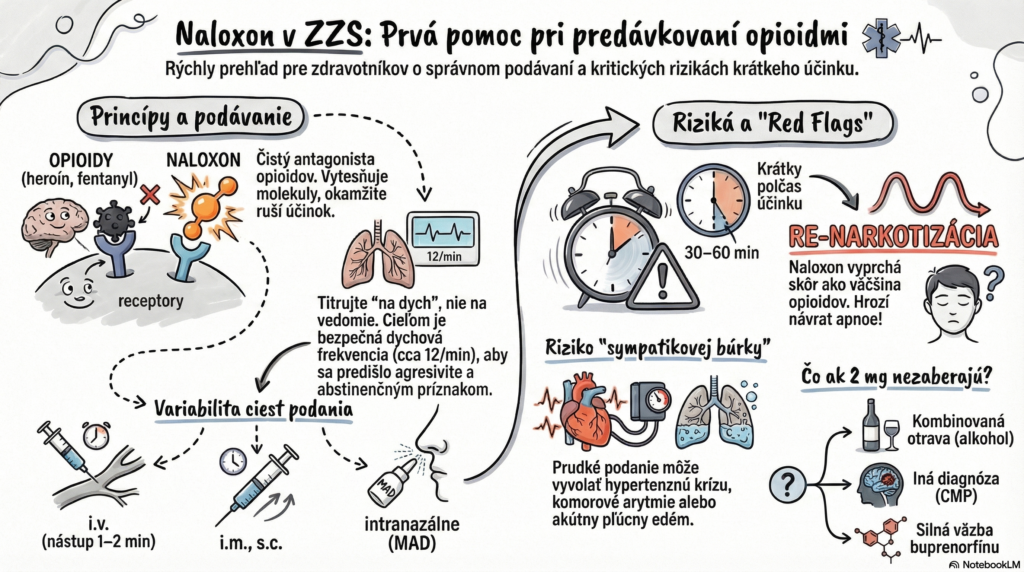
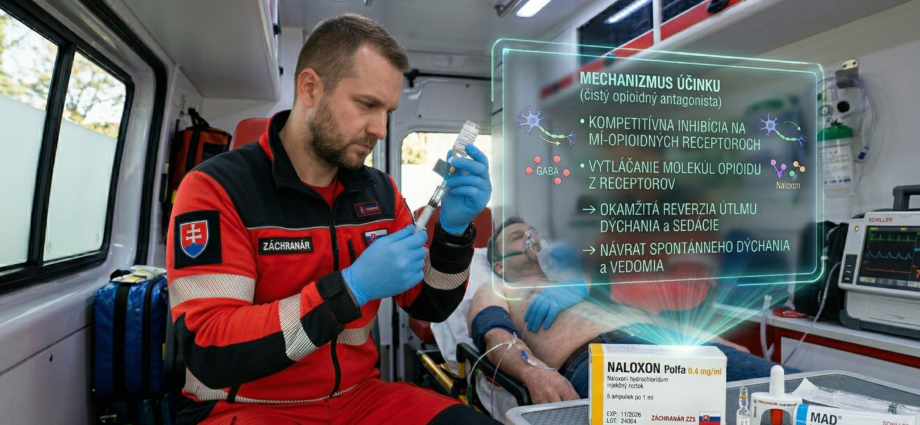
2. Mechanism of Action (Pharmacodynamics) Naloxone acts with high affinity on all three types of opioid receptors (mu, kappa, delta), with the strongest effect on mu-receptors:
- Competitive inhibition: Naloxone has a higher affinity for the receptors than most opioids. It literally “pushes” the opioid off the receptor.
- Reversal of depression: Immediately reverses opioid-induced respiratory depression, sedation, and hypotension.
- Mydriasis: Reverses the pinpoint pupils typical of opioid intoxication.
3. Hemodynamic Effects – IN DETAIL
- BP and HR: In opioid overdose, naloxone raises BP and HR toward normal as breathing and sympathetic activity return.
- Risk of a “sympathetic storm”: If naloxone is given too quickly or in a large dose to a dependent individual, a sudden catecholamine surge occurs. This can lead to hypertensive crisis, ventricular arrhythmias, or acute pulmonary edema.
4. Pharmacokinetics (from a Paramedic’s Perspective)
- Routes of administration:
- IV: Fastest onset (within 1–2 minutes).
- IM / SC: Onset after 2–5 minutes (used when venous access isn’t available).
- IN (intranasal): Increasingly popular via an atomizer (MAD device).
- Duration of effect: A critical point! Naloxone acts for only 30 to 60 minutes. Many opioids (e.g., methadone or fentanyl) last much longer.
- “Re-narcotization” risk: Once naloxone wears off, the patient can return to apnea and unconsciousness, because the opioid is still circulating in the body.
5. Indications in Prehospital Practice
- Complete or partial reversal of respiratory depression caused by natural or synthetic opioids.
- Differential diagnosis of unconsciousness of unknown origin (if intoxication is suspected).
- Opioid overdose during pain treatment (iatrogenic fentanyl/morphine overdose).
- Neonatal resuscitation, if the mother received opioids shortly before delivery.
6. Dosing in EMS
- Adult (apnea/severe depression): Initial 0.4 mg IV. If no response, repeat every 2–3 minutes up to a total dose of 2 mg (in extreme cases up to 10 mg).
- Titrated administration (if the patient is breathing but unconscious): Dilute 0.4 mg in 10 ml normal saline and give in 0.04 mg (1 ml) increments until adequate respiratory rate returns. The goal is not full awakening, but safe breathing.
- Scope of practice: Physician (RLP). A basic-crew paramedic (RZP) — in Slovakia, naloxone is within paramedic scope of practice for managing life-threatening respiratory depression.
7. Contraindications
- Absolute: Hypersensitivity to naloxone.
- Relative: Opioid dependence (give with extreme caution due to withdrawal syndrome).
8. Adverse Effects
- Acute withdrawal syndrome: Aggression, vomiting, sweating, shivering, abdominal cramps, severe pain (if the opioid was given for pain).
- Cardiovascular: Tachycardia, hypertension, pulmonary edema.
9. Drug Interactions in EMS
- Opioids: Direct antagonism (reverses fentanyl, morphine, sufentanil).
- Buprenorphine (Norspan/Transtec): Naloxone has difficulty displacing buprenorphine due to its extremely strong receptor binding. Requires very high naloxone doses.
10. Specifics in Emergency Medicine
- Error #1: “Waking into aggression.” Give a person who uses drugs a full 0.4 mg IV bolus “all at once,” and they’ll wake into severe withdrawal, rip out their IV line, and become aggressive. Titrate to breathing only!
- Error #2: Letting the patient go home. After 5 minutes the patient feels great and wants to sign a refusal. They must not! Within an hour they could be back in apnea. They must be observed in hospital for at least 2–4 hours.
- Combined poisoning: If the patient doesn’t wake after 2 mg naloxone, it’s likely a combination with alcohol, benzodiazepines, or another cause (trauma, stroke).
11. Red Flags
- Pulmonary edema: Pink frothy sputum after naloxone administration.
- Vomiting: As consciousness returns, aspiration is a risk; the patient must be in the recovery position or suction must be ready.
12. Antidote
- None exists. Naloxone itself is not toxic.
13. Practical Field Scenario Situation: A 24-year-old man found in a bathroom, pinpoint pupils, respiratory rate 3/min, cyanosis. A syringe lies nearby. Status: GCS 3, SpO2 65%, BP 90/60. Decision-making:
- Assisted ventilation with a bag-valve-mask at 100% O2 (priority #1).
- Secure IV access.
- Naloxone 0.4 mg IV (titrated, 0.1 mg every minute).
- Once respiratory rate reaches 12/min and consciousness returns, stabilize and transport. Hemodynamic rationale: Monitor BP. If it rises sharply after waking and the patient is agitated, this indicates mild withdrawal syndrome.
14. Practical Summary – 5 Key Points
- Breathing over consciousness: The goal is for the patient to breathe, not to jump off the stretcher.
- Short half-life: Naloxone “leaves” before heroin does. Monitor for re-narcotization!
- MAD device: If you have no vein, spray it into the nose.
- Withdrawal syndrome: Be prepared for vomiting and aggression.
- Zero effect in non-opioid causes: If it doesn’t help, look for another cause of unconsciousness.
Professional Sources and Literature:
- SmPC (Summary of Product Characteristics) – Naloxon Polfa 0.4 mg/ml.
- ERC Guidelines 2021: Cardiac arrest in special circumstances (opioid overdose).
- Dobiáš, V. et al.: Emergency Healthcare. Osveta, 2021.
- Remedium 2026: Antidotes in Emergency Medicine.
- Slovak Ministry of Health guidance on the management of acute intoxications.