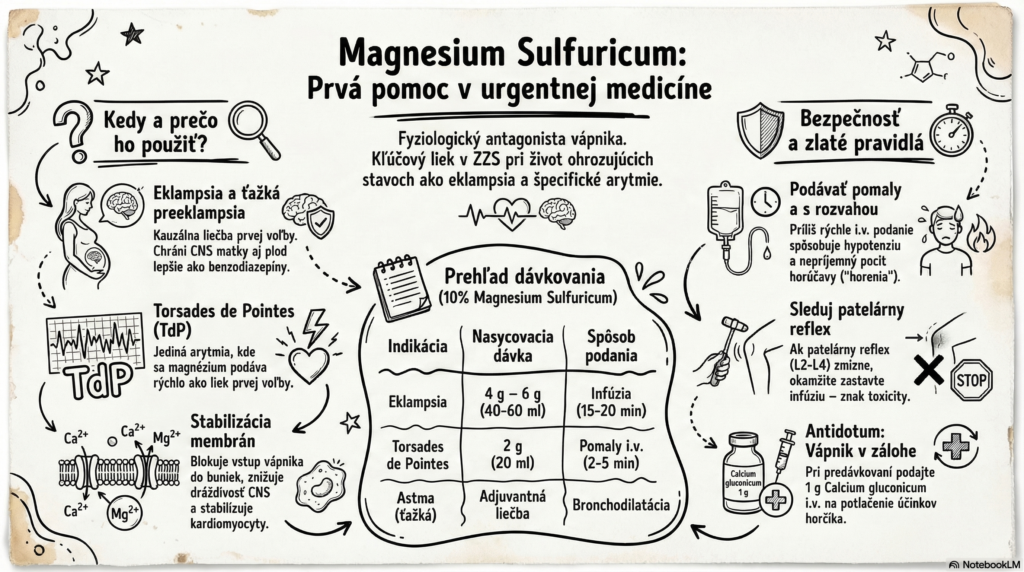
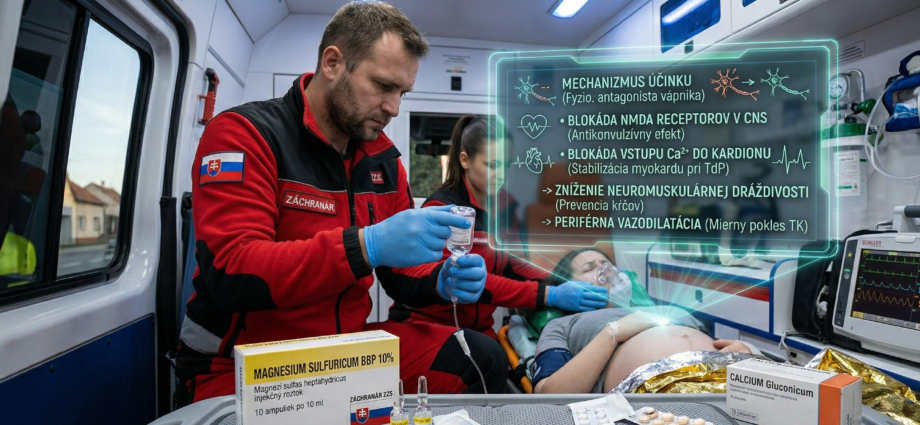
Introduction Magnesium sulfate acts as a physiological calcium antagonist. In emergency medicine it has an irreplaceable role as a myocardial membrane stabilizer and a potent anticonvulsant in obstetrics. Unlike benzodiazepines, in eclampsia it is causal treatment that protects the mother’s CNS and the fetus.
1. Drug Identification
- Active substance: Magnesii sulfas heptahydricus.
- Trade name in Slovakia: Magnesium Sulfuricum BBP 10%.
- ATC classification: A12CC02 (Mineral supplements, magnesium).
- Dosage form in EMS: 10% injection solution (1 g/10 ml ampule).
- Pharmacological group: Magnesium salts, anticonvulsant, antiarrhythmic.
2. Mechanism of Action (Pharmacodynamics) Magnesium blocks calcium entry into cells, producing several effects:
- Neurological (anticonvulsant): Blocks NMDA receptors and reduces acetylcholine release at the neuromuscular junction. Raises the CNS excitability threshold.
- Cardiac (antiarrhythmic): Stabilizes cardiomyocyte membranes and prolongs conduction time, which is key for suppressing early afterdepolarizations.
- Vascular (vasodilatory): Direct relaxant effect on vascular smooth muscle (BP drop) and a spasmolytic effect on the uterus (tocolysis).
3. Hemodynamic Effects – IN DETAIL
- Blood pressure: BP drop. Significant peripheral vasodilation can lead to hypotension, particularly with rapid administration.
- Heart rate: Usually stable; at toxic levels, bradycardia and even arrest are a risk.
- Neuromuscular depression: At high doses, weakens skeletal muscle and suppresses deep tendon reflexes.
4. Pharmacokinetics (from a Paramedic’s Perspective)
- Route of administration: Exclusively IV (slow injection or infusion). IM administration is painful in EMS and not recommended.
- Onset of action: Immediate with IV administration.
- Duration of effect: Approximately 30 minutes (in serum).
- Elimination: Exclusively renal.
5. Main Indications in EMS
- Eclampsia and severe preeclampsia: Prevention and treatment of seizures in pregnant patients (past 20 weeks) and postpartum women.
- Torsades de Pointes (TdP): Polymorphic ventricular tachycardia associated with a prolonged QT interval. Magnesium is the first-line drug here even with normal serum magnesium levels.
- Refractory ventricular fibrillation: If amiodarone has failed and hypomagnesemia is suspected.
- Severe asthma exacerbation: Adjunctive treatment (bronchodilation via calcium blockade) if unresponsive to Ventolin.
6. Dosing in EMS
- Eclampsia: Loading dose 4 g to 6 g IV (i.e., 40–60 ml of 10% solution) as an infusion over 15–20 minutes.
- Torsades de Pointes: 2 g IV (20 ml of 10% solution), given slowly over 2–5 minutes. In pulseless TdP (cardiac arrest), it may be given as a bolus.
- Scope of practice: Physician (RLP). A basic-crew paramedic (RZP) — administration for TdP during CPR or for eclampsia per current algorithms.
7. Contraindications
- Absolute: Myasthenia gravis (risk of respiratory failure), 3rd-degree AV block, severe renal failure (anuria).
- Relative: Hypotension, concurrent use of calcium channel blockers.
8. Adverse Effects and Toxicity Magnesium has a narrow therapeutic window. Toxicity symptoms correlate with dose:
- Mild: A sensation of warmth, flushing, sweating, nausea.
- Moderate: Loss of the patellar reflex (L2–L4), muscle weakness.
- Severe: Respiratory depression, conduction disturbances, asystole.
9. Drug Interactions in EMS
- Calcium channel blockers (verapamil, amlodipine): Significant potentiation of hypotension and muscle weakness.
- Gentamicin: Increases risk of neuromuscular blockade.
10. Specifics in Emergency Medicine
- Error #1: Too-rapid administration. Leads to sudden hypotension and a sensation of the whole body “burning.”
- Error #2: Insufficient monitoring. During a magnesium infusion, you must monitor respiratory rate and, ideally, the patellar reflex. If the reflex disappears, stop the infusion immediately.
- Dilution: The 10% solution is relatively safe, but for a longer infusion it’s better to dilute it in 100 ml normal saline.
11. Red Flags
- Bradypnea: A drop in respiratory rate below 10/min signals hypermagnesemia.
- Oliguria: If the patient isn’t urinating, magnesium accumulates and toxicity develops faster.
12. Antidote
- Calcium gluconate (or calcium chloride): 1 g IV, slowly. Calcium immediately antagonizes magnesium’s effects on the heart and muscles.
13. Practical Field Scenario (Eclampsia) Situation: A 32-year-old first-time mother at 36 weeks, generalized seizures at home, now unconscious. BP 190/110. Status: Postictal, lower-extremity edema, another seizure imminent. Decision-making:
- Positioning, oxygen therapy.
- Secure IV access.
- Magnesium Sulfate 4 g IV (40 ml of 10%) as an infusion over 20 minutes.
- If seizures continue, diazepam 5–10 mg IV. Hemodynamic rationale: Magnesium reduces cortical excitability while also mildly lowering critically high blood pressure, without compromising placental perfusion.
14. Practical Summary – 5 Key Points
- Eclampsia = magnesium: Benzodiazepines are only second-line.
- Torsades de Pointes: The one arrhythmia where we push magnesium fast.
- Watch the patellar reflex: If present, the patient isn’t overdosed.
- Have calcium on standby: Always keep calcium ready as the antidote.
- Give it slowly: Prevents hypotension and patient discomfort.