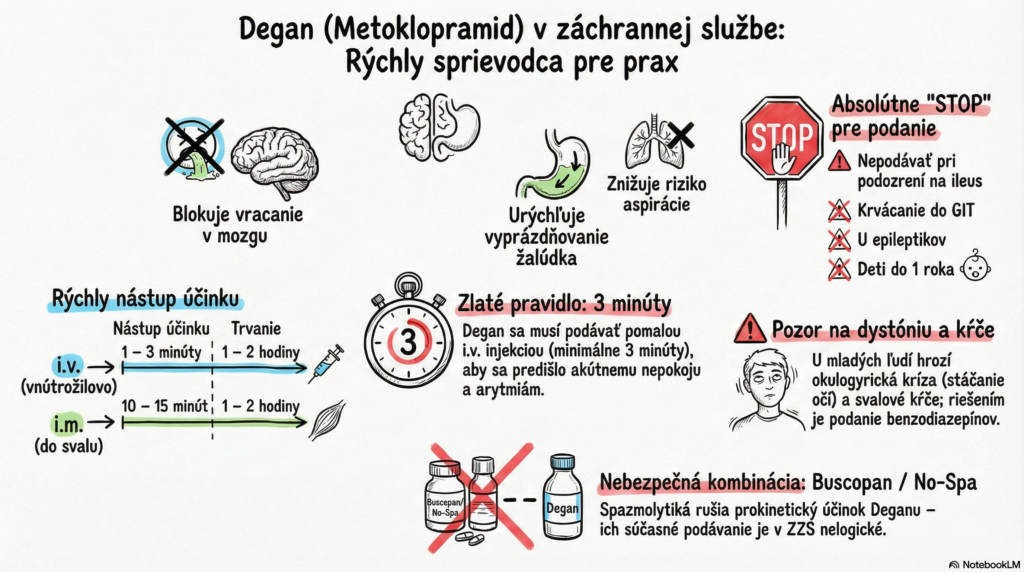

Introduction Degan (metoclopramide) is a dopamine antagonist with prokinetic and antiemetic effects. In EMS it’s key for managing nausea and vomiting of various origins (except vestibular), with a unique property of speeding gastric emptying, which reduces aspiration risk.
1. Drug Identification
- Active substance: Metoclopramidi hydrochloridum.
- Trade name in Slovakia: Degan 10 mg.
- ATC classification: A03FA01 (Propulsives).
- Dosage form in EMS: Injection solution 10 mg/2 ml (ampule).
- Pharmacological group: Prokinetic, antiemetic.
2. Mechanism of Action (Pharmacodynamics) Acts in a complex way both centrally and peripherally:
- Central effect: Blockade of dopamine D2 receptors in the chemoreceptor trigger zone (area postrema) in the medulla, raising the threshold for vomiting.
- Peripheral effect: Increases acetylcholine release in postganglionic cholinergic neurons in the GI tract.
- Result: Increases lower esophageal sphincter tone (reflux prevention), speeds gastric antral contraction, and relaxes the pylorus. Markedly shortens gastric and duodenal transit time.
3. Hemodynamic Effects – IN DETAIL
- BP and HR: Usually no direct effect.
- Arrhythmia risk: Serious cardiac rhythm disturbances (QT prolongation, Torsades de Pointes, bradycardia) have been reported after IV administration.
- Safety: Extra caution is needed with IV administration in elderly patients and those with a cardiac history.
4. Pharmacokinetics (from a Paramedic’s Perspective)
- Routes of administration: IV (slowly!), IM.
- Onset of action: IV administration: 1–3 minutes; IM administration: 10–15 minutes.
- Duration of effect: 1–2 hours.
- Elimination: Renal.
5. Indications in Prehospital Practice
- Symptomatic treatment of nausea and vomiting: Including vomiting from acute migraine.
- Aspiration prevention: In patients with a full stomach requiring an urgent procedure.
- Hiccups (singultus): Effective in some cases of persistent hiccups.
6. Dosing in EMS
- Adult: Single dose 10 mg (1 ampule).
- Maximum dose: 30 mg/24h (in EMS, typically just one dose).
- Method: Slow IV injection over at least 3 minutes (prevention of adverse effects).
- Scope of practice: Physician (RLP). A basic-crew paramedic (RZP) — a standard competency for managing vomiting.
7. Contraindications
- Absolute: Gastrointestinal bleeding, mechanical bowel obstruction (ileus) or perforation, pheochromocytoma (hypertensive crisis risk), epilepsy (increases seizure frequency).
- Children under 1 year: Strictly contraindicated.
- Relative: Parkinson’s disease (worsens symptoms), children aged 1–18 years (only as second-line).
8. Adverse Effects
- Extrapyramidal symptoms (EPS): Acute dystonia (spasms of facial muscles, eyes, neck) — more common in young adults and children.
- Neurological: Drowsiness, restlessness (akathisia).
- Cardiac: Bradycardia, QT prolongation.
9. Drug Interactions in EMS
- Buscopan / No-Spa: Antagonism! Anticholinergics cancel Degan’s prokinetic effect.
- Opioids (fentanyl, morphine): Additive sedation, but Degan helps counter opioid-induced nausea.
- Neuroleptics: Increase the risk of extrapyramidal disorders.
10. Specifics in Emergency Medicine
- Error #1: Rapid bolus. Causes sudden restlessness, a feeling of anxiety, and increases the risk of dystonia and arrhythmias. Always give over 3 minutes.
- Error #2: Administration with suspected ileus. With a mechanical bowel obstruction, the prokinetic effect increases perforation risk.
- Vestibular vomiting: For motion sickness or vertigo, Degan is minimally effective — Torecan is the drug of choice there.
11. Red Flags
- Oculogyric crisis: Upward eye deviation after administration (an EPS manifestation). Treated with diazepam or an antihistamine.
- Bradycardia: If the pulse suddenly drops, stop administration.
12. Antidote
- None exists. For extrapyramidal reactions, a benzodiazepine (Apaurin) or biperiden (Akineton) is given.
13. Practical Field Scenario Situation: A 40-year-old woman with an acute migraine attack, repeatedly vomiting, dehydrated. Status: In pain, BP 130/85, HR 88. Decision-making:
- Secure IV access and rehydrate (500 ml normal saline).
- Degan 10 mg IV, very slowly (3 minutes).
- Analgesia (e.g., metamizole). Hemodynamic rationale: Degan improves absorption of oral medications (if given) and stops vomiting, easing transport. We watch for any onset of muscular restlessness.
14. Practical Summary – 5 Key Points
- 3 minutes: The golden rule for IV administration speed.
- Gets the stomach moving: Ideal for aspiration and reflux risk.
- Watch for facial “spasms”: Young people are at risk of dystonia.
- Forbidden in GI bleeding: Increased peristalsis worsens the condition.
- Don’t combine with spasmolytics: Buscopan and Degan work against each other.
Professional Sources and Literature:
- SmPC (Summary of Product Characteristics) – Degan 10 mg injection solution.
- EMA Safety Update (2013): Recommendations for minimizing the neurological and cardiac risks of metoclopramide.
- Dobiáš, V. et al.: Emergency Healthcare. Osveta, 2021.
- Remedium 2026: Management of Nausea in Emergency Medicine.
- Slovak Ministry of Health guidance on the treatment of migraine in the prehospital phase.