Driving Under Blue Lights —
legal framework and responsibility of the driver
Priority driving is not an exception to the law. It is a precisely defined right with specific conditions, limits, and responsibilities. What does Slovak Act No. 8/2009 Coll. actually say?
Turning on the blue light and siren doesn’t mean unlimited freedom of movement. The law precisely determines when priority driving arises, what it permits the driver to do, and where those rights end. Ignorance of these boundaries can carry criminal-law consequences.
What priority driving is — and what it isn’t
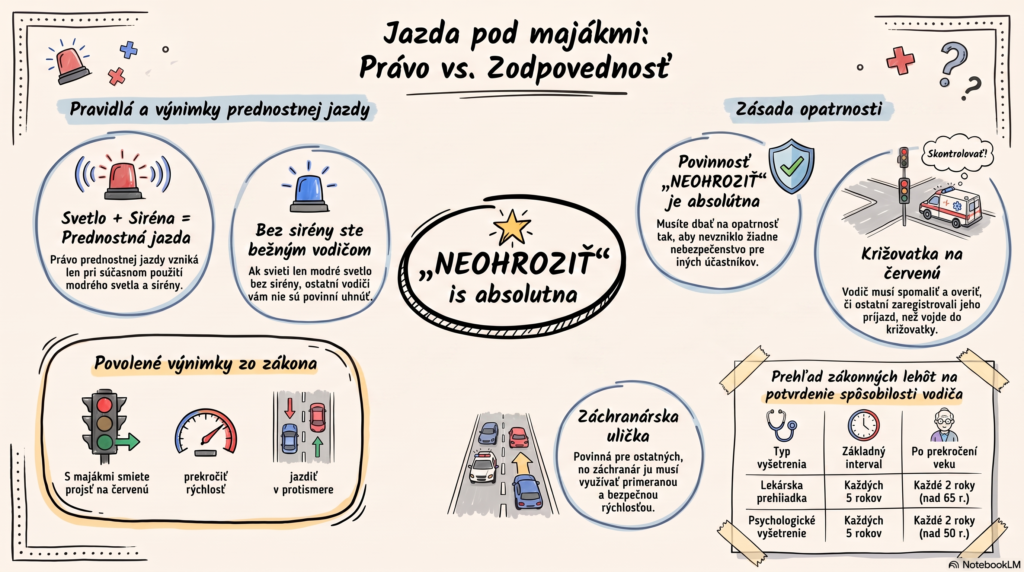
An ambulance’s priority driving is legally valid only when two conditions are met simultaneously: the vehicle must use a special blue warning light and, at the same time, a special audible warning signal (siren). The law states this clearly, with no exception.
Emergency medical service vehicles, the Fire and Rescue Corps, the Police Force, and other integrated rescue system components have the right of priority driving if they simultaneously use a special blue warning light and a special audible warning signal.
Source: § 40(1) of Act No. 8/2009 Coll. on Road Traffic, as amendedFrom this follows a key rule: if an EMS driver operates with the blue light on but without the siren (for example, out of consideration for nighttime quiet in a residential zone), the right of priority driving does not arise. Other drivers are not obligated to yield, and the EMS driver bears full responsibility as an ordinary driver.
What a driver with the right of priority driving may do
Under § 41(1) of Act 8/2009 Coll., a driver of a vehicle with the right of priority driving is not obligated to comply with most of the duties and prohibitions established by the law. Specifically, they may:
Not endangering others — an absolute duty that always applies
All the entitlements under § 41(1) are conditional on one sentence that the law states without exception:
The driver of a vehicle with the right of priority driving is obligated to exercise the necessary caution so as not to endanger other road users.
Source: § 41(1) of Act No. 8/2009 Coll. on Road TrafficThe word “endanger” has a precise definition in the law (§ 2(2)(o)): the duty to act so that no danger whatsoever arises for another road user. Not lesser danger — none. If passing through a red light would endanger a pedestrian legally crossing at a walk signal, the EMS driver is obligated to stop — despite the right of priority driving.
The duty not to endanger other road users applies absolutely — no provision of § 41 suspends or limits it. If a traffic accident occurs during priority driving, the EMS driver’s criminal liability is assessed primarily on whether this duty was breached.
The emergency vehicle lane (“rescue lane”)
Since 2020, the law (§ 10(11)) has required other drivers to actively form an emergency vehicle lane in a traffic jam on a motorway or a road divided by direction — between the left lane and the adjacent one. This lane may be used exclusively by a vehicle with the right of priority driving or a vehicle clearing the aftermath of an accident. Any other driver is legally prohibited from using it.
The emergency vehicle lane is a legal tool, not a physical guarantee. Not all drivers form it in time or correctly. Driving through it requires an appropriate speed and continuous monitoring of the situation ahead of the vehicle.
Requirements for an EMS driver — beyond an ordinary driving license
Act No. 8/2009 Coll. places specific requirements on drivers of vehicles with the right of priority driving that other drivers don’t have:
| Requirement | Legislative basis | Interval |
|---|---|---|
| Medical examination (medical fitness) — performed by a general practitioner; the driver must carry the certificate | § 87 of Act No. 8/2009 Coll. | Max. 5 years (max. 2 years after age 65) |
| Psychological examination (psychological fitness) — performed by a certified traffic psychologist | § 88 of Act No. 8/2009 Coll. | Max. 5 years (max. 2 years after age 50) |
| Category B driving license at minimum; category C for vehicles over 3,500 kg | § 73 of Act No. 8/2009 Coll. | Valid license |
Missing valid documentation while driving is an offense — and in the event of a traffic accident it can carry serious criminal-law consequences for both the driver and the employer.
Three scenarios — how the law works in practice
An ambulance with active signaling (blue light + siren) passes through an intersection against a red light. The driver of a passenger car doesn’t notice the ambulance and doesn’t brake. A collision occurs.
A nighttime call in a residential zone. The driver turned on the blue light but didn’t activate the siren, out of consideration for nighttime quiet. In a collision, they invoke priority driving.
An ambulance passes through an intersection against a red light. A pedestrian legally entered the crosswalk on a green signal. The driver endangers them while passing through — no collision occurs.
Ten rules for the EMS driver
1. Always activate priority driving with both signals — blue light and siren simultaneously.
2. At every intersection with a red light, slow to a speed at which you can safely stop until you’ve confirmed other drivers are reacting.
3. A pedestrian at a crosswalk with a green signal still has the right of way — not even priority driving changes that.
4. Use the emergency vehicle lane at an appropriate speed — continuously monitor the situation ahead of the vehicle.
5. For a non-urgent call — consider whether to activate priority driving. The law conditions its use on carrying out duties, not merely on the call category.
6. Crew communication during driving about the traffic situation is part of teamwork, not a disruptive element.
7. Report and document any traffic incident that occurs during a call to dispatch.
8. The medical examination and psychological evaluation must be valid — carry the documents with you.
9. Fatigue reduces reaction time below the level at which priority driving is safe — communicate this to the crew and dispatch.
10. Priority driving gives you rights, not immunity. Responsibility remains yours.
- VZ-LEG-01 — Driving Under Blue Lights — Legal Framework and Driver Responsibility (this article)
- VZ-LEG-02 — Driver Responsibility in a Traffic Accident During a Call
- VZ-LEG-03 — Alcohol, Medications, and EMS Driver Fitness
- Slovak Act No. 8/2009 Coll. on Road Traffic and on Amendments to Certain Acts, as amended. Current wording as of January 1, 2026. slov-lex.sk
- § 40 — Right of way and the right of priority driving; Act No. 8/2009 Coll.
- § 41 — Vehicles with the right of priority driving; Act No. 8/2009 Coll.
- § 10(11) — Emergency vehicle lane; Act No. 8/2009 Coll. (added by Act No. 393/2019 Coll.)
- § 87, § 88 — Medical and psychological fitness of the driver; Act No. 8/2009 Coll.
- § 2(2)(o) — Definition of “non-endangerment”; Act No. 8/2009 Coll.
- Slovak Act No. 579/2004 Coll. on Emergency Medical Services, § 2(3) — definition of urgent healthcare.