Physical Examination in the Field vs. the Hospital
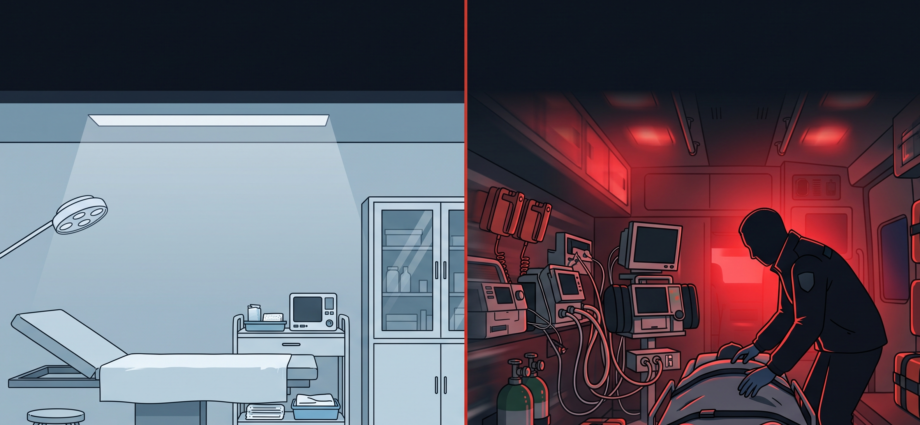
Identical techniques, completely different conditions. In the field, a paramedic isn’t examining in a quiet exam room with good lighting and unlimited time — they’re examining in a car, on a sidewalk, in a crowded apartment, under time pressure. Knowing what can be reliably examined and what can’t is just as important as knowing the technique itself.
The hospital physical examination is the reference standard on which textbooks — and this series — are built. Prehospital examination doesn’t differ from it in technique — it differs in the conditions under which it’s performed, and therefore also in what can be reliably concluded from it. This installment covers six limiting factors of the field, adaptations that partially compensate for them, and decision principles for when shortening the exam is clinically justified.
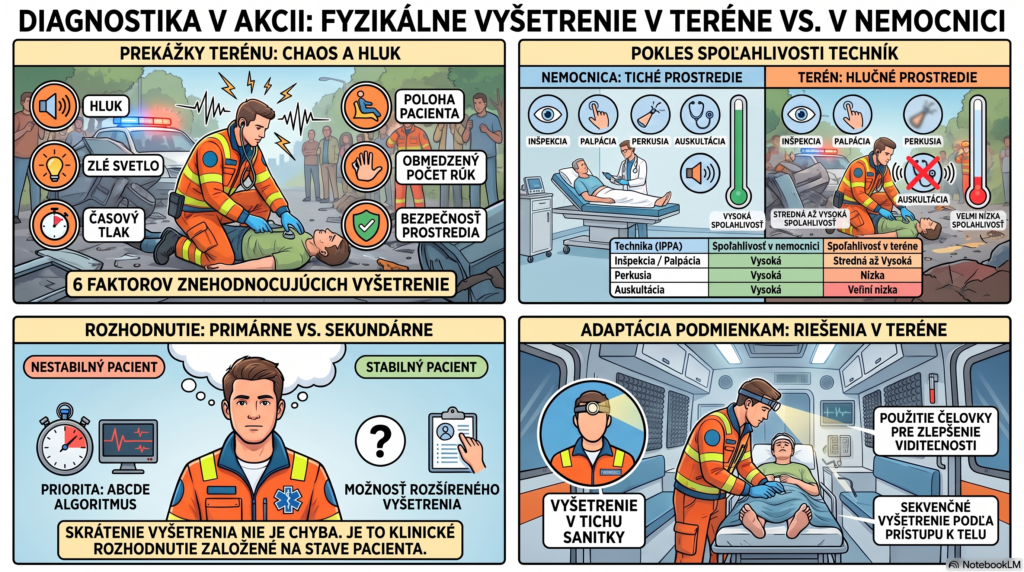
Six limiting factors of the field
1. Noise — vehicle engine, traffic, a crowd of bystanders; auscultation and fine percussion are the first things noise degrades.
2. Light — darkness on the road at night, dim apartment lighting; inspection of the skin, color, and pupils is unreliable without good light.
3. Time — for an unstable patient, time at the scene is deliberately minimized; a complete four-step examination of every body region isn’t realistic.
4. Patient position — pinned in a vehicle, on stairs, in bed with no ability to turn; access to certain body regions is physically limited.
5. Number of hands — a two-person crew simultaneously examines, monitors, prepares equipment, and communicates; the exam runs in parallel with other tasks, not as an isolated activity.
6. Environmental safety — the roadway, an unstable structure, an aggressive patient or bystanders; the exam adapts to whatever the environment allows to be done safely.
Adaptations that partially compensate for the environment
Moving to a quieter location — if the patient’s condition allows, cardiac and lung auscultation is performed in the ambulance with the engine off, not on a sidewalk next to traffic.
Your own light source — a headlamp or flashlight for inspecting pupils, skin, and mucous membranes in a poorly lit apartment; skin color under yellow interior lighting is unreliable.
Sequential instead of simultaneous examination — with limited access to the patient (pinned in a vehicle), examine the currently accessible area by area, not in head-to-toe anatomical order.
Repeating after stabilization — a finding that wasn’t reliable at the scene due to noise or time pressure is completed during transport, when the environment is somewhat calmer.
Primary vs. secondary survey — when to shorten the exam
The decision of how much time to devote to physical examination isn’t a matter of comfort — it’s part of clinical decision-making. The basic framework structuring this decision is the division into primary survey (identifying immediately life-threatening conditions) and secondary survey (a detailed examination after stabilization).
| Patient condition | Examination scope | Where performed |
|---|---|---|
| Critically unstable (CPR, severe trauma, shock) | Primary survey only — targeted at ABCDE | On scene, minimal time |
| Stable, but at risk (chest pain, dyspnea) | Primary + targeted secondary (affected system) | On scene + completed during transport |
| Stable, low risk | Complete secondary survey | On scene, no time pressure |
Shortening the scope of examination for a critically unstable patient is clinically correct — the exam is limited to what directly affects the immediate decision (e.g., chest auscultation for suspected tension pneumothorax during CPR). The mistake isn’t the shortening itself, but abandoning systematics within what does get examined — that is, skipping inspection and going straight to intervention without the paramedic registering the visual finding even for a second.
The physical examination finding, including the reason for any shortening or limitation (e.g., an inaccessible body region, time pressure with a critically unstable patient), is part of the medical documentation for urgent healthcare provided and is subject to medical documentation requirements under Decree of the Slovak Ministry of Health No. 10548/2009-OL. Accurate and legible documentation of the finding is important not only medically but also legally — it retrospectively demonstrates the basis on which the treatment decision was made.
Source: Decree of the Slovak Ministry of Health No. 10548/2009-OL on minimum staffing and material-technical equipment requirements for individual types of healthcare facilitiesThree scenarios from practice
A 60-year-old patient with chest pain, hemodynamically stable, at home, quiet, good lighting.
A patient with dyspnea after a traffic accident on a busy road, traffic passing by, noise, reduced evening visibility.
A patient pinned in a vehicle after impact, limited access, concurrent extrication by firefighters underway.
What the next installment covers
Installment VYS-03 covers head and neck examination — assessing pupils, the components of GCS in practical execution, jugular venous distension, tracheal position, and carotid palpation, including what these findings realistically mean for further decision-making in the field.
- VYS-01 — Inspection, Palpation, Percussion, Auscultation: The Four Pillars of Physical Examination
- VYS-02 — Physical Examination in the Field vs. the Hospital (this article)
- VYS-03 — Head and Neck Examination
- VYS-04 — Lung Auscultation
- VYS-05 — Chest Examination
- VYS-06 — Heart Auscultation
- VYS-07 — Abdominal Examination
- VYS-08 — Peritoneal Signs and Acute Abdomen
- VYS-09 — Examination of the Limbs and Peripheral Circulation
- VYS-10 — Neurological Examination in the Field
- VYS-11 — The Skin as a Diagnostic Tool
- VYS-12 — Examining the Pediatric Patient
- VYS-13 — Examining the Geriatric Patient
- VYS-14 — From Examination to Decision
- Bickley LS, Szilagyi PG, Hoffman RM. Bates’ Guide to Physical Examination and History Taking. 13th ed. Wolters Kluwer, 2021.
- National Association of EMTs (NAEMT). PHTLS — Prehospital Trauma Life Support. 10th ed., 2023 — primary and secondary survey.
- International Trauma Life Support (ITLS) — Assessment and Management Principles, 9th ed., 2020.
- Jones CM, et al. Reliability of prehospital physical examination findings under field conditions. Prehospital Emergency Care. Informa Healthcare.
- Decree of the Slovak Ministry of Health No. 10548/2009-OL — medical documentation requirements in healthcare facilities.
- Slovak Act No. 578/2004 Coll. on Healthcare Providers, Healthcare Professionals, and Professional Organizations in Healthcare.