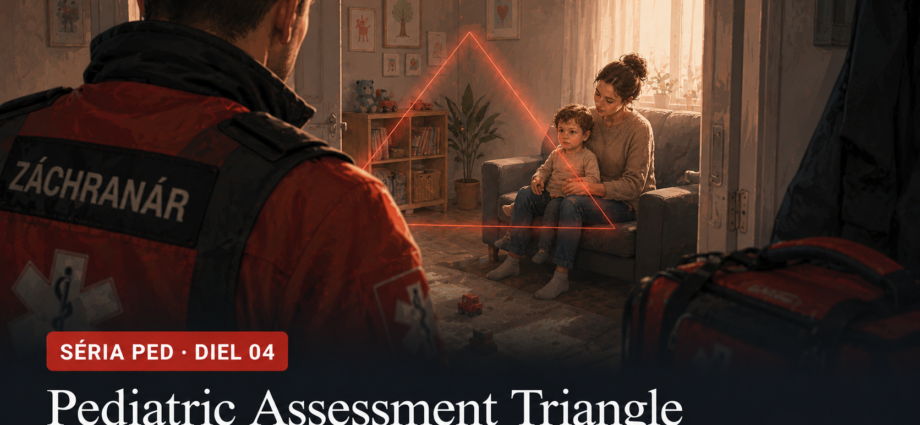
Pediatric Assessment Triangle (PAT)
Assessing the child before you ever touch them — ten seconds that determine the direction of the whole call
Before a paramedic ever lays a hand on a child, measures saturation, or hooks up a monitor, they can already — if they know what to look for — gather fundamental clinical information purely through sight and hearing. The Pediatric Assessment Triangle (PAT) exists precisely for this: a standardized, few-seconds-long initial-assessment tool developed by consensus of the Emergency Nurses Association, the American Academy of Pediatrics, and other professional organizations. It builds directly on the anatomical-physiological foundations from the previous installments of the PED series — and is the first step of every contact with a pediatric patient.
Three points of the triangle
PAT assesses three areas simultaneously: Appearance, Work of Breathing, and Circulation to Skin. Each reflects a different physiological system — but together they provide a surprisingly accurate picture of the severity of the condition before any measurement at all.
1. Appearance — the TICLS mnemonic
Appearance reflects primarily the function of the central nervous system, oxygenation, and brain perfusion. It’s assessed through five elements that can be remembered with the acronym TICLS:
| Element | What to observe |
|---|---|
| Tone | Is the child limp like a rag doll, or moving appropriately for their age? |
| Interactiveness | Does the child respond to surroundings, track with their eyes, show interest in objects/people? |
| Consolability | If crying, can the child be soothed by a parent or familiar person? |
| Look/Gaze | Does the child make eye contact, or stare blankly into the distance? |
| Speech/Cry | Is the voice/cry strong and age-appropriate, or weak, hoarse, quiet? |
2. Work of breathing
This point assesses how much effort the child is expending on breathing — not the rate itself. What’s observed: abnormal sounds (snoring, wheezing, a barking cough, grunting in infants), abnormal position or posture, retractions, nasal flaring, and in infants also head bobbing synchronous with breathing.
3. Circulation to skin
The third point reflects the state of central circulation and perfusion. Skin color and temperature are assessed — pallor, mottling, cyanosis, or petechiae. This finding connects directly to the shock compensatory mechanisms described in PED-03: peripheral vasoconstriction manifests outwardly through a change in skin color and temperature before blood pressure changes.
Practical implications for the paramedic
- Perform PAT before touching or disturbing the child — touch and manipulation change their behavior and invalidate the observation.
- If anything in the triangle is abnormal, move immediately to hands-on ABCDE assessment and intervention — PAT is an urgency trigger, not a final diagnosis.
- In children with chronic illness (e.g., cerebral palsy, severe autism), “normal” appearance can differ from the general population — always verify baseline status with the parent/legal guardian.
- In poor lighting or a chaotic environment (e.g., an apartment full of people), a subtle increase in work of breathing can easily be missed — deliberately make time to focus on it.
Connection to the next part of the series
PAT gives the first, rapid overall picture. In PED-05, we’ll follow up with the hands-on physical examination of the child — a systematic approach that differs by age and follows immediately once PAT signals the need for closer assessment.
- Dieckmann RA, Brownstein D, Gausche-Hill M. The Pediatric Assessment Triangle: A Novel Approach for the Rapid Evaluation of Children. Pediatric Emergency Care. 2010.
- American Heart Association. Pediatric Advanced Life Support (PALS) Provider Manual.
- Van de Voorde P, Turner NM, Djakow J, et al. European Resuscitation Council Guidelines 2021: Paediatric Life Support. Resuscitation. 2021.