Source analyzed: BARBUĽÁKOVÁ, Rebeka. Ebriety and Its Management Options for a Basic-Level EMS Crew [Bachelor’s thesis]. University of Prešov. Faculty of Health Care. Department of Emergency Health Care. Supervisor: Ing. Bc. Michal Hudák. Prešov: FZO PU, 2025. 62 pp.
A night shift in the city has its own particular rhythm. The ambulance’s blue lights illuminate a figure lying on the ground outside a bar, while passersby just wave a hand — “eh, it’s just another drunk.” To a layperson, it’s a banal scene. To a basic-level EMS (RZP) crew, it’s the start of a medical, legal, and safety puzzle.
A state of intoxication, clinically called ebriety, isn’t just a matter of social fatigue in the context of emergency services. It’s a state that masks death, provokes aggression, and paralyzes a system that’s supposed to be on standby for heart attacks or serious accidents. So why is an intoxicated patient far more dangerous to the emergency system than the general public realizes?
Fact #1: A Slovak record we’re definitely not proud of
Slovakia faces a worrying trend in alcohol consumption that makes us the region’s “leapers.” While in 2019 the average consumption per capita over age 15 was 10.5 liters of pure alcohol, World Health Organization (WHO) forecasts for 2025 predict a rise to 11.3 liters.
This increase of 0.8 liters is the most dramatic compared to all our neighbors. While Poland expects a milder rise (+0.2 l) and Ukraine +0.3 l, consumption in neighboring Hungary is actually declining. Although countries like Czechia (13.4 l) or Austria (12.2 l) have higher overall consumption, the growth dynamic in Slovakia is alarming. For emergency services, this means one thing: a rising systemic burden from a substance society legalizes and downplays — yet whose consequences on the front line are drastic.
Fact #2: When intoxication masks death and the paramedic’s hands are tied
Diagnosing a patient under the influence of alcohol is a paramedic’s “nightmare.” The symptoms of ebriety almost identically overlap with hypoglycemia (low blood sugar), which can have fatal consequences for the patient.
Ethanol acts in the body as a metabolic saboteur. It suppresses gluconeogenesis (sugar production) in the liver, and experts are also concerned about another clinical detail: alcohol reduces growth hormone secretion, further complicating the body’s ability to recover from a critical drop in blood glucose. Paramedics are additionally often “handicapped” in treatment. Many standard medications, such as diazepam or tramadol, are strictly contraindicated in acute alcohol intoxication due to the risk of dangerous interactions and respiratory depression.
“Alcohol toxicity is highly variable depending on age (children are significantly more sensitive), tolerance, health status (hypoglycemia, hypothermia, aspiration), and acute supportive treatment.” (Toxicology Information Center 2024)
Fact #3: The anatomy of a “drunk” fall: 39% more head injuries
Alcohol drastically affects the cerebellum, causing ataxia — loss of coordination. When a sober person falls, their protective reflexes soften the impact. Under the influence of alcohol, however, these mechanisms are disabled.
Clinical studies (e.g., Johnston 2004) bring a shocking finding: in falls from standing height, people under the influence of alcohol suffer 39% more craniocerebral injuries (head injuries) than sober individuals. A brain “intoxicated” by ethanol can’t correct movement in time, so even a trivial stumble on the sidewalk often ends in intracranial hemorrhage — which can be overlooked for hours under the mask of intoxication.
Fact #4: The “sobering station” crisis: 15,000 cases absorbed by hospitals
The systemic problem with ebriety in Slovakia isn’t just medical — it’s also logistical. We’re witnessing the complete disappearance of anti-alcohol sobering stations, which has created a huge gap in the system.
Historical development of the sobering-station network in Slovakia:
- 1988: 14 stations / 105 beds
- 1992: 32 stations / 270 beds — a record 15,798 admissions were processed that year.
- 2005: 1 station / 5 beds
- 2015 – 2024: 0 stations / 0 beds
Those nearly 16,000 people a year haven’t disappeared from the system. They’ve simply shifted from specialized sobering stations to hospital emergency departments. RZP crews today are forced to direct aggressive or deeply sleeping patients to hospitals that are neither staffed nor spatially equipped for this, overburdening the care of patients in genuinely critical condition.
Fact #5: The negative-reversal paradox and frontline aggression
Can a person who has trouble standing on their feet sign a legal refusal of treatment? This is the paramedic’s biggest ethical dilemma. Alcohol fundamentally impairs cognitive function and the ability to reason, which makes signing a negative reversal (refusal of care) legally questionable. The paramedic thus finds themselves on “thin legal ice” (Vondráček) — if they leave the patient at the scene, they risk being accused of neglect; if they take the patient against their will, they face accusations of unlawfully restricting personal liberty.
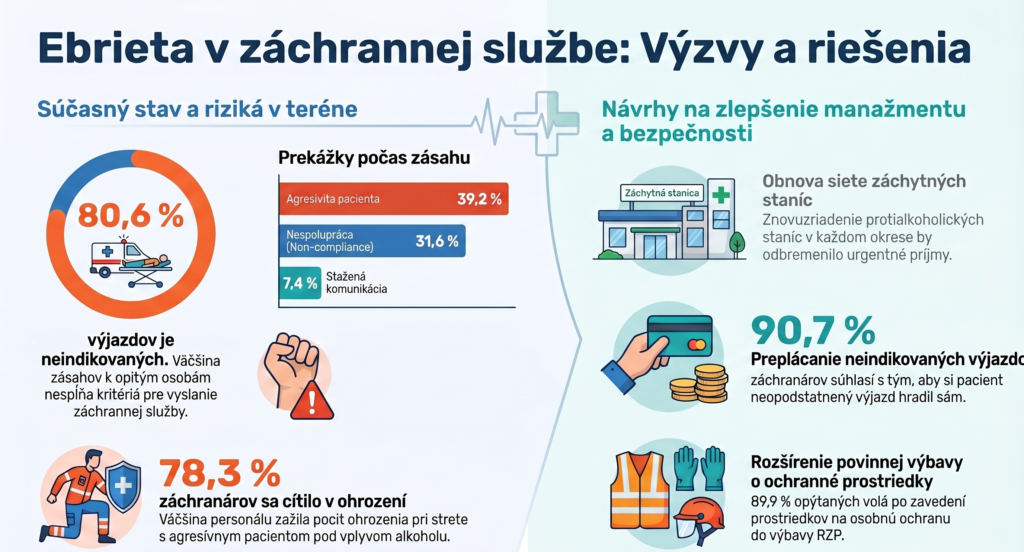
This pressure is compounded by rising aggression. A large Australian study (Victoria) analyzed more than 11,000 dangerous encounters between paramedics and patients and confirmed that alcohol was the number-one cause of aggression. Our paramedics thus face verbal and physical attacks daily from patients who, in an ideal system, should never end up in the hands of medical crews at all.
“It is a manifestation of will directed at extinguishing a healthcare professional’s right to perform one or more successive healthcare interventions of a diagnostic or therapeutic nature on the patient.” (Moravanský 2014)
A future in the fog
Ebriety isn’t just a diagnosis on a patient’s chart — it’s a mirror of a failing system. Rising alcohol consumption in Slovakia, combined with the total disappearance of sobering stations, creates unsustainable pressure on paramedics. They’re now forced to substitute for the social system, face masked diagnoses, and — not least — direct aggression.
Are we, as a society, prepared to bear the cost of ignoring the issue of ebriety, while our paramedics face growing aggression on the front line?
Ebriety and Its Management Options for an RZP Crew: A Comprehensive Briefing
This document presents a synthesis of knowledge on the issue of persons under the influence of alcohol within prehospital emergency medical care (PNZS). The analysis draws on data about alcohol consumption in Slovakia, the clinical aspects of ethanol intoxication, and the practical experience of paramedics.
Executive summary
The issue of ebriety represents a multifactorial challenge for the emergency medical service (EMS), combining medical risks with safety and systemic shortcomings. Slovakia shows a rising trend in average alcohol consumption (a projected 11.3 liters per capita in 2025), which is directly reflected in the frequency of calls to intoxicated persons. Key complications include difficult diagnosis of associated conditions (hypoglycemia, craniocerebral injuries), a high rate of aggression toward staff, and legal uncertainty around signing negative reversals. A critical point in the system is the complete disappearance of anti-alcohol sobering stations in 2005, which leads to non-indicated patients being directed to emergency departments and burdens RZP crews.
Clinical picture and pharmacokinetics of ethanol
The effects of alcohol on the body are highly variable and depend on the individual’s age, sex, tolerance, and health status.
Phases of alcohol’s effect by blood concentration
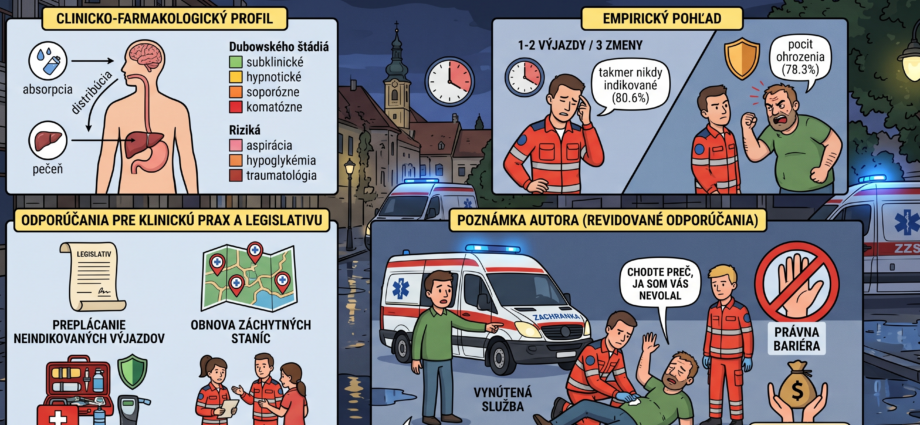
The clinical course of ebriety is divided into six stages according to Dobowski’s table:
| Alcohol concentration (g/100ml) | Stage of influence | Characteristic signs |
|---|---|---|
| 0.01 – 0.05 | Subclinical | Behavior without marked changes, mild euphoria. |
| 0.03 – 0.12 | Euphoric | Sociability, talkativeness, reduced sober judgment and attention. |
| 0.09 – 0.25 | Excitement | Emotional instability, loss of critical judgment, vomiting, ataxia. |
| 0.18 – 0.30 | Confusion (hypnotic) | Disorientation, diplopia (double vision), progressive lethargy. |
| 0.25 – 0.40 | Stupor | Loss of motor function, incontinence, markedly reduced response to stimuli. |
| 0.35 – 0.50 | Coma | Coma, absent reflexes, risk of respiratory and circulatory failure. |
| Median 0.36 | Death | Death due to failure of vital functions. |
Mechanism of action in the body
- Absorption: Begins in the oral cavity, continues in the stomach (slower, partial breakdown by the enzyme alcohol dehydrogenase), and proceeds fastest in the small intestine.
- Distribution: Ethanol is a hydrophilic substance. It concentrates in the bloodstream and muscles; less in fat. The highest concentration is in richly perfused organs (liver, brain, kidneys, lungs).
- Metabolism: Takes place primarily in the liver (oxidation to acetaldehyde and subsequently to acetate). The end products are CO2 and water. A minimal percentage is excreted unchanged (breath, urine, sweat).
Specific risks and complications in patient management
Ebriety often masks other serious conditions, which requires rigorous differential diagnosis.
- Hypoglycemia: Alcohol inhibits gluconeogenesis in the liver. In diabetics, the risk of a fatal drop in blood glucose is high, and the signs of hypoglycemia are easily mistaken for intoxication.
- Hypothermia: Cooling (a drop in core temperature below 35 °C) is common in people with alcohol dependence and homeless people exposed to the outdoor environment.
- Injuries and falls: People under the influence of alcohol have a 39% higher incidence of head injuries from falls from standing height. Ataxia (impaired coordination) caused by ethanol’s effect on the cerebellum increases injury risk.
- Traffic accidents: Despite a declining overall number of fatal accidents in Slovakia, the proportion of accidents caused by alcohol has remained nearly unchanged over the last decade (37 in 2011 vs. 35 in 2021).
- Aggression: Alcohol reduces the ability to process positive aspects of communication and increases impulsivity. Studies confirm that alcohol is the most common factor in aggression toward EMS staff.
- Dual diagnosis: Alcoholism frequently overlaps with other mental disorders (depression, schizophrenia, bipolar disorder). In 2023, alcoholism was the primary reason for psychiatric hospitalizations in Slovakia.
Prehospital care procedures
Managing an intoxicated patient focuses on maintaining vital functions and preventing complications.
- History-taking: Difficult due to the patient’s condition. Establishment staff (amount of alcohol consumed, time sequence) provide more reliable information than close relatives.
- Therapeutic interventions:
- Vital-sign checks every 5 minutes with pathological values.
- Emetic reflex: Indicated only with preserved consciousness within 30 minutes of ingestion, with emphasis on a position preventing aspiration.
- Hydration: Administration of 500–1000 ml of normal saline IV to compensate for alcohol’s dilutional effect and reduce its blood concentration.
- Glucose: 5% glucose IV can speed up alcohol metabolism by 25%, if not contraindicated.
- Contraindications: In acute intoxication, medications such as diazepam and tramadol are prohibited in the RZP kit due to dangerous interactions.
Legal aspects of the negative reversal
Signing a negative reversal (refusal of care) is legally problematic in persons with a high degree of intoxication. Alcohol affects cognitive function and decision-making, so a person with a visible objective finding and impaired judgment shouldn’t be allowed to sign a reversal. The final decision and responsibility rest with the healthcare professional.
Systemic challenges and a survey of paramedics
The document reflects the results of a survey with 258 respondents (72.9% with up to 10 years of experience).
- Location of calls: 77.5% of paramedics work in an urban environment, where the concentration of intoxicated persons is highest.
- Disappearance of sobering stations: Since 2005 (when the last station closed), there has been no systemic solution in Slovakia for persons who need only supervision, not acute hospital care. In 1992, 32 stations with 270 beds were operating.
- Need for restoration: Discussion continues among professionals about the need to restore anti-alcohol sobering stations, which would relieve emergency departments and EMS crews of non-indicated calls to persons in a state of simple ebriety.
This document serves as a basis for further discussion on optimizing the management of intoxicated patients and the safety of RZP crews.