Introduction: Crossing the Competency Threshold in Slovak EMS
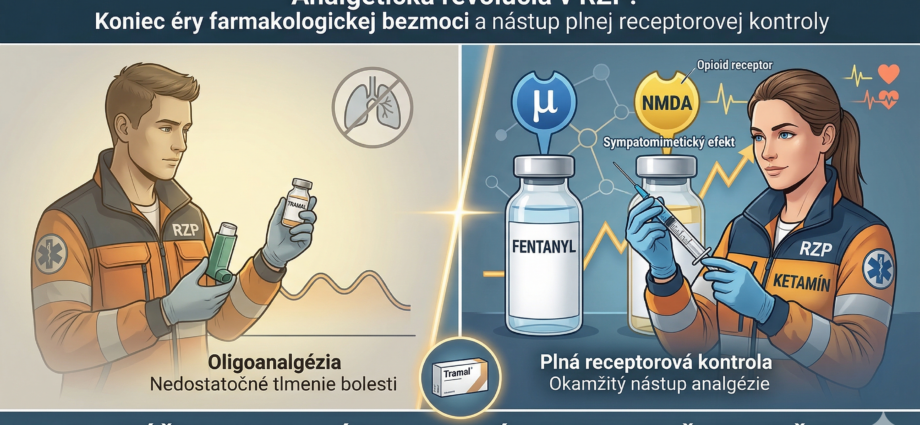
For many years, the paramedic on a basic-level (RZP) EMS crew in Slovakia was in an unenviable position. When managing devastating injuries, amputations, or crush fractures of the pelvis, they had only partial solutions available — the weak opioid tramadol or inhaled methoxyflurane. In situations where the patient progressed into decompensated shock, this equipment was clinically insufficient, and the paramedic became a passive witness to the body’s deepening traumatic response.
The current implementation of fentanyl and ketamine into the basic-level paramedic’s competency framework (in accordance with Decree of the Slovak Ministry of Health No. 321/2005 Coll.) definitively changes the rules of the game. This is no longer just symptomatic pain relief, but targeted neuromodulation and hemodynamic stabilization at the most critical phase of prehospital care. However, this shift requires deep understanding of pharmacodynamics, because an incorrect choice in the field can lead to fatal failure of vital-function management in an environment where the paramedic is often alone with the intervention.
Pathophysiological Limits of Tramadol and Methoxyflurane
Previous practice on physician-less crews relied on tramadol, which as a partial agonist requires complex hepatic biotransformation into its active metabolite O-desmethyltramadol. In emergency medicine, its time to peak effect when given intravenously is 15 to 30 minutes — an unacceptably long interval within trauma’s “golden hour.” Additionally, its significant emetogenic potential directly endangers the patient with aspiration risk in the forced position on a transport stretcher.
Methoxyflurane offers a faster onset, but its effectiveness is strictly limited by the patient’s consciousness and full cooperation, which quickly disappears as shock develops and circulation centralizes. The shift to potent selective agonists and dissociative anesthetics gives the paramedic the ability to titrate immediately, with the body’s clinical response observable in near real time — enabling precise dosing based on the patient’s actual need rather than a rough tabular estimate.
Pharmacodynamic Analysis: What Happens After Pressing the Syringe Plunger?
Before administration, the paramedic must understand that fentanyl and ketamine aren’t just “stronger drugs,” but substances that aggressively reconfigure the patient’s physiological balance. Their safe implementation rests on the ability to anticipate three fundamental processes:
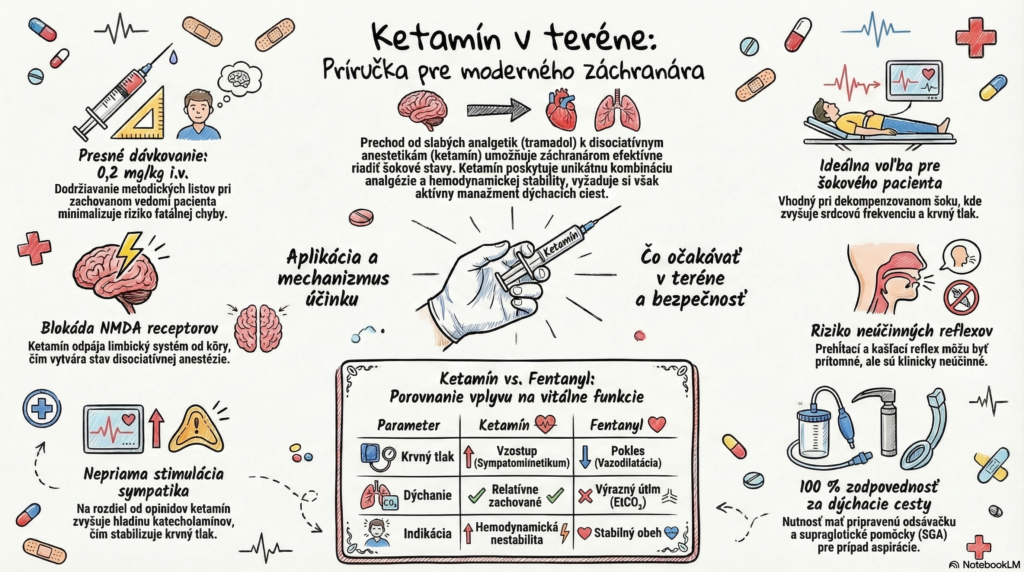
1. Selective receptor affinity and respiratory center depression Fentanyl is a pure mu-opioid agonist. Its molecules immediately occupy receptors in the medulla oblongata that control the automaticity of breathing. Unlike tramadol, fentanyl dramatically reduces the respiratory center’s sensitivity to carbon dioxide (CO2). The paramedic must not wait for visual signs of hypoxia; they must monitor the capnometric waveform (EtCO2). If the waveform disappears or flattens, iatrogenic apnea is a reality, and the paramedic must immediately move to assisted ventilation.
2. Sympathomimetic effect versus vascular tone collapse This is the most critical decision point with a shock patient. Fentanyl suppresses the sympathetic system, leading to vasodilation and a risk of falling blood pressure. If given to a hypovolemic patient, it can eliminate their last compensatory mechanisms. Ketamine works oppositely — by blocking NMDA receptors and indirectly stimulating the sympathetic system, it raises circulating catecholamine levels. The result is a rise in heart rate and blood pressure, making ketamine an ideal tool in hemodynamic instability.
3. Dissociation of consciousness and loss of protective reflexes Ketamine induces dissociative anesthesia — it disconnects the limbic system from the cerebral cortex. Although the swallowing and coughing reflexes may mechanically still be present, they’re clinically ineffective. The paramedic must expect that after administering these substances, they take on 100% responsibility for airway patency and protection against aspiration, requiring permanent readiness with suction and preparedness to insert a supraglottic airway device (SGA).
Professional Analysis: Systemic Benefit and Paramedic Readiness
Introducing these medications into RZP practice is a fundamental test of the profession’s maturity. Analysis of real-world practice shows that success depends on the shift from mechanically executing orders to analytical clinical reasoning.
- Clinical benefit: Eliminating oligoanalgesia leads to hemodynamic stabilization, reduced stress-hormone secretion, and better patient cooperation.
- Educational demands: Mastering these substances requires automated schemes (e.g., fentanyl 1 microgram/kg or ketamine 0.2 mg/kg with preserved consciousness). As soon as a paramedic starts improvising outside the methodological protocols, the risk of a fatal error rises.
- Systemic safety: Expanded competencies relieve advanced-level (RLP) crews, while the RZP paramedic now has sufficient pharmacological power to independently stabilize the patient during transport.
Conclusion: Expertise as Insurance Against Malpractice
A paramedic in Slovakia is no longer just a patient transporter. With new competencies, they become a clinical pharmacologist right at the scene of the incident. Expanding competencies to include fentanyl and ketamine administration is a test of our professional expertise. The ability to assess hemodynamic status within seconds and choose the correct receptor pathway is what defines a modern professional in emergency medicine today. We’re equipped with tools that genuinely save lives — but their safety and effectiveness depend entirely on our ability to precisely anticipate their physiological effects on the body of a critically ill patient.
Sources and legislative basis:
- Decree of the Slovak Ministry of Health No. 321/2005 Coll. on the scope of practice in individual healthcare professions.
- Methodological guidance of the Slovak EMS Operations Center No. 1/2024 on medication protocols in prehospital care.
- Katzung, B. G. & Trevor, A. J. (2021): Basic & Clinical Pharmacology (15th edition).
- Lüllmann, H.: Pharmacology and Toxicology — mechanisms of action of opioids and general anesthetics.
- ERC Guidelines 2025: Trauma and prehospital analgesia section.
- Slovak Act No. 576/2004 Coll. on Healthcare and Related Services.