A night shift in the third quarter of the year has its own particular rhythm. When the tone of an emergency call sounds at three in the morning for “a feeling of general weakness and mild stomach pressure” in a 72-year-old patient, an experienced paramedic’s subconscious sometimes switches into routine mode. Yet it’s exactly this mindset that opens the door to one of the most dangerous cognitive traps in emergency medicine — premature closure of the diagnosis. We arrive at the apartment of Mr. Ján, a longtime diabetic on insulin, who’s sitting in an armchair, mildly pale, and complains that “dinner didn’t agree with him.” His vital signs don’t raise alarm at first glance: blood pressure 135/85 mmHg, heart rate 88 beats per minute in sinus rhythm, and saturation 94% on room air. A glucose level of 14.2 mmol/l is his usual baseline.
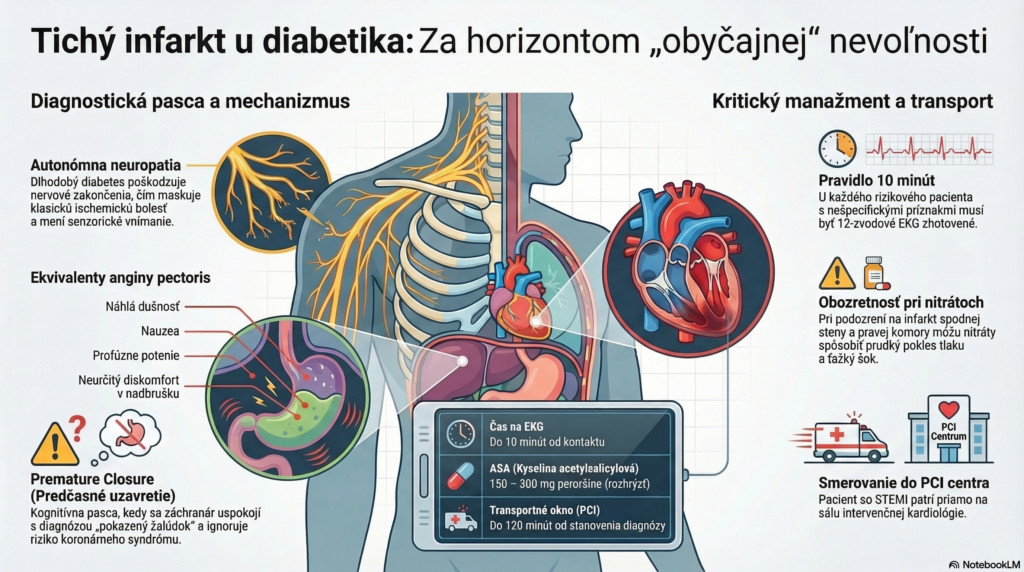
Yet the clinical picture of a diabetic is a notorious minefield in emergency cardiology. A patient with long-standing type 2 diabetes mellitus develops progressive autonomic neuropathy, which alters the sensory perception of visceral pain. The classic crushing retrosternal pressure radiating to the left arm is here often replaced by so-called anginal equivalents. These include sudden-onset dyspnea, nausea, profuse sweating, or just a vague discomfort in the epigastrium. Mr. Ján isn’t lying when he says his chest “barely hurts.” His nerve endings simply can’t transmit the warning signal of ischemia at full intensity. If the paramedic yields to confirmation bias at this point and settles for the working diagnosis of “gastric complaints from hyperglycemia,” they risk a fatal failure in managing acute coronary syndrome.
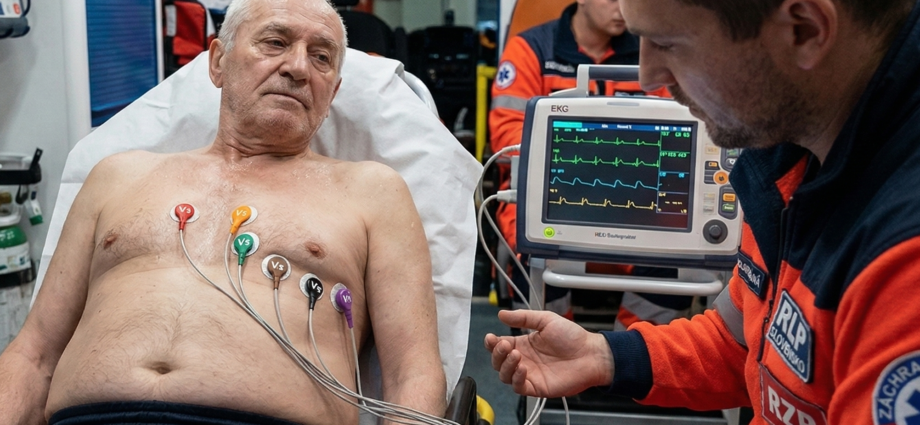
The decisive step in the field isn’t just history-taking, but an early and technically correctly performed 12-lead ECG, which must be obtained within 10 minutes of first contact in every at-risk patient with nonspecific symptoms. In Mr. Ján’s case, we find discrete but significant ST elevations in leads II, III, and aVF, which, combined with reciprocal depression in I and aVL, confirms a diagnosis of inferior STEMI. This is precisely where routine work parts ways with critical clinical thinking. The paramedic must reassess the whole situation in a split second. Although the patient appears stable and communicates calmly, his myocardium is undergoing irreversible necrosis. Time is myocardium, and every delay at the address worsens the prognosis for survival and the quality of the patient’s future life.
Practical management by the advanced- or basic-level EMS crew must strictly follow the current professional guidelines of the Slovak Ministry of Health and the recommendations of the European Society of Cardiology (ESC). The foundation is securing venous access and immediate pharmacotherapy. We administer 150 to 300 mg of acetylsalicylic acid (ASA) orally, chewed, if not contraindicated, and consider giving a second antiplatelet agent, such as ticagrelor, after consulting the interventional center. In an inferior infarction, we must be extremely cautious with nitrates. If there’s suspicion of right ventricular involvement (requiring the addition of right-sided leads V3R and V4R), giving nitroglycerin can lead to a sharp drop in preload and subsequent severe shock. Opioid analgesia should be titrated to suppress not only pain but also sympathetic activation, which unnecessarily increases myocardial oxygen consumption.
A critical decision within the Slovak EMS system is transport destination. A STEMI patient doesn’t belong at the nearest emergency department, but directly in the interventional cardiology suite (PCI center), if available within a time window of up to 120 minutes from diagnosis. Communication with the cardiac center must be clear, concise, and based on transmitting the ECG recording via telemetry. Continuous ECG monitoring during transport is essential, because inferior infarctions in particular carry a known high risk of bradyarrhythmias or higher-degree AV block. In this scenario, the paramedic isn’t just a “transporter,” but an active guarantor of the patient’s stability, who must anticipate complications before they show up on the monitor.
The takeaway lesson from this case for everyday practice is important: a silent infarction in a diabetic isn’t a rarity — it’s a statistical probability. We must never let the absence of typical pain dull our clinical vigilance. A paramedic’s professional growth rests on the ability to question their own first impressions and seek objective evidence even where the patient’s subjective state is misleading. Only this way can we minimize diagnostic errors and give the patient a chance at successful revascularization and a return to ordinary life.
Sources:
- Standard Diagnostic and Therapeutic Procedure: Acute ST-Elevation Coronary Syndrome (STEMI), Slovak Ministry of Health.
- Byrne RA, et al. 2023 ESC Guidelines for the management of acute coronary syndromes. European Heart Journal.
- Slovak Society of Cardiology (SKS): Recommendations for the diagnosis and treatment of acute myocardial infarction.