In the current architecture of prehospital emergency medical care in Slovakia, the EMS Operations Center (OS ZZS) represents a key management element — one that, however, increasingly shows signs of systemic rigidity and inefficiency. This article analyzes how operational management affects the clinical practice of field crews, where administrative pressure collides with the requirement to provide healthcare lege artis.
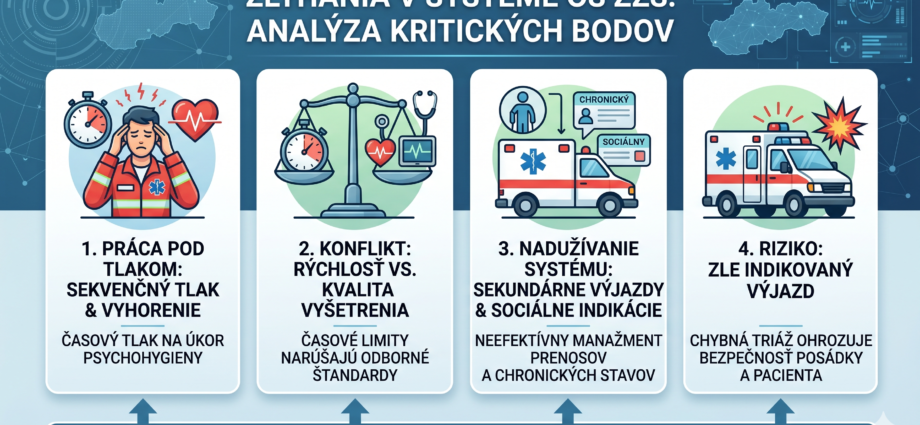
1. Working Under Systemic Pressure: Operational Management as a Determinant of Clinical Performance
The EMS Operations Center isn’t just a communications hub — it’s a governing body that directly affects a paramedic’s cognitive load. Under Slovak Act No. 579/2004 Coll. on Emergency Medical Services, the Operations Center is obligated to ensure the continuity and coherence of prehospital emergency care. In practice, however, we run into the phenomenon of “sequential pressure,” where a crew is forced into rapid re-availability without adequate time for psychological decompression or technical preparation after a demanding call.
This pressure erodes patient safety. When the system prioritizes quantitative indicators over qualitative analysis of availability, professional standards erode.
Source: Slovak Act No. 579/2004 Coll. (§ 3(3) on the management and coordination of emergency medical services).
2. Pressure for Speed vs. Examination Quality: KPI Conflict with Professional Standards
The system is currently evaluated primarily through response times and on-scene time. This approach directly conflicts with the Slovak Ministry of Health’s Professional Guidance on Prehospital Emergency Medical Care, which requires comprehensive differential diagnosis and patient stabilization.
- Conflict analysis: If operational management pressures crews to conclude a call for patients with unclear symptomatology (e.g., atypical chest pain with a negative ECG), the risk of underestimating a developing condition rises.
- Consequence: Shortening the time for physical examination and history-taking at the expense of the “cleanliness” of the Operations Center’s statistical data.
Source: Professional Guidance of the Slovak Ministry of Health No. 05354/2005-OO on the concept of the emergency medicine specialty.
3. Secondary Calls and Inefficient Resource Management
The issue of secondary transports (interhospital transfer) and system misuse (so-called “social indications”) represents a critical resource drain. The Operations Center often abandons strict triage per the Slovak Decision Algorithm for Emergency Calls.
- Systemic error: Shifting responsibility from primary care (general practitioners / out-of-hours primary care) onto EMS. Calls to chronic conditions without acute alteration of vital functions conflict with the purpose of EMS under Slovak Act No. 578/2004 Coll.
- Impact: At the moment a critical condition occurs (e.g., sudden cardiac arrest), the nearest crew is tied up on a secondary, medically non-indicated call, prolonging the time to definitive therapy.
Source: Slovak Act No. 578/2004 Coll. on Healthcare Providers.
4. Poorly Indicated Calls: Triage Failure and Safety Risks
Incorrect categorization of emergency calls (under-triage vs. over-triage) directly endangers the safety of both crew and patient.
- Under-triage: Dispatching a basic-level (RZP) crew to a condition requiring a physician intervention (RLP) without adequate information delays specific treatment (e.g., thrombolysis, analgesia in polytrauma).
- Over-triage under signal: Unnecessary driving in priority-driving mode increases traffic accident risk.
Under the Slovak Ministry of Health’s Professional Guidance for Operations Center Activity, the operator is responsible for correctly processing information. Insufficient emphasis on “dispatch-assisted CPR” or incorrect localization are viewed by the professional community as systemic failures that demean field work.
Source: Professional Guidance of the Slovak Ministry of Health No. 14214-1/2006-OO on processing emergency calls.
Professional Conclusion and Recommendations for Practice
The current state of the relationship between the Operations Center and field crews requires a radical paradigm shift. Proposed measures:
- Revising triage algorithms: Strengthening operators’ authority to decline dispatch for non-indicated conditions in accordance with legislation.
- Qualitative audit: Shifting from tracking response times to tracking clinical outcomes and adherence to diagnostic-therapeutic protocols.
- Mandatory feedback: Implementing a closed information loop between the hospital, the field crew, and the Operations Center for continuing education and eliminating errors in the decision-making process.
Without systemic support and protection of the paramedic from inadequate pressure by operational management, prehospital emergency medical care in Slovakia remains captive to statistical formalism at the expense of medical excellence.