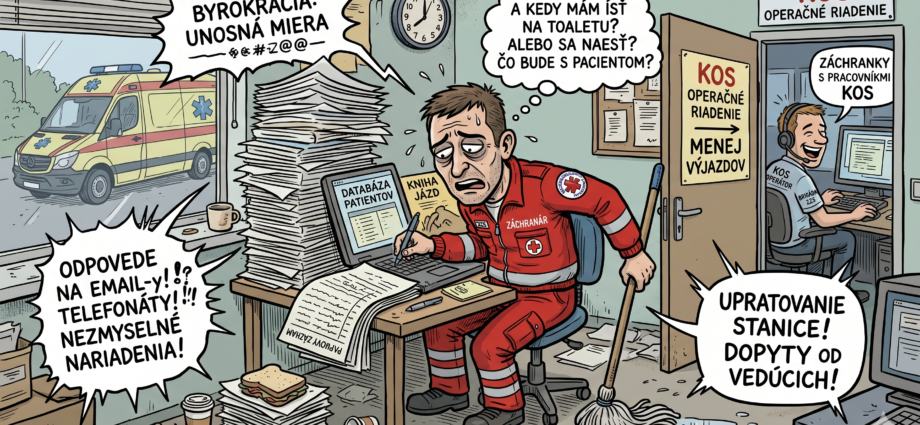
I’m standing at the end of a twelve-hour shift, running through the balance sheet of the day in my head. Eight calls. The clean time in the field, in direct contact with patients, maneuvering the ambulance through heavy traffic, and attempting professional diagnostics, took up more than ten hours. Add the administrative merry-go-round, where I have to log every single action into a paper record, then transcribe it into a digital database, fill out the patient log, and, as the driver, also the trip log, and I’m pushing fourteen hours of actual work. The math doesn’t lie. I’m in a deep time deficit. For food, hygiene, or just an ordinary breath between two adrenaline-fueled situations, I have exactly zero minutes left. This isn’t an exceptional state — this is the everyday reality of a professional paramedic in 2026.
What frustrates me most, though, is the feeling that this exhaustion isn’t shared fairly. There’s a public secret in our field about how the regional Operations Centers function. A system that should be built on mathematical precision and geographic availability often runs into the human factor and conflicts of interest in practice. It’s unacceptable that within one region, one crew doesn’t know which way to run first, while another crew is “parked,” because a colleague from the operations center is on duty there — having just slipped away for a side gig on a field crew. This favoritism isn’t just unfair to overworked colleagues — it’s a direct gamble with a patient’s life. Every minute lost because a farther crew was dispatched to an urgent condition just because the closer one was being “spared” can turn out to be fatal.
Added to this logistical chaos is a total erosion of the triage process. It’s as if professional history-taking has vanished from the 155 emergency line. The overwhelming majority of calls we’re dispatched to carry completely different information than what we find at the address. The operator, instead of using their professional training to filter out banal conditions that belong at a doctor’s office, takes the alibi route and sends an ambulance to every call where someone “wants to ask something.” We then end up substituting for an advice line and social services in the field, while somewhere else someone might genuinely be fighting for breath. This informational blindness at the operations center robs us of precious time and mental energy that we should be devoting to critical patients.
The height of it all is the medieval level of administration and operational duties. In an age of digital transformation, we’re forced to function like scribes in a monastery. We write the same data in three different places, deal with endless emails and inquiries from supervisors that often lack logic and just needlessly fragment our attention. And when we finally get back to the station, what awaits us isn’t recovery, but a mop and cleaning supplies. Requiring a university-educated healthcare specialist, after an extremely demanding shift, to substitute for the cleaning crew and handle building maintenance is a degradation of our profession.
This situation creates dangerous pressure on mental health and safety. An overworked paramedic in a state of cognitive saturation makes mistakes. Fatigue from sleep deprivation and constant running without a break is equivalent to a certain blood alcohol level — and we’re supposed to be making life-and-death decisions in this state. The system consciously pushes us into violating both the Labor Code and safety protocols. If nothing changes, if real automation without duplication isn’t introduced, if the unhealthy ties at operations centers aren’t cut, and if the paramedic isn’t relieved of manual work unrelated to medicine, the staffing crisis will consume us for good. The state is currently borrowing paramedics’ health and time against a debt it will never be able to repay. And sooner or later, that debt will show up exactly where it hurts most — at the bedside of a patient no one will be left to come help.