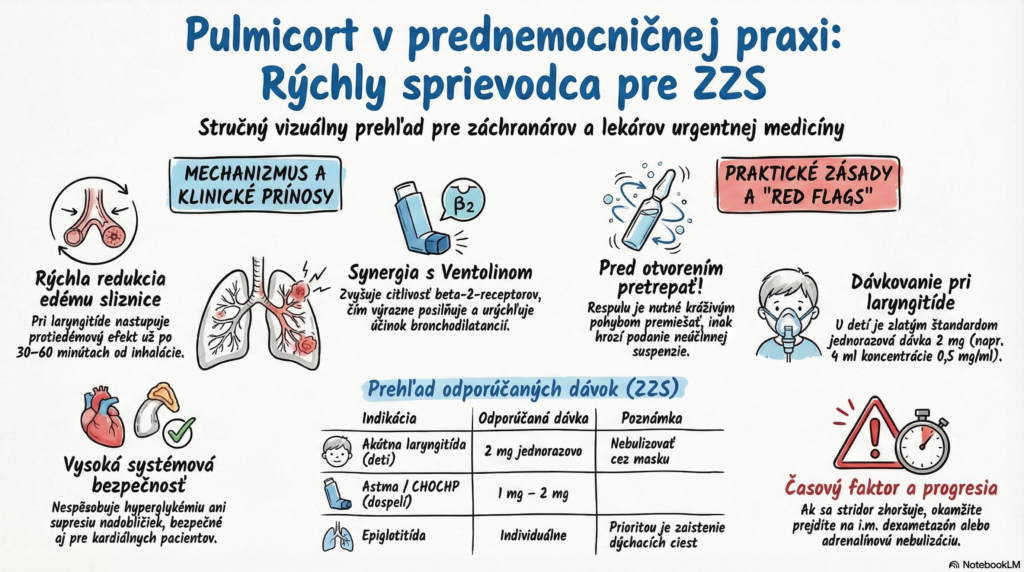
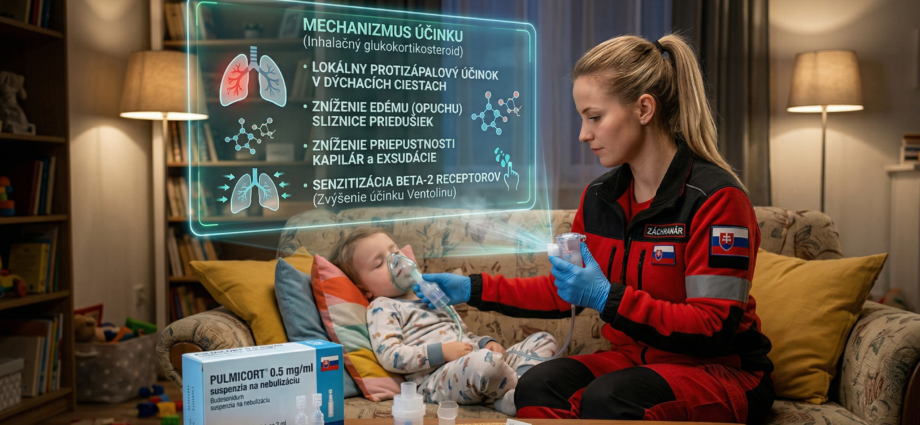
Introduction Pulmicort (budesonide) is a potent non-halogenated glucocorticosteroid with strong local anti-inflammatory action. In EMS it’s used as a nebulizer suspension. Its main benefit is reducing bronchial mucosal edema, suppressing exudation, and providing long-term airway stabilization in acute exacerbations and laryngitis.
1. Drug Identification
- Active substance: Budesonidum.
- Trade name in Slovakia: Pulmicort (nebulizer suspension).
- ATC classification: R03BA02 (Glucocorticoids).
- Dosage form in EMS: Plastic ampules (respules), 2 ml volume (concentration 0.25 mg/ml or 0.5 mg/ml).
- Pharmacological group: Inhaled corticosteroid (ICS).
2. Mechanism of Action (Pharmacodynamics) Budesonide works by affecting gene expression in airway cells:
- Anti-inflammatory effect: Reduces release of inflammatory mediators (cytokines, leukotrienes) from macrophages and T-lymphocytes.
- Mucosal vasoconstriction: Reduces capillary permeability, directly reducing mucosal edema (swelling).
- Receptor sensitization: Increases the number and affinity of beta-2 receptors in bronchial smooth muscle, significantly strengthening Ventolin’s effect (synergy).
- Onset of local effect: In laryngitis, the anti-edema effect is observable as early as 30–60 minutes after inhalation.
3. Hemodynamic Effects – IN DETAIL Inhaled administration has minimal systemic impact:
- BP and HR: No direct effect on systemic hemodynamics.
- Metabolic effect: A single EMS dose causes no hyperglycemia or adrenal suppression (unlike IV hydrocortisone).
- Cardiovascular stability: A safe choice for cardiac patients with bronchospasm.
4. Pharmacokinetics (from a Paramedic’s Perspective)
- Route of administration: Inhaled (exclusively via nebulizer).
- Onset of action: Lung function improvement after 1–3 hours; peak anti-inflammatory effect after several days of regular use.
- Distribution: 25–30% of the nebulized dose reaches the lungs.
- Metabolism: Rapid hepatic inactivation (biotransformation to low-activity metabolites) for any portion of the dose that is swallowed.
5. Indications in Prehospital Practice
- Acute laryngitis (croup): The gold standard in children to relieve inspiratory stridor and barking cough.
- Bronchial asthma exacerbation: Given in combination with a SABA (Ventolin) to suppress both the early and late phases of inflammation.
- COPD exacerbation: Reducing local inflammation and mucus hypersecretion.
- Epiglottitis: (With caution; priority is securing the airway, and inhalation must not agitate the patient.)
6. Dosing in EMS
- Children (laryngitis): 2 mg as a single dose (e.g., 4 ml of 0.5 mg/ml suspension).
- Adults (asthma/COPD): 1 mg to 2 mg per nebulization.
- Technique: Nebulize mixed with Ventolin and normal saline (total nebulizer chamber volume 4–6 ml).
- Scope of practice: Both physician (RLP) and basic-crew paramedic (RZP) — Pulmicort is a standard part of Slovak EMS ambulance equipment.
7. Contraindications
- Absolute: Hypersensitivity to budesonide.
- Relative: Active pulmonary TB, untreated fungal or viral airway infections.
8. Adverse Effects
- Local: Throat irritation, coughing, hoarseness.
- Other: Oral candidiasis (thrush) with long-term use — irrelevant for a single EMS dose.
- Eyes: Risk of eye irritation with a poorly sealed nebulizer mask.
9. Drug Interactions in EMS
- Bronchodilators (Ventolin, Syntophyllin): Desired positive interaction (increased receptor sensitivity).
- Ketoconazole: Increases systemic exposure to budesonide (significant only with chronic therapy).
10. Specifics in Emergency Medicine
- Error #1: Not resuspending. Before opening the Pulmicort ampule, gently swirl it to redisperse the settled medication.
- Error #2: Waiting for a miracle. Pulmicort does not stop an acute spasm within seconds. It must always run simultaneously with Ventolin, which addresses the spasm immediately.
- Hygiene: After inhalation in hospital, it’s recommended to rinse the mouth with water and wash the face (preventing skin irritation under the mask).
11. Red Flags
- Progressive stridor: If laryngitis doesn’t improve after nebulization, the condition requires IM/IV dexamethasone or nebulized epinephrine.
- Paradoxical bronchospasm: Very rare worsening of dyspnea after inhalation (stop immediately).
12. Antidote
- None exists. Acute overdose is not a clinical problem.
13. Practical Field Scenario Situation: A 3-year-old child, sudden “barking” cough at night, inspiratory stridor at rest. Parents panicking. Status: Conscious, SpO2 94%, marked suprasternal retractions. Decision-making:
- Calm the child and parents.
- Pulmicort 2 mg (4 ml of 0.5 mg/ml) nebulized via mask.
- Provide cool, humid air (open window). Hemodynamic rationale: The inhaled steroid locally constricts vessels and reduces vocal cord swelling without systemic side effects, safer for a young child than IV administration.
14. Practical Summary – 5 Key Points
- The pediatric kit staple: Pulmicort is the #1 drug for pediatric croup.
- Shake before opening: Otherwise you’re just giving normal saline.
- Combine it: In asthma, always run Ventolin and Pulmicort in the same nebulizer.
- A safe steroid: Minimal systemic effect risk.
- Time factor: The effect builds gradually — don’t lose time on transport if the condition is severe.
Professional Sources and Literature:
- GINA 2024: Global recommendations for asthma management.
- SmPC (Summary of Product Characteristics) – Pulmicort nebulizer suspension.
- Pediatrics (Kovács, L. et al.): Protocols for treating croup.
- Dobiáš, V. et al.: Emergency Healthcare. Osveta, 2021.
- EMA Pharmacovigilance Review: Safety profile of inhaled steroids in children.