In emergency medicine, the biggest enemy is not a lack of equipment, but our own cognitive wiring. This article breaks down the mental processes behind both good and bad field decisions, focused on the reality of Slovak EMS crews.
1. INTRODUCTION – A REALISTIC SCENARIO
Dispatch: Basic ambulance, 03:20, female, 72 years old, “shortness of breath, worsening condition.” On scene: The patient is sitting on the edge of the bed, leaning on her arms (orthopneic position). Known to the crew as a cardiac patient with hypertension and a history of asthma. The crew transported her a month ago for a COPD exacerbation. Objective findings: Tachypnea 24/min, SpO2 90% on room air. Expiratory wheeze audible. The patient says: “It’s got me again, just give me the inhaler like last time, that’ll fix it.” Atmosphere: Crew fatigue at night, third call to this same patient in six months. The paramedic prepares a Ventolin nebulizer treatment.
2. CLINICAL ANALYSIS OF THE SITUATION (ABCDE)
Where does clinical reasoning break down in this scenario?
- A (Airway): Patent, but audible expiratory sounds.
- B (Breathing): Tachypnea and low saturation. Caution: wheezing does not automatically mean bronchospasm. It can be so-called “cardiac asthma” from left-sided heart failure.
- C (Circulation): BP 180/100, HR 110/min (regular). Skin is diaphoretic, cooler at the periphery. Red flag: A mismatch between the history of asthma and the presence of hypertension with peripheral vasoconstriction.
- D (Disability): GCS 15, but anxiety is present (often an underrated sign of hypoxia or impending pulmonary edema).
- E (Exposure): What did we miss? Jugular venous distension and lower-extremity edema, which were absent during the prior COPD exacerbation.
Most commonly underestimated: The trend of change. If the condition doesn’t improve after the first dose of bronchodilator, the working diagnosis must be reassessed immediately.
3. THE MOST COMMON ERRORS IN PRACTICE
A paramedic’s decision-making is shaped by these cognitive biases:
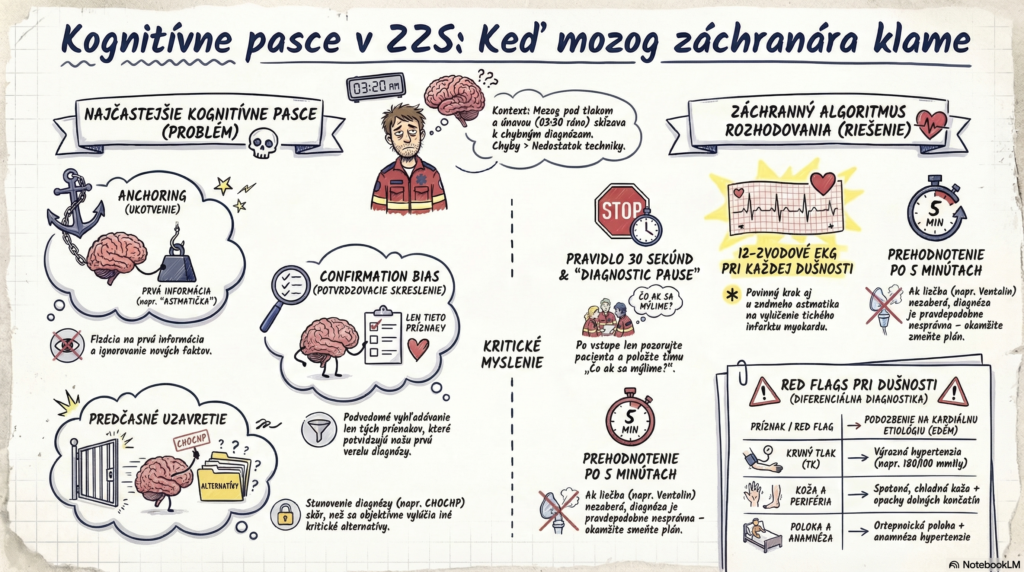
- Anchoring: Fixating on the first piece of information (“we’ve been here before for asthma”). The brain ignores new facts that don’t fit the asthma picture.
- Confirmation bias: We look only for evidence that confirms our hypothesis (e.g., we hear only the wheeze but ignore crackles at the lung bases).
- Premature closure: Settling on a diagnosis before alternatives are weighed. “It’s COPD, give the nebulizer.”
- Routine and fatigue: At 03:20, critical thinking capacity drops. The brain switches to “autopilot” (Kahneman’s System 1), which is fast but error-prone.
4. DECISION POINTS (CRITICAL THINKING)
An experienced paramedic knows when to “slow down” in order to speed up the right treatment:
- Change the plan: If there’s no subjective or objective improvement (SpO2, respiratory rate) after 5 minutes of treatment, your diagnosis is probably wrong.
- Transport vs. leaving on scene: For shortness of breath of unclear etiology in a geriatric patient, “leaving on scene” is not an option. Every new episode of dyspnea warrants a chest X-ray and lab workup (NT-proBNP).
- Working with uncertainty: Admit it: “I don’t know for sure if this is cardiac or pulmonary.” In that case, choose therapy that does no harm (O2, positioning, transport) and avoid aggressive treatment aimed at only one possibility (e.g., aggressive fluid resuscitation for suspected dehydration, which can trigger pulmonary edema).
5. A PRACTICAL APPROACH FOR BASIC AMBULANCE CREWS
An algorithm for eliminating cognitive errors:
- The 30-second rule: After entering the room, stop and just observe (overall appearance, skin color, work of breathing) — the so-called “doorway diagnosis,” no equipment involved.
- Ruling out “killer conditions”: Ask yourself: “Could this be a heart attack? Could this be a PE? Could this be a tension pneumothorax?”
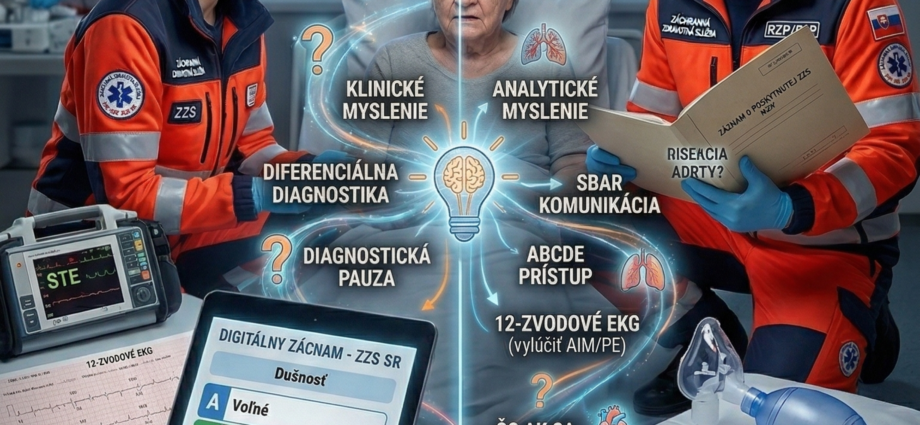
- Team check-in question: “What if we’re wrong? What else could this be?” (the so-called diagnostic pause).
- Objectify it: A 12-lead ECG is mandatory for every dyspnea call, even in a known asthmatic.
6. PHARMACOLOGICAL CONSIDERATIONS FOR THE BASIC CREW
In the differential diagnosis of dyspnea (asthma vs. pulmonary edema):
- Salbutamol (Ventolin): 2.5–5 mg by nebulizer. Watch for tachycardia and a proarrhythmic effect in the presence of myocardial ischemia.
- Furosemide: Within basic-crew scope of practice with clear signs of pulmonary edema (crackles, edema, hypertension). Dose 20–40 mg IV.
- Isosorbide dinitrate: 1–2 sublingual sprays for systolic BP > 100 mmHg. Reduces preload, key in cardiac dyspnea.
- Oxygen: Target saturation 94–98%, but only 88–92% in chronic lung disease patients (COPD).
7. TAKE-HOME MESSAGE
- Don’t trust the first diagnosis: Especially with patients you “know.” Every call is a fresh sheet of paper.
- A silent chest is an alarm: If a dyspneic patient isn’t wheezing, it can mean critical bronchospasm with no air movement, or end-stage pulmonary edema.
- Watch the red flags: Hypertension + dyspnea = cardiac, until proven otherwise.
- Set emotion aside: Professional distance is not coldness — it’s protection against cognitive overload.
8. BONUS – “HOW THIS COULD GO WRONG”
Error scenario: The paramedic falls prey to confirmation bias. He gives the patient a nebulizer treatment and adds IV aminophylline. The condition doesn’t improve, tachycardia climbs to 140/min. The wheeze persists, so he adds corticosteroids. During transport the patient loses consciousness, followed by cardiac arrest (PEA).
Retrospective: The real cause was a silent heart attack with subsequent acute left-sided heart failure. Administering beta-agonists (Ventolin) and aminophylline increased myocardial oxygen demand and hastened a fatal arrhythmia. A single 12-lead ECG at the outset would have been enough.
Consequence: Irreversible harm caused by anchoring on an old diagnosis.