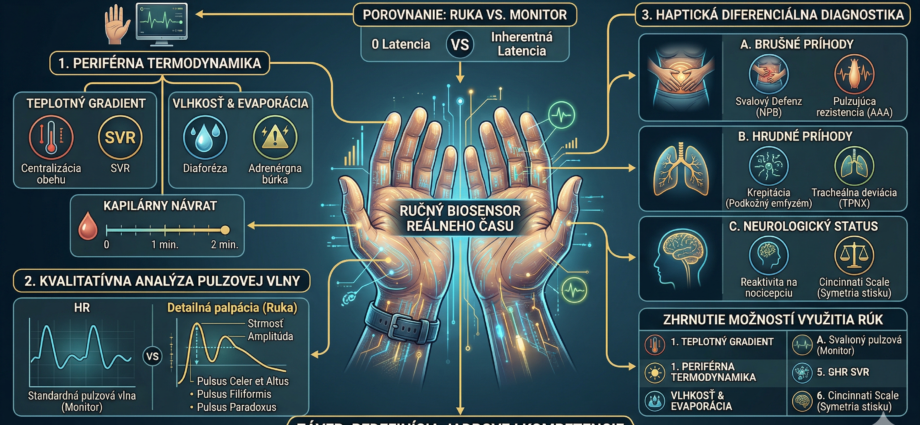
A dangerous phenomenon is emerging in current clinical practice — the cognitive delegation of diagnosis to device-based technology. While vital sign monitors offer high quantitative precision, they suffer from inherent latency and an inability to capture dynamic physiological nuance. For the professional paramedic, the hand is a primary biosensor, capable of simultaneously integrating thermodynamic, mechanical, and neurological data about the patient with zero phase delay.
1. Peripheral thermodynamics and microcirculation
While digital thermometry measures a static core or surface temperature value, haptic examination allows analysis of the temperature gradient.
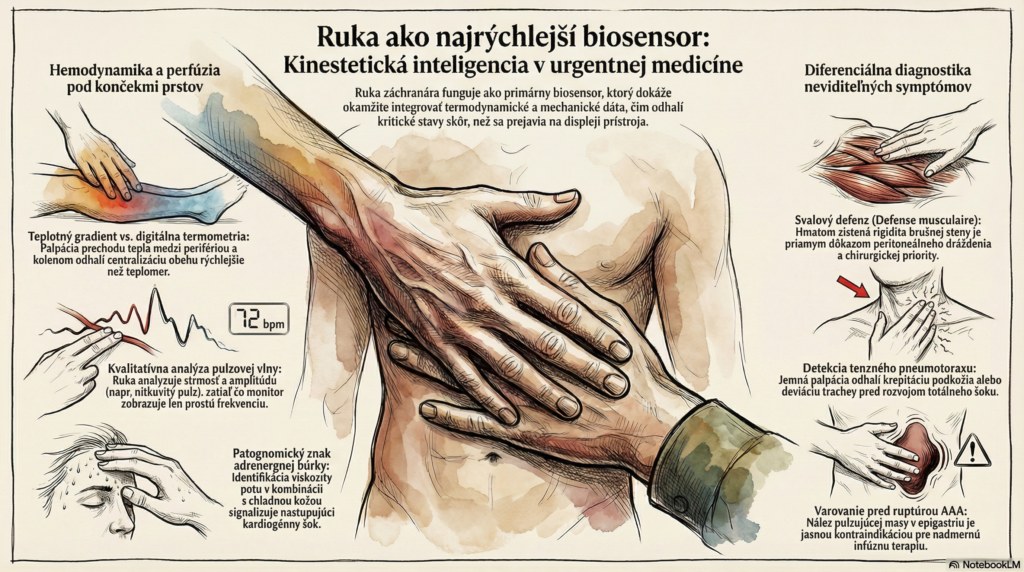
- Circulatory centralization: Palpating the temperature transition between the distal periphery and proximal limb segments is the fastest indicator of volume redistribution. The temperature difference between the top of the foot and the knee directly mirrors systemic vascular resistance (SVR).
- Moisture and evaporation: Detecting diaphoresis (cold sweat) is not merely a visual impression. Haptic identification of sweat viscosity combined with cold skin is a pathognomonic sign of a massive adrenergic surge, typical of cardiogenic shock or acute left-sided heart failure, where rising hypoperfusion outpaces the drop in blood pressure.
2. Qualitative pulse wave analysis: beyond the rate
The monitor reports heart rate (HR), but the hand analyzes the steepness and amplitude of the pulse wave.
- Pulsus celer et altus: A rapid, bounding pulse detected manually can signal a hyperdynamic circulation in early sepsis or aortic regurgitation — conditions a monitor interprets simply as tachycardia.
- Pulsus filiformis (thready pulse): Indicates a low stroke volume (SV). If a pulse is only palpable centrally, it signals critical hypotension requiring immediate aggressive circulatory resuscitation.
- Pulsus paradoxus: Manually identifying a drop in pulse amplitude during inspiration (typically in tension pneumothorax or cardiac tamponade) is a skill that field digital monitoring often cannot reliably replicate due to signal filtering.
3. Haptics in the differential diagnosis of abdominal and chest emergencies
The hand is irreplaceable for identifying symptoms that are invisible to monitors:
- Guarding (defense musculaire): Abdominal wall rigidity found on palpation is direct evidence of peritoneal irritation. Distinguishing a soft abdomen from a “board-like” abdomen in the first minute on scene changes the priority toward surgical intervention.
- Tracheal deviation and subcutaneous emphysema: Gentle palpation of the suprasternal notch and chest wall can detect crepitus (air under the skin) or tracheal deviation before full obstructive shock develops in tension pneumothorax.
- Pulsatile mass: Identifying a pulsatile mass in the epigastrium on abdominal palpation is a clear warning sign for the paramedic of a ruptured abdominal aortic aneurysm (AAA), where any further manipulation or aggressive fluid therapy is counterproductive.
4. Neurological status and muscle tone
Touch provides immediate information about neurological integrity:
- Response to a painful stimulus: Purposeful response vs. decerebrate/decorticate rigidity.
- Lateral difference in tone: Identifying unilateral weakness through a handshake grip is often faster than formal testing with the Cincinnati scale.
5. Summary of applications of the hands in professional practice
- Perfusion assessment: Capillary refill, temperature gradient, moisture.
- Hemodynamic monitoring: Amplitude, rhythm, symmetry, and steepness of the pulse wave.
- Trauma screening: Pelvic stability, skeletal crepitus, subcutaneous emphysema.
- Differential diagnosis of acute abdomen: Guarding, masses, referred pain.
- Neurological screening: Muscle tone, grip symmetry, response to nociception.
- Therapeutic intervention: Massive hemorrhage control, manual airway support, psychophysiological stabilization (crew resource management).
6. Conclusion: Redefining haptics as a core competency
Haptic diagnosis in emergency medicine is not a relic of the pre-technological era, but a necessary corrective to device data. The professional paramedic who consciously uses their hands as a biosensor gains a comparative advantage in both speed and accuracy. Reducing a patient to a set of numbers on a monitor leads to diagnostic blindness; physical contact, by contrast, deepens situational awareness and enables detection of pre-shock states before the numbers themselves decompensate.
Mastery in our field lies not in flawless operation of equipment, but in the ability to synthesize technological data with a precise physical examination. The paramedic’s hand is the fastest line to the patient’s pathophysiology — ignoring it is a voluntary surrender of the most valuable source of information we have in the field.
Sources and References:
- Bickley, L. S. (2020): Bates’ Guide to Physical Examination and History Taking. Wolters Kluwer.
- Croskerry, P. (2009): Clinical Cognition and Diagnostic Error. In: New England Journal of Medicine.
- Vincent, J. L. (2016): The Circulatory System and Shock. In: Textbook of Critical Care.
- Slovak Ministry of Health Guidance (2020): Standard Procedures for Emergency Medicine – Physical Examination.
- ERC Guidelines (2021): Section 4: Cardiac arrest in special circumstances.
- Silverman, J. (2013): Skills for Communicating with Patients. Radcliffe Publishing.