In the loud, dynamic world of prehospital emergency care, silence is often perceived as emptiness, inaction, or even a sign of uncertainty. The modern paramedic is trained for immediate action, a rapid volley of questions, and parallel execution of technical tasks. Yet it is precisely in this environment, saturated with cognitive noise, that deliberate silence represents one of the most sophisticated diagnostic tools available. “Diagnostic silence” is not the absence of communication; it is a strategic muting of the verbal layer of the response, aimed at maximizing sensory intake and processing of critical clinical information.
1. Defining the diagnostic silence paradigm
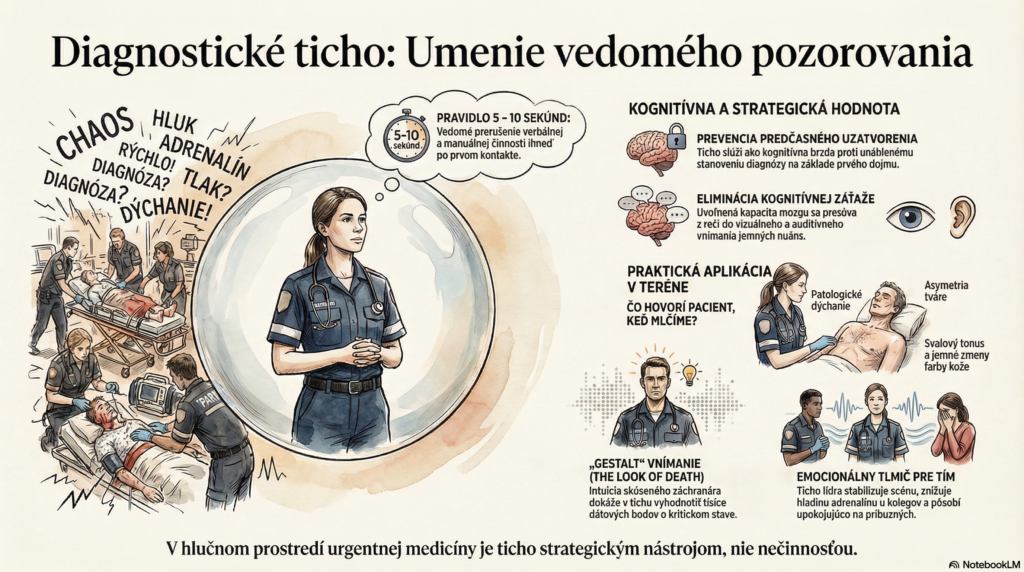
We define diagnostic silence as a deliberate, time-boxed (5–10 second) pause in verbal interaction and manual activity immediately upon first contact with the patient. In emergency medicine we face a phenomenon where the ambient soundscape — family members shouting, the hiss of oxygen, radio traffic, and the paramedic’s own questions — creates a barrier to in-depth analysis of the patient.
Silence acts as a filter. It lets the paramedic shift from “transmit” mode into “receive” mode. In these few seconds, the crew isn’t asking “what’s wrong with you?” — instead, they let the patient and the surrounding environment speak in their own, non-verbal language.
2. The cognitive benefit: reducing noise and preventing premature closure
Eliminating cognitive load
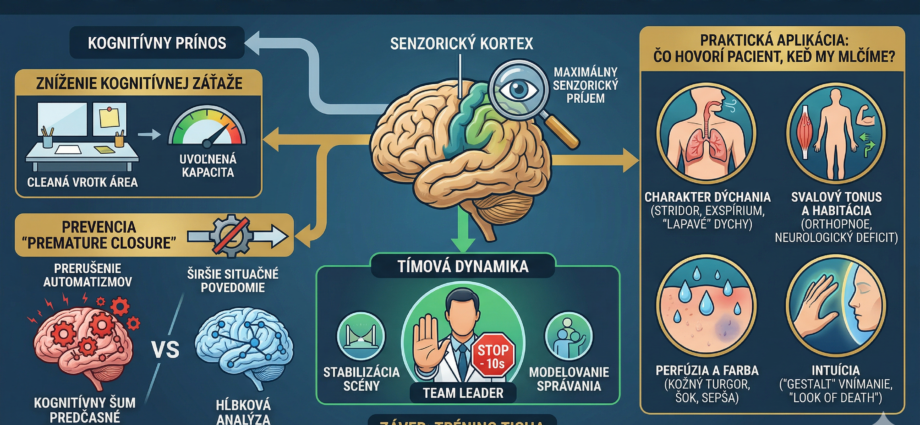
The human brain has limited working-memory capacity. When a paramedic speaks, they process syntax, tone of voice, and anticipate a response, consuming a significant share of cognitive resources. If the paramedic stays silent at the moment of first laying eyes on the patient, that freed-up capacity shifts to the visual and auditory cortex. This allows the paramedic to perceive subtle nuances that would otherwise be lost: facial asymmetry, abnormal muscle tone, or subtle use of accessory breathing muscles.
Interrupting automaticity and preventing “premature closure”
One of the most common errors in emergency medicine is premature closure of a diagnosis. The brain tends toward fast heuristics — after the first piece of information (“my chest hurts”), it locks onto a single diagnosis (heart attack) and ignores other signals. Deliberate silence acts as a cognitive brake. By consciously “switching off” verbal automaticity, the paramedic gains space for broader situational awareness. Silence forces the paramedic to observe the patient as a whole, not merely as a set of symptoms matching the first working hypothesis.
3. Practical application: what does the patient say when we stay silent?
There are clinical signs that are almost imperceptible amid the noise, yet are key to determining the severity of a condition. During those 5–10 seconds of diagnostic silence, the paramedic focuses on:
- Breathing pattern (auditory analysis): It’s not just about rate. Silence allows you to hear subtle stridor, prolonged expiration, unilaterally reduced chest movement, or agonal breaths, which get lost in verbal noise.
- Muscle tone and posture: Observing body position. Is the patient seeking a position of comfort (orthopnea)? Is there unilateral weakness suggesting stroke? Does the patient’s face respond expressively to the crew’s presence, or is it mask-like (shock, neurological deficit)?
- Perfusion and color (visual diagnosis): Detailed perception of skin turgor, microcirculation at the extremities, and the character of sweating (cold, clammy sweat in cardiogenic shock vs. dry, hot skin in sepsis).
- Intuition (“gestalt” perception): An experienced paramedic can, during silence, subconsciously process thousands of small data points and arrive at a sense that the patient is “truly sick” (“the look of death”) — information no answer to “how are you feeling” can convey as clearly.
4. Team dynamics: silence as a display of authority and stability
A team leader’s deliberate silence has a profound effect on crew resource management (CRM). When the leader steps back and goes quiet for a few seconds upon reaching the patient, it sends a clear signal to the whole team and to bystanders alike:
- Scene stabilization: Silence acts as an “emotional dampener.” It lowers adrenaline levels in the rest of the team and calms distressed family members.
- Modeling behavior: The team sees that the situation is under control and that an analysis phase is underway, not mindless chaos.
- Creating space for feedback: The leader’s silence allows other team members (if properly mentored) to build their own situational awareness, increasing patient safety through multiple layers of monitoring.
Conversely, a leader who talks and issues commands non-stop from the first second creates a cognitive tunnel for themselves and their colleagues, raising the risk of overlooking a critical detail.
5. Conclusion: implementing and training silence
Introducing diagnostic silence into practice requires discipline and training, because it runs counter to the natural urge to “do something.”
Recommendations for simulation training:
- The 10-second rule: In a simulated scenario, introduce a rule that no one may speak for the first 10 seconds after entering the patient zone. Team members then must report what they saw and heard during those 10 seconds.
- Visual debriefing: During the after-action review, don’t ask “what did you do” — ask “what did you see in the silence.”
- Non-technical skills: Train the team leader’s discipline in maintaining silence even under pressure (e.g., a screaming simulated bystander).
Silence in emergency medicine is not empty space. It is space for intellectual work, for precise diagnosis, and for setting a safe trajectory for the entire response. Learning to stay quiet in a critical moment is one of the highest expressions of a paramedic’s professional maturity.
Sources and recommended reading:
- Kahneman, D. (2011): Thinking, Fast and Slow. (Foundations of cognitive processes and decision-making errors.)
- Croskerry, P. (2003): The Importance of Cognitive Errors in Diagnosis and Strategies to Prevent Them. Academic Medicine.
- Endsley, M. R. (1995): Toward a theory of situation awareness in dynamic systems. Human Factors.
- Gawande, A. (2009): The Checklist Manifesto. (Principles of discipline in complex systems.)