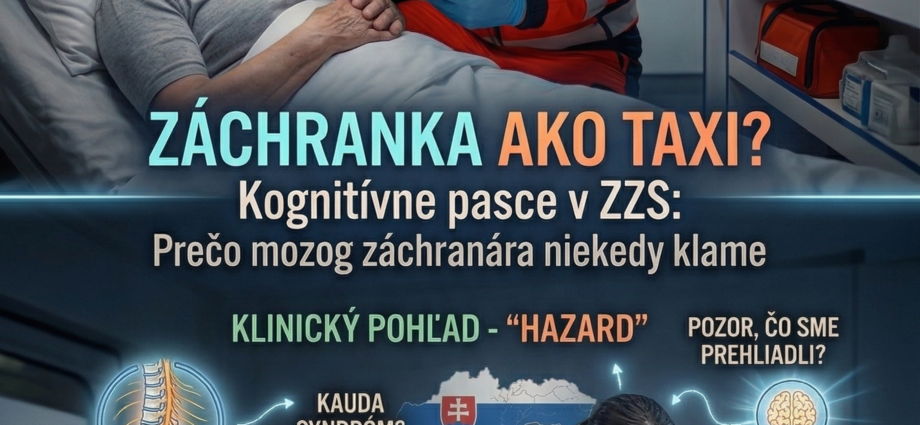
In the Slovak EMS system, the line between a genuine emergency and standing in for primary care is increasingly blurred. But frustration over “acting as a taxi” must never cloud clinical judgment, because it’s precisely in the most banal-looking cases that the highest forensic risk hides.
1. INTRODUCTION – A REALISTIC SCENARIO
Dispatch: Basic ambulance, 19:40, female, 44 years old, “lower back pain, can’t move.” On scene: The patient is lying on the couch, complaining of intense lumbar pain radiating into her right thigh. She reports it “pulled” while lifting groceries two days ago, and it worsened today. Her GP was on vacation, and she had no way to reach after-hours primary care. Objective findings: BP 135/85 mmHg, HR 92/min, SpO2 98%, temp 37.1°C. The patient is afebrile, conversational, but gasps in pain when attempting to move. Context: The crew is on their 10th call of the shift, 6 of which were similarly “social/outpatient” in nature. The paramedic reaches for an ampule of an NSAID.
2. CLINICAL ANALYSIS OF THE SITUATION (ABCDE)
With “back pain,” we often skip systematic assessment — a fundamental mistake.
- A/B: No pathology.
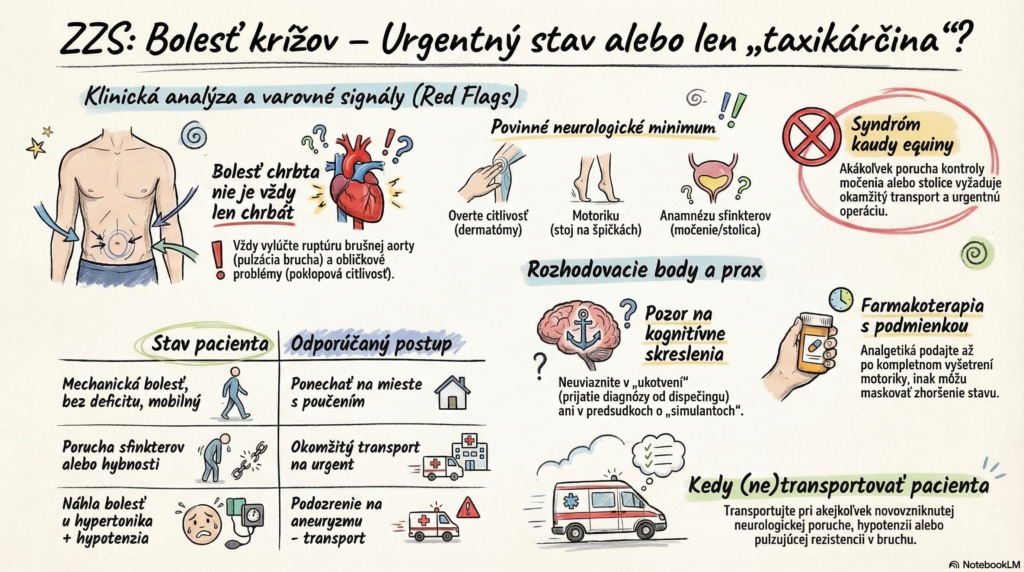
- C (Circulation): BP and HR within normal limits. Caution: In patients over 40 with sudden lower back pain (even without trauma), we must consider abdominal aortic aneurysm rupture/dissection. Is there a pulsatile abdominal mass?
- D (Disability): The key phase. Examine mobility and sensation in the lower limbs. Does the patient have sphincter dysfunction? (Did you ask about urination/bowel movements?) Is there “saddle” numbness in the perineum?
- E (Exposure): Abdominal exam and renal punch tenderness (costovertebral angle). Is the pain really musculoskeletal, or is it a renal colic or a gynecological problem?
Red flags:
- Loss of bladder/bowel control (cauda equina syndrome — a surgical emergency!).
- Sudden-onset pain in a hypertensive patient (aneurysm).
- Weakness (paresis) of a distal limb segment (e.g., foot drop).
3. THE MOST COMMON ERRORS IN PRACTICE
- Anchoring: Accepting the dispatch diagnosis (“lower back pain”) as final. The paramedic looks only for confirmation of muscle spasm.
- Confirmation bias: “She’s faking it, she just wants a ride.” Ignoring the fact that the patient is sweating more than a typical lumbago would explain.
- Filling in for primary care: Giving pain medication “at the door” without in-depth assessment, just to close the call quickly.
- Poor handoff communication: Handing the patient off as “back pain, needs reassessment” while overlooking a neurological deficit.
4. DECISION POINTS (CRITICAL THINKING)
When to stop being a “taxi” and start being EMS:
- When transport is required: Any new-onset sensory, motor, or sphincter dysfunction. Any back pain associated with hypotension or a pulsatile abdominal mass.
- When to leave at home: Only if the pain is clearly mechanical, without neurological deficit, the patient can stand with assistance, and follow-up care is arranged (family, a morning doctor’s visit).
- Working with uncertainty: If the patient says “this pain is different from before,” you must believe them. A patient’s subjective sense is often more sensitive than your first impression.
5. A PRACTICAL APPROACH FOR BASIC AMBULANCE CREWS
For a call involving “trivial” lower back pain:
- History: Ask about trauma, anticoagulant therapy (risk of epidural hematoma), and any oncology history.
- Physical exam: Straight-leg raise (Lasegue’s sign) to objectify nerve root irritation.
- Neurological minimum: Sensation (dermatomes), motor function (standing on toes/heels), sphincters (by history).
- Differential diagnosis in brief:
- Muscle spasm vs. disc herniation.
- Renal colic (radiating to the groin).
- Aortic dissection (autonomic symptoms, asymmetric pulses).
- Cauda equina syndrome (an emergency!).
6. PHARMACOLOGICAL CONSIDERATIONS
Within basic-crew scope for musculoskeletal pain:
- NSAIDs (e.g., diclofenac): 75 mg IM or infusion. Watch for allergies and a history of GI ulcers.
- Analgesic-antipyretics (e.g., paracetamol): 1 g IV — a safer alternative in the elderly and cardiac patients.
- Antispasmodics (e.g., hyoscine butylbromide): If a renal cause is suspected.
- Caution: Analgesics can mask progression of a neurological finding. A complete motor exam must be documented before administration.
7. TAKE-HOME MESSAGE
- Back pain isn’t always the back: Rule out the abdominal aorta and kidneys.
- Sphincters are fundamental: Asking about urination and bowel movements isn’t awkward, it’s a professional obligation.
- Triage is dynamic: Just because dispatch assigned a low priority doesn’t mean the on-scene findings can’t be critical.
- Communication: During ED handoff, state facts (neurological status), not your feelings about “misuse” of the system.
8. BONUS – “HOW THIS COULD GO WRONG”
Alternative scenario: The crew gives an IM NSAID and leaves the patient at home with instructions to see a doctor in the morning. During the night, the patient loses sensation in her right leg and falls trying to get to bed. Family calls EMS again at 04:00. Reality: A massive disc herniation compressing the cauda equina. Consequence: Permanent deficits (incontinence, paresis), and a forensic follow-up against the paramedic for neglecting the neurological exam and failing to document sphincter status.