Introduction
Anopyrin (ASA – acetylsalicylic acid) is an irreversible antiplatelet agent that in emergency medicine represents the “gold standard” of initial treatment for acute coronary syndrome (ACS). Its early administration significantly reduces mortality in both STEMI and NSTEMI patients by immediately halting thrombus growth in the coronary artery. In EMS, speed of administration and the form (chewed) are key, to ensure the fastest possible absorption through the oral mucosa.
1. Drug Identification
• Active substance: Acidum acetylsalicylicum (ASA).
• Trade names in Slovakia: Anopyrin, Aspirin, Acylpyrin.
• ATC classification: B01AC06 (Platelet aggregation inhibitors excluding heparin).
• Dosage form in EMS: Tablets, 100 mg or 400 mg (typically 100 mg in the cardiac kit).
• Pharmacological group: Antiplatelet agent, non-steroidal anti-inflammatory drug (NSAID).
2. Mechanism of Action (Pharmacodynamics)
ASA acts at the level of arachidonic acid metabolism:
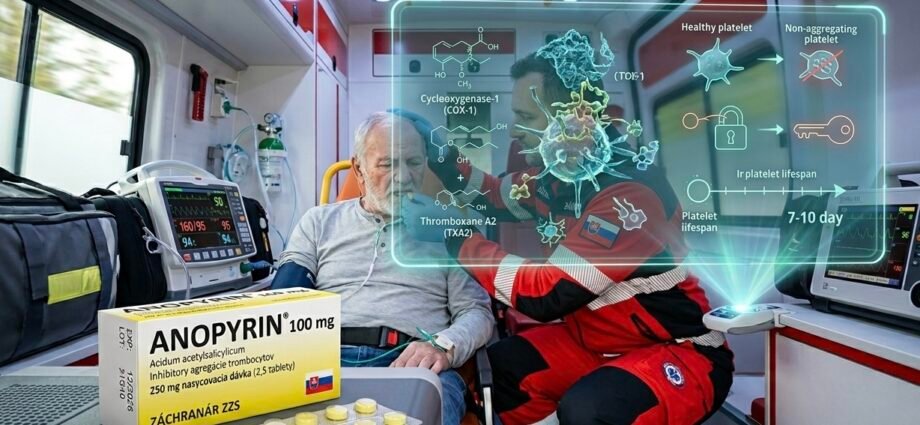
• Irreversible COX-1 inhibition: ASA acetylates the active site of the cyclooxygenase-1 (COX-1) enzyme in platelets.
• Blockade of thromboxane A2 (TXA2): This halts synthesis of TXA2, a potent promoter of platelet aggregation and vasoconstriction.
• Irreversibility: Since platelets have no nucleus, they cannot synthesize new enzyme. The effect therefore lasts for the entire lifespan of the platelet (7–10 days).
• Higher doses: At higher doses it also inhibits COX-2 (analgesic and anti-inflammatory effect), which is not the primary goal in acute ACS.
3. Hemodynamic Effects – IN DETAIL
• SVR, preload, afterload: ASA has no direct effect on systemic hemodynamic parameters.
• Coronary microcirculation: By inhibiting TXA2-mediated vasoconstriction, it can mildly improve flow to the ischemic area.
• Destabilization risk: Indirect, related to the risk of gastrointestinal bleeding in predisposed patients, which could lead to secondary ischemia from anemia.
4. Pharmacokinetics (from a Paramedic’s Perspective)
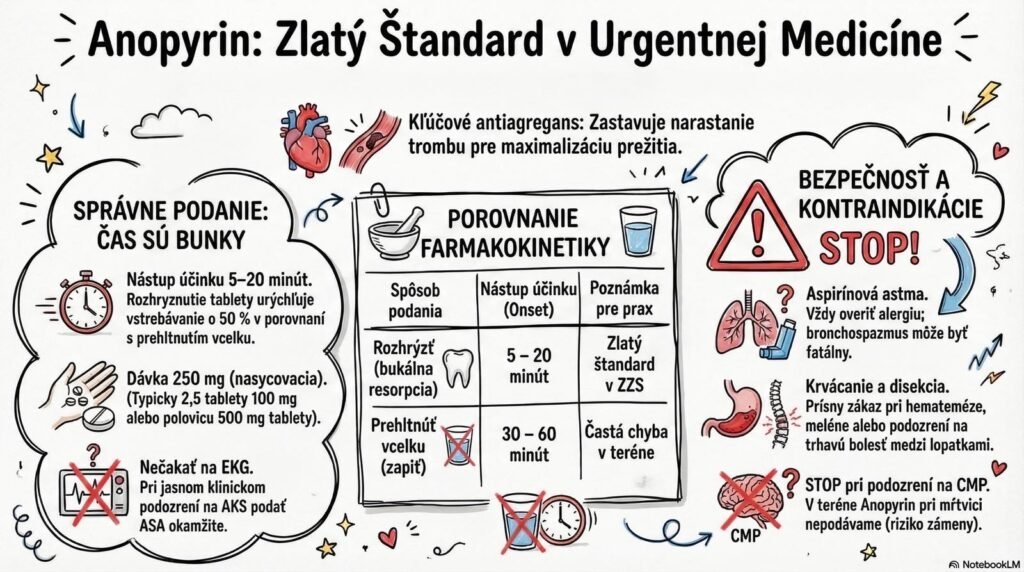
• Route of administration: Oral (PO). In EMS, strictly chewed (buccal absorption speeds onset by 50% compared to swallowing the whole tablet).
• Onset of action: If chewed, 5–20 minutes; if swallowed whole, 30–60 minutes.
• Half-life: Short (approximately 20 minutes for free ASA), but the pharmacodynamic effect (antiplatelet action) is permanent for a given platelet.
• Metabolism: Hydrolysis in plasma and liver to salicylic acid.
5. Indications in Prehospital Practice
1. Acute coronary syndrome (ACS): For any clinical suspicion (chest pain of ischemic character), regardless of ECG findings.
2. Suspected STEMI / NSTEMI / unstable angina pectoris.
3. Ischemic stroke: (In Slovakia, ASA is generally not recommended prehospitally for stroke due to the risk of mistaking it for hemorrhagic stroke before a CT scan.)
6. Dosing in EMS
• Adult (loading dose): 150–300 mg PO (in Slovakia, typically 250 mg, i.e., 2.5 Anopyrin 100 mg tablets or half of a 500 mg tablet).
• Method: The patient must chew the tablets and mix them with saliva in the mouth.
• Scope of practice: Physician (RLP). A basic-crew paramedic (RZP) administers it as part of the standard ACS protocol.
7. Contraindications
• Absolute: Active gastrointestinal bleeding, known ASA hypersensitivity (aspirin-exacerbated asthma/angioedema), coagulation disorders (severe hemophilia).
• Relative: History of peptic ulcer, severe hepatic or renal impairment.
8. Adverse Effects
• Gastrointestinal: Epigastric discomfort, nausea, vomiting, GI bleeding (rare with a single dose).
• Respiratory: Bronchospasm (in hypersensitive patients).
• Dermatologic: Urticaria, angioedema.
9. Drug Interactions in EMS
• Heparin / P2Y12 inhibitors (Brilique): Synergistic effect (desired dual antiplatelet therapy).
• NSAIDs (ibuprofen): Concurrent administration can block ASA’s binding site on COX-1, reducing its cardioprotective effect (irrelevant for a single EMS dose).
10. Specifics in Emergency Medicine
• Error #1: “Swallow with water.” Swallowing the tablet whole significantly delays time to therapeutic level.
• Error #2: Waiting for the ECG. If the clinical picture is clear, ASA should be given as soon as possible, even before the 12-lead ECG is done, if the situation allows.
• Aspirin-exacerbated respiratory disease: Always ask about allergies to pain medications.
11. Red Flags
1. Hematemesis / melena: If the patient reports black stool or vomiting blood, ASA is strictly contraindicated.
2. Stridor / bronchospasm after administration: Treat immediately as an anaphylactic/pseudoallergic reaction (epinephrine).
3. History suggesting aortic dissection: If pain radiates between the shoulder blades and is tearing in nature, antiplatelet agents can worsen the prognosis before surgery.
12. Antidote
• No specific antidote exists. For bleeding, platelet concentrate transfusion is needed in a hospital setting.
13. Practical Field Scenario
Situation: A 60-year-old woman with pressure-like retrosternal pain for 15 minutes, radiating to the jaw.
Status: BP 150/90, HR 88, SpO2 96%. ECG: nonspecific ST-segment changes so far.
Decision-making:
1. Allergy history (negative).
2. Give 250 mg Anopyrin (chewed).
3. Repeat ECG after 10 minutes (ST elevation develops).
Hemodynamic rationale: Early ASA administration stopped clot growth already during the unstable angina phase, minimizing the extent of myocardial damage during the subsequent STEMI.
14. Practical Summary – 5 Key Points
1. Chew it: The most important instruction for the patient.
2. Time is muscle: Give ASA as the first drug when ACS is suspected.
3. 250 mg: The standard loading dose in Slovak EMS practice.
4. Ask about allergy: Aspirin-exacerbated asthma can be fatal.
5. Nothing for stroke: Do not give Anopyrin in the field when stroke is suspected.
Professional Literature for Anopyrin (ASA)
1. Slovak Ministry of Health guidance on the provision of emergency healthcare for adults with chest pain.
2. SmPC (Summary of Product Characteristics) – Anopyrin 100 mg, registration no. 16/0150/93-S.
3. ESC Guidelines 2023 for the management of acute coronary syndromes.
4. Dobiáš, V. et al.: Emergency Healthcare. Osveta, 2021.
5. Lüllmann, H. et al.: Pharmacology and Toxicology. Grada, 2014. (Chapter: Platelet aggregation inhibitors.)
6. Remedium 2026: Compendium medicamentorum. (Current pharmacological standards in Slovakia.)