Introduction
Almiral (diclofenac) is a phenylacetic acid derivative with marked analgesic, anti-inflammatory, and antipyretic effects. In EMS it’s valued for its ability to rapidly relieve pain associated with inflammation and edema. It is a firm part of protocols for treating acute spinal blockages and serves as an alternative or adjunct for visceral pain.
1. Drug Identification
• Active substance: Diclofenacum natricum.
• Trade names in Slovakia: Almiral, Diclac, Voltaren, Dolmina.
• ATC classification: M01AB05 (Acetic acid derivatives and related substances).
• Dosage form in EMS: Injection solution 75 mg/3 ml.
• Pharmacological group: Non-steroidal anti-inflammatory drug (NSAID).
2. Mechanism of Action (Pharmacodynamics)
The main mechanism is inhibition of prostaglandin synthesis:
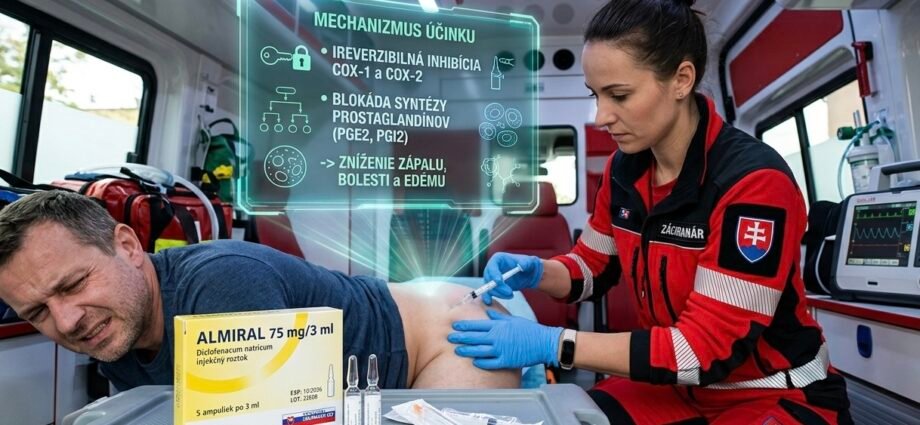
• COX inhibition: Non-selectively blocks cyclooxygenase-1 (COX-1) and cyclooxygenase-2 (COX-2) enzymes.
• Reduced inflammatory mediators: Reduces production of prostaglandins that sensitize nociceptors to chemical and mechanical stimuli.
• Faster onset: Unlike oral forms, IM or IV infusion administration bypasses the first-pass effect and quickly reaches therapeutic concentration at the site of inflammation.
3. Hemodynamic Effects – IN DETAIL
• Blood pressure: Can cause a mild rise in BP due to sodium and water retention (renal prostaglandin inhibition).
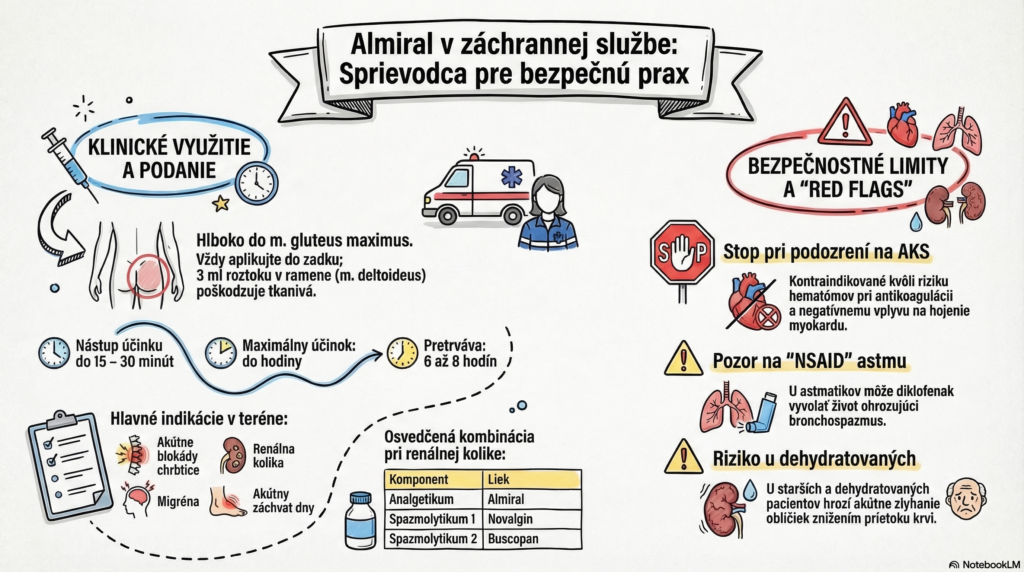
• Renal perfusion: Risk! In dehydrated patients or those with chronic renal insufficiency (CRI), it can lead to acute kidney failure by reducing glomerular blood flow.
• Cardiovascular risk: Long-term use increases thromboembolic event risk; with a single EMS dose this risk is minimal, except in patients with active ACS.
4. Pharmacokinetics (from a Paramedic’s Perspective)
• Routes of administration: IM (deep intramuscular injection into the upper outer quadrant of the gluteal muscle), IV infusion (must be diluted and buffered, e.g., in 100 ml normal saline; less common in the field).
• Onset of action: IM administration: 15–30 minutes.
• Peak effect: 30–60 minutes.
• Duration of effect: 6–8 hours.
• Metabolism: Hepatic. Elimination: 60% renal, the rest biliary.
5. Indications in Prehospital Practice
1. Acute musculoskeletal pain: Lumbago, radicular syndrome, post-traumatic states (without massive bleeding).
2. Renal colic: Very high efficacy due to reduced renal filtration and relief of ureteral pressure.
3. Acute gout attack.
4. Migraine: Acute attacks.
6. Dosing in EMS
• Adult: Usually 75 mg (1 ampule) IM.
• Severe cases: Exceptionally 150 mg/day (split into two doses).
• Scope of practice: Physician (RLP). A basic-crew paramedic (RZP) per standard pain-management procedures (in Slovakia, within RZP scope for musculoskeletal pain).
7. Contraindications
• Absolute: Active peptic ulcer, GI bleeding, severe heart failure (NYHA III/IV), severe renal or hepatic failure, 3rd trimester of pregnancy.
• Aspirin triad: History of asthma or urticaria after ASA/NSAIDs.
• Children and adolescents: The injectable form of Almiral is not intended for children (in Slovakia, usually the limit is 15–18 years per SmPC).
8. Adverse Effects
• Local: Pain and induration at the injection site, abscess risk with shallow injection.
• Gastrointestinal: Epigastric discomfort, nausea.
• Renal: Transient decline in kidney function.
• Immune: Hypersensitivity reactions (bronchospasm, rash).
9. Drug Interactions in EMS
• Antiplatelet agents (Anopyrin, Brilique): Increases GI bleeding risk.
• Anticoagulants (heparin): Potentiates bleeding risk.
• Diuretics (furosemide): Diclofenac reduces their effect and increases nephrotoxicity risk.
10. Specifics in Emergency Medicine
• Error #1: IM administration in a patient with suspected ACS. If thrombolysis or heavy anticoagulation is anticipated, an IM injection is contraindicated due to the risk of a hematoma that cannot be urgently addressed.
• Error #2: Injection into the shoulder. 3 ml of Almiral solution is too large a volume for the deltoid muscle, risking nerve and tissue damage. Always inject into the gluteus maximus.
• Renal colic: The combination of metamizole + Almiral + hyoscine butylbromide is the “golden triangle” of colic treatment in EMS.
11. Red Flags
1. Anaphylactoid reaction: Monitor the patient for the first 15 minutes after administration.
2. Bleeding from the injection site: Patients on warfarin/NOACs risk an extensive intramuscular hematoma.
3. Acute dyspnea: In asthmatics, diclofenac can trigger life-threatening bronchospasm.
12. Antidote
• None exists. Overdose treatment is symptomatic (gastric lavage for oral ingestion, renal function support).
13. Practical Field Scenario
Situation: A 45-year-old man, sudden “twinge” in the lower back while lifting a load, unable to straighten up.
Status: Stable, BP 145/90, marked paravertebral muscle spasm, no neurological deficit in the lower limbs.
Decision-making:
1. Rule out spinal trauma and aortic dissection.
2. Almiral 75 mg IM, deep gluteal.
3. Educate about dry heat and rest.
Hemodynamic rationale: Diclofenac suppresses the inflammatory component of the nerve root edema. Since the patient has no ulcer disease, this is a safe and effective choice.
14. Practical Summary – 5 Key Points
1. Deep into the muscle: Prevent tissue necrosis with correct IM technique.
2. Watch the kidneys: In elderly, dehydrated patients, choose a different analgesic instead.
3. Don’t give in ACS: Hematoma risk and adverse effect on myocardial healing.
4. Ask about ulcers: A history of stomach bleeding is a red flag.
5. Asthma: NSAID-induced asthma can be severe.
Professional Sources and Literature:
1. SmPC (Summary of Product Characteristics) – Almiral injection solution 75 mg/3 ml.
2. Slovak Ministry of Health guidance on the treatment of acute pain.
3. Dobiáš, V. et al.: Emergency Healthcare. Osveta, 2021.
4. Lüllmann, H. et al.: Pharmacology and Toxicology. Grada, 2014. (Chapter: Non-steroidal anti-inflammatory drugs.)
5. ESC Guidelines: Recommendations for NSAID use in cardiac patients.