Introduction Hydrocortisone (cortisol) is a natural glucocorticoid produced by the adrenal cortex. In emergency medicine, its water-soluble form (succinate) is used, allowing immediate IV administration. Unlike dexamethasone, hydrocortisone has lower glucocorticoid potency but stronger mineralocorticoid activity, which is advantageous for circulatory stabilization.
1. Drug Identification
- Active substance: Hydrocortisoni natrii succinas.
- Trade name in Slovakia: Hydrocortison VUAB 100 mg.
- ATC classification: H02AB09 (Glucocorticoids).
- Dosage form in EMS: Powder for injection solution (100 mg vial) with a solvent.
- Pharmacological group: Corticosteroid for systemic use.
2. Mechanism of Action (Pharmacodynamics) Acts via cytoplasmic receptors that, once activated, affect gene transcription in the nucleus:
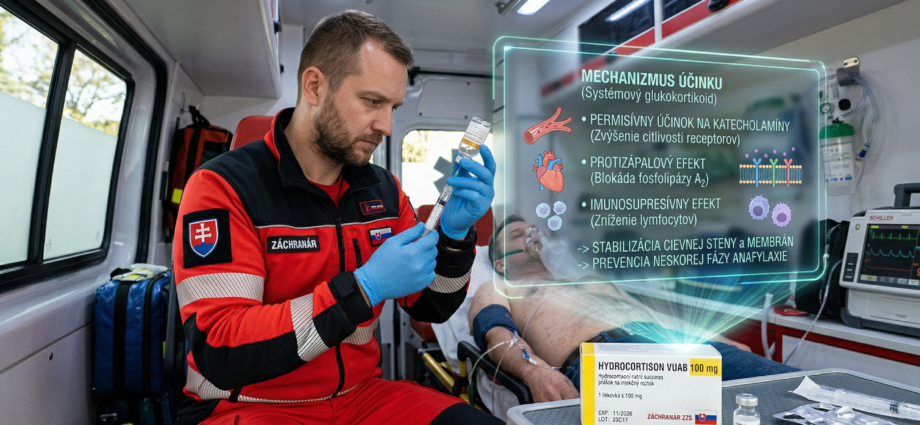
- Anti-inflammatory effect: Inhibits phospholipase A2, blocking synthesis of prostaglandins and leukotrienes.
- Immunosuppressive effect: Reduces circulating lymphocyte count and stabilizes lysosomal membranes.
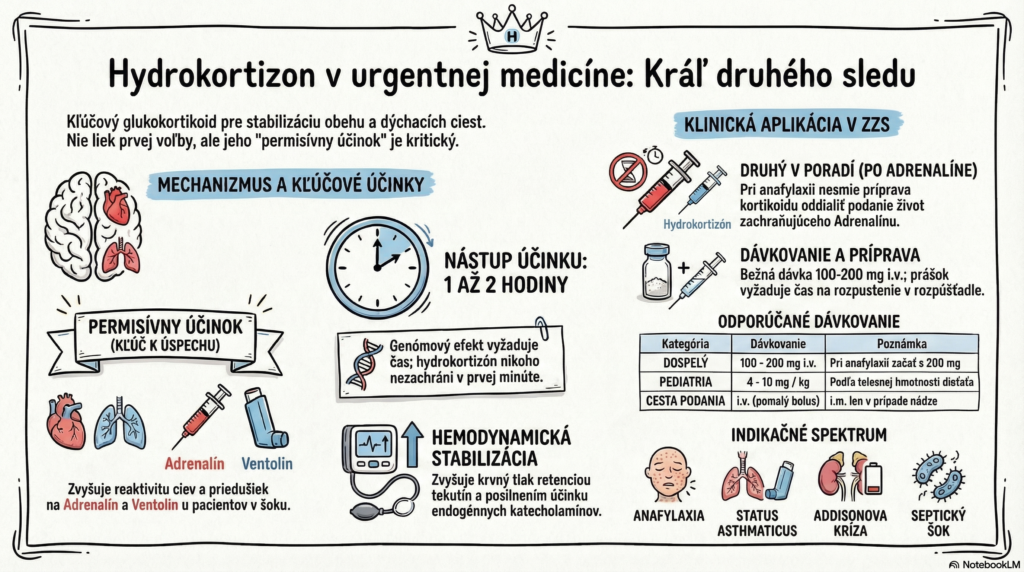
- Permissive effect: Key for EMS! Increases vascular and bronchial reactivity to catecholamines (epinephrine, norepinephrine). Without corticosteroids, receptors become “blunted” in severe shock.
- Membrane stabilization: Reduces capillary permeability, preventing further edema development.
3. Hemodynamic Effects – IN DETAIL
- Blood pressure: Raises BP through sodium and water retention (mineralocorticoid effect) and by enhancing the effect of endogenous catecholamines.
- Heart rate: No direct effect, but rhythm can stabilize as shock resolves.
- Glycemia: Raises blood glucose (stimulates gluconeogenesis), which should be monitored in diabetics.
4. Pharmacokinetics (from a Paramedic’s Perspective)
- Routes of administration: IV (slow bolus or infusion), IM (in emergencies).
- Onset of action: The genomic effect (protein changes) begins after 1 to 2 hours. The non-genomic effect (membrane stabilization) is observable sooner.
- Peak effect: 1–2 hours after administration.
- Duration of effect: 6–12 hours.
- Metabolism: Hepatic. Elimination: renal.
5. Indications in Prehospital Practice
- Anaphylactic shock: Given as a second-line drug (after epinephrine) to prevent the late-phase reaction.
- Status asthmaticus / severe bronchospasm: To suppress inflammation and bronchial mucosal edema.
- COPD exacerbation: Easing acute obstruction.
- Addisonian crisis: Acute adrenal cortex insufficiency (a life-threatening condition).
- Septic shock: For refractory hypotension (per protocols).
6. Dosing in EMS
- Adult: Standard dose 100 mg to 200 mg IV. In anaphylaxis, treatment often starts with 200 mg.
- Pediatrics: 4 mg/kg to 10 mg/kg body weight.
- Technique: The powder is dissolved in the 2 ml of included solvent or normal saline.
- Scope of practice: Both physician (RLP) and basic-crew paramedic (RZP) — a fundamental drug in treating allergic and respiratory conditions.
7. Contraindications In emergency situations, with a single administration, no absolute contraindications exist.
- Relative: Systemic fungal infections, ocular herpes simplex, acute psychosis, severe decompensated hypertension.
8. Adverse Effects With a single EMS dose, these are rare:
- Metabolic: Hyperglycemia.
- Psychological: Euphoria, restlessness, rarely psychosis.
- Gastrointestinal: Gastric mucosal irritation.
- Cardiovascular: Fluid retention, hypokalemia (with high doses).
9. Drug Interactions in EMS
- NSAIDs (Almiral): Increased risk of gastrointestinal bleeding and ulceration.
- Diuretics (furosemide): Increased hypokalemia risk.
- Insulin / oral antidiabetics: Reduces their effectiveness (due to hyperglycemia).
10. Specifics in Emergency Medicine
- Error #1: Corticosteroid instead of epinephrine. In anaphylaxis, giving hydrocortisone must never delay epinephrine administration. A corticosteroid won’t save anyone within a minute; epinephrine will.
- Error #2: Slow preparation. The powder form takes time to dissolve. Prepare it immediately after giving epinephrine.
- Permissiveness: If you give Ventolin and the condition doesn’t improve, hydrocortisone helps “open” the receptors for that Ventolin.
11. Red Flags
- Hyperglycemia: In diabetics, report the corticosteroid dose given upon hospital handoff.
- Genital-area paresthesia: With very rapid IV administration of high corticosteroid doses, patients may feel unpleasant burning or tingling (with 200 mg hydrocortisone in EMS, this is less common than with methylprednisolone).
12. Antidote
- None exists. Treatment is symptomatic.
13. Practical Field Scenario Situation: A 45-year-old man, bee sting 10 minutes ago. Generalized urticaria, lip swelling, wheezing, BP 85/50. Status: Anaphylactic shock. Decision-making:
- Epinephrine 0.5 mg IM into the thigh (immediately).
- Oxygen mask, secure IV access, fluid therapy (crystalloids).
- Hydrocortisone 200 mg IV, slowly.
- Dithiaden 2 mg IV. Hemodynamic rationale: Hydrocortisone stabilizes the vessel wall and prevents a later relapse of shock, while epinephrine addresses the acute collapse.
14. Practical Summary – 5 Key Points
- Second in line: In anaphylaxis, it’s second, not first choice.
- A lung helper: Opens receptors for Ventolin.
- Prepare ahead: Dissolving the powder takes a moment.
- Safe in the acute phase: Don’t worry about side effects; the priority is stabilization.
- Addison’s: Don’t forget it in unexplained shock in chronically ill patients.
Professional Sources and Literature:
- ERC Guidelines 2021: Anaphylaxis treatment protocols.
- SmPC (Summary of Product Characteristics) – Hydrocortison VUAB 100 mg.
- Dobiáš, V. et al.: Emergency Healthcare. Osveta, 2021.
- Lüllmann, H. et al.: Pharmacology and Toxicology. Grada, 2014. (Chapter: Adrenal cortex hormones.)
- Slovak Ministry of Health guidance on treating anaphylactic shock.