
EtCO₂ and terminating CPR:
when to continue and when not to
Deciding to terminate resuscitation is one of the hardest calls a paramedic makes. EtCO₂ is an important supporting parameter — but not the only one, and not absolute. Here’s what current evidence says.
The previous installment warned against blind trust in the capnograph. This installment addresses the situation where EtCO₂ plays its clinically and ethically most weighty role — the decision to terminate prehospital resuscitation. We’ll go from historical studies through current evidence to what it all means for the paramedic in the field under Slovak EMS conditions.
The historical foundation — the Levine 1997 study
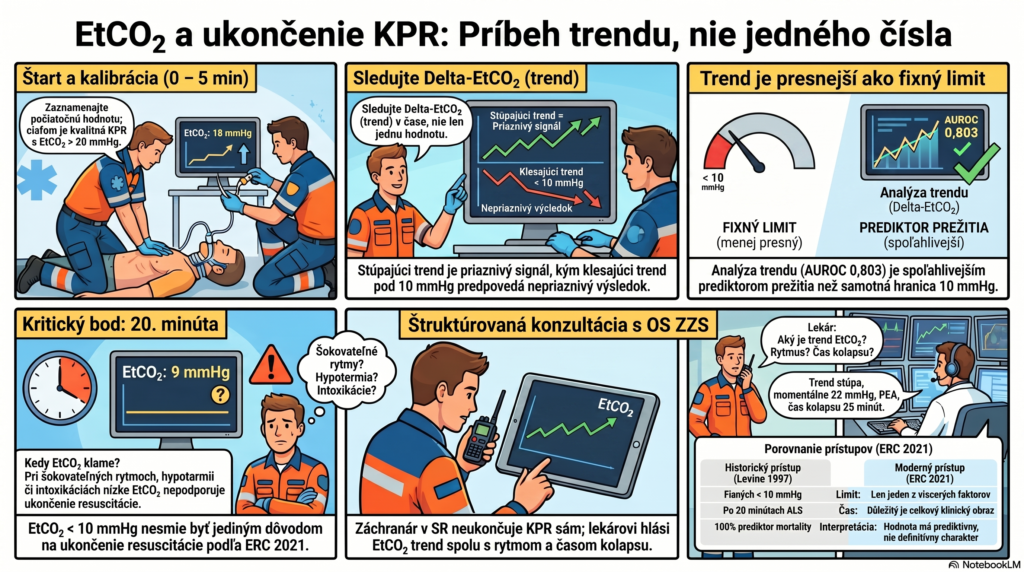
Most clinical protocols for terminating CPR cite the Levine et al. study from 1997, published in the New England Journal of Medicine. The authors followed 150 patients with out-of-hospital cardiac arrest (OHCA) and found that EtCO₂ < 10 mmHg after 20 minutes of ALS resuscitation had 100% sensitivity, specificity, and positive and negative predictive value for mortality in their cohort.
This number — 10 mmHg after 20 minutes — became a reference point for dozens of resuscitation-termination protocols worldwide, including ERC guidelines. The problem: the study had 150 patients, was single-center, and predates the era of modern high-quality CPR with mechanical devices and standardized protocols.
It said: EtCO₂ < 10 mmHg after 20 min of ALS = a strong predictor of mortality in that cohort.
It did not say: that EtCO₂ < 10 mmHg alone is sufficient to terminate resuscitation.
It did not say: that this parameter applies universally to all patients, all rhythms, and all resuscitation conditions.
What current evidence says
Two key studies from 2023–2024 have significantly challenged the absolute validity of the 10 mmHg threshold and shifted the discussion toward the EtCO₂ trend over time — the so-called delta-EtCO₂.
The ESO Dataset 2018–2021 (Smida et al., 2024)
A retrospective analysis of 14,122 OHCA patients from the ESO dataset showed that after 20 minutes of resuscitation, only fewer than 12% of patients had an EtCO₂ < 10 mmHg. This cutoff was 96.7% specific but only 6.9% sensitive for mortality — meaning the large majority of patients who ultimately died had an EtCO₂ above 10 mmHg. Modern resuscitation practices emphasizing uninterrupted compressions have likely raised EtCO₂ values across the patient population.
The Portland Cardiac Arrest Registry 2018–2021 (Hambelton et al., 2024)
A retrospective analysis of 297 cases of refractory non-shockable OHCA compared absolute EtCO₂ cutoff values with the trend (delta-EtCO₂). Key finding: the AUROC for delta-EtCO₂ was 0.803, compared to 0.731 for the absolute 10 mmHg cutoff. Both survivors had an EtCO₂ > 10 mmHg at the 30-minute mark and a rising trend.
The key message of these studies: the EtCO₂ trend over time is more informative than any single reading. A patient with a rising EtCO₂ — even below 10 mmHg — has a better prognosis than a patient with a declining EtCO₂ above 10 mmHg.
What ERC 2021 says
The European Resuscitation Council, in its 2021 guidelines, takes a cautious stance on EtCO₂ and terminating CPR. Key points:
| ERC 2021 — position | Practical consequence |
|---|---|
| EtCO₂ can be one of the factors in the decision to terminate CPR | Never the sole factor — always combined with other criteria |
| EtCO₂ < 10 mmHg after 20 min must not be the sole criterion for termination | The value has predictive, not definitive, character |
| EtCO₂ > 10 mmHg doesn’t rule out termination given other favorable criteria | The overall clinical picture, time since collapse, bystander CPR, rhythm |
| A sudden EtCO₂ rise during CPR = a strong ROSC signal | Always check pulse and rhythm before terminating |
Decision factors — EtCO₂ in context
The decision to terminate CPR in the prehospital setting never rests on a single parameter. EtCO₂ is part of a broader clinical picture the paramedic evaluates holistically:
Shockable rhythm (VF/pVT): patients with VF can have a low EtCO₂ and still survive after defibrillation.
Epinephrine or bicarbonate administration: these drugs transiently alter EtCO₂ — read the value at least 3 minutes after administration.
Hypothermia: for patients with hypothermic cardiac arrest, the principle “not dead until warm and dead” applies — EtCO₂ isn’t a relevant prognostic parameter here.
Intoxication: in poisonings (opioids, tricyclic antidepressants, digoxin), cardiac arrest can be fully reversible even after a long resuscitation.
The situation in Slovak EMS — the legislative framework
Under the Slovak Emergency Medical Service system, the decision to terminate resuscitation is regulated by Slovak Act No. 579/2004 Coll. and the relevant methodological guidance. A basic-crew (RZP) paramedic is not authorized to independently decide to terminate CPR — this decision belongs to the physician at the EMS Operations Center, with whom the paramedic remains in contact.
“EtCO₂ after 20 minutes of quality ALS resuscitation is 7 mmHg, declining trend from an initial 14 mmHg. Rhythm asystole throughout. Estimated time since collapse 12 minutes, no bystander CPR. Reversible causes ruled out. Requesting consultation on termination.”
This is the correct form — EtCO₂ as part of a structured report, not as an isolated number.
A practical algorithm for the paramedic
Based on current evidence and the Slovak legislative framework, we propose the following approach to evaluating EtCO₂ in the context of terminating CPR:
| Time | EtCO₂ status | Paramedic action |
|---|---|---|
| 0–5 min | Record the initial value after securing the airway | Calibrate compressions — target > 20 mmHg |
| 5–20 min | Watch the trend every 2 minutes — rising, stagnant, declining? | Rule out the 4Hs/4Ts, optimize treatment |
| 20 min | EtCO₂ < 10 mmHg + declining trend + non-shockable rhythm | Consult the Operations Center — report all parameters including the EtCO₂ trend |
| At any time | Sudden EtCO₂ rise > 40 mmHg | Check pulse and rhythm — likely ROSC |
- Capnography in EMS: why it’s your second monitor
- The capnographic waveform: reading the patient’s story
- Capnography during CPR: reading resuscitation quality in real time
- Capnography traps: when the waveform lies
- EtCO₂ and terminating CPR: when to continue and when not to (this article)
- Capnography in the spontaneously breathing patient — opioid intoxication, status epilepticus, DKA
- Levine RL, et al. End-tidal carbon dioxide and outcome of out-of-hospital cardiac arrest. N Engl J Med. 1997;337(5):301–306.
- Smida T, et al. The Association of Prehospital End-Tidal Carbon Dioxide with Survival Following Out-of-Hospital Cardiac Arrest. Prehosp Emerg Care. 2024;28(3):478–484. doi:10.1080/10903127.2023.2262566
- Hambelton S, et al. Utility of end-tidal carbon dioxide to guide resuscitation termination in prolonged out-of-hospital cardiac arrest. Am J Emerg Med. 2024;77:32–37. doi:10.1016/j.ajem.2023.11.052
- Perkins GD, et al. European Resuscitation Council Guidelines 2021: Adult Advanced Life Support. Resuscitation. 2021;161:115–151.
- Hartmann SM, et al. Utility of End-Tidal Carbon Dioxide to Guide Resuscitation Termination in Prolonged OHCA. Physicians Weekly. May 2024.
- Cantineau JP, et al. End-tidal carbon dioxide during cardiopulmonary resuscitation in humans. Crit Care Med. 1996;24(5):791–796.
- JEMS. The Role of EtCO2 in Termination of Resuscitation. jems.com. October 2024.
- Slovak Act No. 579/2004 Coll. on the Emergency Medical Service, as amended, including amendment 69/2025 Coll.
Paramedic with more than 15 years of experience in prehospital emergency care, RZP Leopoldov. Administrator and editor of zachranarjecool.eu. Author of the Capnography in EMS series.