Traffic Accident During a Call —
EMS driver responsibility step by step
Priority driving does not mean immunity. If a traffic accident occurs during a call, the EMS driver has the same duties as any other road user — and must also resolve the conflict between the legal duty to remain at the scene and the duty to continue to the patient.
A traffic accident during an EMS call is a situation most drivers aren’t systematically prepared for. Yet the law places clear duties on the driver — and failing to meet them can carry criminal-law consequences regardless of whether the driver had the right of priority driving.
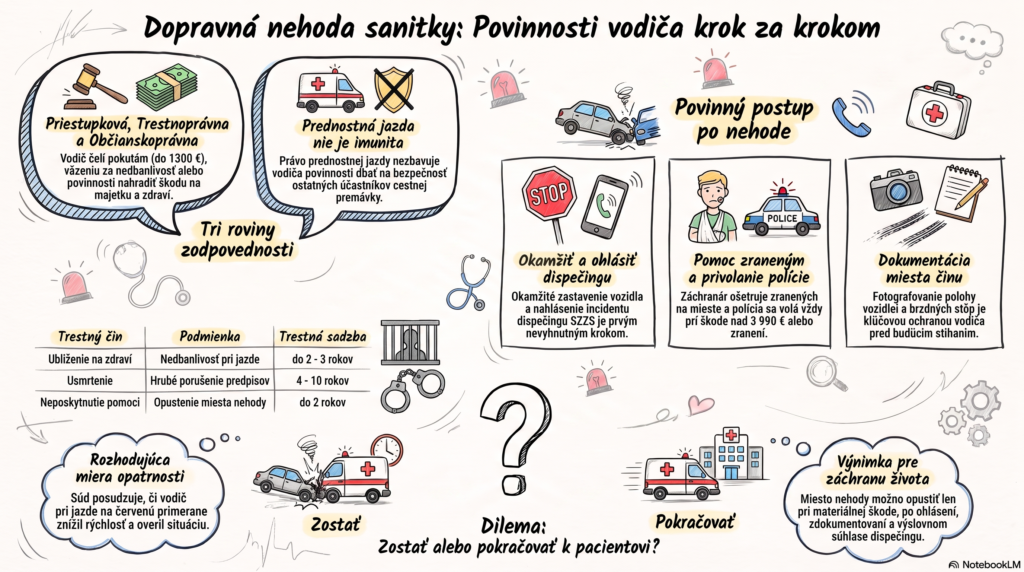
Three levels of EMS driver liability
An EMS driver’s liability in a traffic accident is assessed across three separate but interconnected levels. It’s important to distinguish them — each has a different legal basis, a different authority, and different sanctions.
| Level | Legal basis | Authority | Sanction |
|---|---|---|---|
| Administrative offense Breach of road traffic rules | Act No. 8/2009 Coll., § 22 of Act No. 372/1990 Coll. on Offenses | District Office, Slovak Police | Fine €60–1,300, license suspension |
| Criminal A crime caused by negligence | Act No. 300/2005 Coll. (Criminal Code), § 149, § 157, § 158, § 177 | Law enforcement authorities, court | Imprisonment, activity ban, monetary penalty |
| Civil Damages caused by the accident | Act No. 40/1964 Coll. (Civil Code), Act No. 381/2001 Coll. (mandatory liability insurance) | Civil court, insurer | Compensation for property/health damage, insurer’s recourse claim |
Priority driving does not release the EMS driver from any of these levels of liability. It only affects whether a specific traffic rule was breached — but the duty to exercise caution for the safety of others (§ 41(1) of Act No. 8/2009 Coll.) applies without exception.
The EMS driver’s duties immediately after an accident
Act No. 8/2009 Coll. distinguishes between the duties of a driver (§ 65) and the duties of a party to a traffic accident (§ 66). An EMS driver is both a driver and a party — both provisions apply to them.
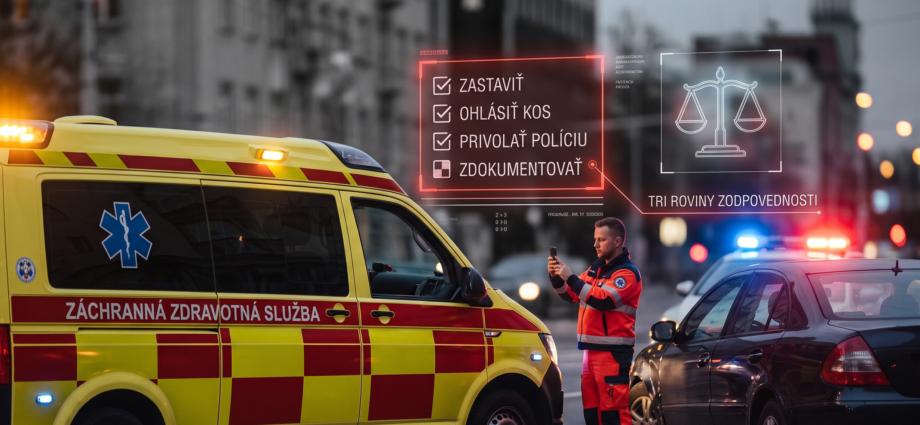
A driver involved in a traffic accident is obligated to stop the vehicle without delay. This duty applies to the EMS driver too — even with the right of priority driving, and even while rushing to a patient in life-threatening danger.
The EMS driver also has an internal duty to immediately report the accident to the EMS medical dispatch center. Dispatch coordinates further steps — sending a replacement crew, communicating with police, documentation. This is the first step the driver takes, alongside stopping.
If the accident caused injuries, the EMS driver is obligated to provide assistance — and as a healthcare professional has both the qualification and the equipment on board to do so. The paramedic from the EMS crew becomes the primary provider of urgent healthcare at the accident scene.
The driver is obligated to call the police whenever the accident causes personal injury or property damage exceeding €3,990 — which practically always happens in a collision with an EMS vehicle. In an accident during an EMS call, always call the police — dispatch can take over this communication.
Photographic documentation of vehicle positions, damage, skid marks, and road signage. Carried out by the paramedic or driver depending on the situation. This documentation is key for any later criminal or offense proceedings.
The driver must not consume alcohol or another addictive substance after the accident, until police arrival. This applies to the EMS driver too, even while present at the scene as a healthcare professional. Breaching this duty could make it impossible to prove the driver was sober before the accident.
The critical conflict: stay, or continue to the patient?
This is the most complex legal and ethical situation an EMS driver can face in an accident during a call. On one hand, the law imposes a duty to remain at the scene of the traffic accident — on the other, the EMS crew is heading toward a patient in immediate life-threatening danger.
A party to a traffic accident is obligated to remain at the scene of the traffic accident until a police officer arrives, or to return to the scene without delay after providing assistance or reporting the traffic accident.
Source: § 66(2)(d) of Act No. 8/2009 Coll. on Road TrafficHowever, the law recognizes an exception — the driver may leave the accident scene in order to provide or call for assistance. For an EMS driver, this means that if the accident is inconsequential (only property damage, no one injured), they may, after fulfilling the basic duties (stopping, reporting, documentation), continue to the original call — in agreement with dispatch.
Leaving the accident scene is justified only if the EMS driver has fulfilled the basic duties — stopped, reported the accident to dispatch, called the police, and secured the scene. Leaving without fulfilling these duties is an offense (§ 22 of Act No. 372/1990 Coll.) or a crime (§ 177 of the Criminal Code — failure to render assistance).
The decision on how to proceed must always be coordinated with EMS dispatch — dispatch is responsible for operational coordination and can send a replacement crew.
Criminal liability — when it applies and for what
An EMS driver’s criminal liability in a traffic accident depends on the severity of the outcome and the degree of fault. Act No. 300/2005 Coll. (the Criminal Code) contains several offense definitions relevant to an EMS driver:
| Crime | Legal provision | Conditions | Penalty range |
|---|---|---|---|
| Bodily harm | § 157, § 158 of the Criminal Code | Negligent causing of bodily harm + breach of an important driver duty | Up to 2 years (§ 157), up to 3 years (§ 158) |
| Grievous bodily harm | § 157(2) of the Criminal Code | Negligent causing of grievous bodily harm + gross breach of regulations | 1–5 years |
| Manslaughter | § 149 of the Criminal Code | Negligent causing of another person’s death | Up to 3 years; 4–10 years for gross breach of regulations and multiple victims |
| Failure to render assistance | § 177 of the Criminal Code | Leaving the accident scene without fulfilling legal duties | Up to 2 years |
Not every breach of road traffic regulations is a “breach of an important duty” under the Criminal Code. An important duty is one whose breach can genuinely endanger life or health — for example, running a red light without confirming the situation, exceeding the speed appropriate to road conditions, or disregarding a pedestrian at a crosswalk.
A gross breach of regulations means simultaneously breaching several important duties, or breaching a single duty to an extreme degree (e.g., 120 km/h in a city).
Three scenarios from practice
An ambulance with active signaling passes through an intersection against a red light. The driver of a passenger car doesn’t notice the ambulance’s approach and a collision occurs. No one is injured, damage to both vehicles is about €5,000.
An ambulance passes through against a red light. A pedestrian entered the crosswalk on a green signal. The driver injures the pedestrian — minor bodily harm (forearm fracture).
An ambulance driving through the emergency vehicle lane collides with a vehicle that didn’t clear the lane in time. Only property damage; the EMS crew is rushing to a priority-1 call.
Documentation — the driver’s first line of protection
Any traffic incident during a call must be documented. Documentation protects both the EMS driver and the EMS provider in any subsequent administrative, offense, or criminal proceedings.
Photos: vehicle positions before being moved, damage to both vehicles, skid marks, surrounding traffic signage, road surface condition, any witnesses.
Time and place: GPS position from navigation / MDT, exact incident time from dispatch communication.
The other driver: name, address, liability insurance policy number, license plate, contact — same as for an ordinary accident.
Witnesses: contact details for at least one witness, if available.
Internal documentation: an entry in the call log describing the event, a report to the shift supervisor.
- VZ-LEG-01 — Driving Under Blue Lights — Legal Framework and Driver Responsibility
- VZ-LEG-02 — EMS Driver Liability in a Traffic Accident During a Call (this article)
- VZ-LEG-03 — Alcohol, Medications, and EMS Driver Fitness
- Slovak Act No. 8/2009 Coll. on Road Traffic, § 41 — vehicles with the right of priority driving; § 64 — definition of a traffic accident; § 65 — driver duties after an accident; § 66 — duties of a party to a traffic accident.
- Slovak Act No. 300/2005 Coll. (Criminal Code), § 149 — manslaughter; § 157, § 158 — negligent bodily harm; § 177 — failure to render assistance.
- Slovak Act No. 372/1990 Coll. on Offenses, § 22 — road traffic offenses.
- Slovak Act No. 40/1964 Coll. (Civil Code) — damages.
- Slovak Act No. 381/2001 Coll. on mandatory contractual motor vehicle liability insurance.
- Slovak Act No. 579/2004 Coll. on Emergency Medical Services, § 10 — paramedic duties.
- Ružarovský, M. (JUDr.). Traffic accidents — legal aspects of driver liability. Právne noviny. 2024. pravnenoviny.sk
- Case law of the Supreme Court of the Slovak Republic — traffic accidents, failure to render assistance, concurrence of offenses. judikaty.info