Alcohol, Medications, and
What the Law Says About EMS Driver Fitness
Zero tolerance for alcohol applies to every driver without exception — including an ambulance driver. The same principle applies to medications that reduce the ability to drive. But the law also addresses situations that occur more commonly in the EMS environment than it might seem.
An EMS driver is not an ordinary employee — they operate a vehicle with the right of priority driving, in urgent situations, under pressure. Precisely for this reason, the law places extraordinary demands on their fitness. Alcohol, prescription medications, and over-the-counter preparations can all be reasons a driver must not report for a shift.
Zero tolerance for alcohol — no exceptions
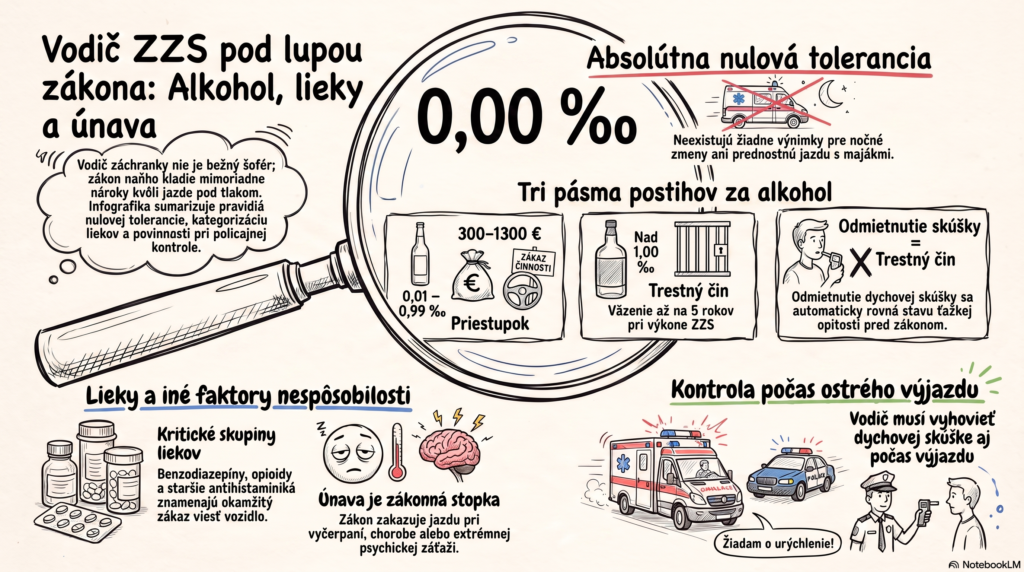
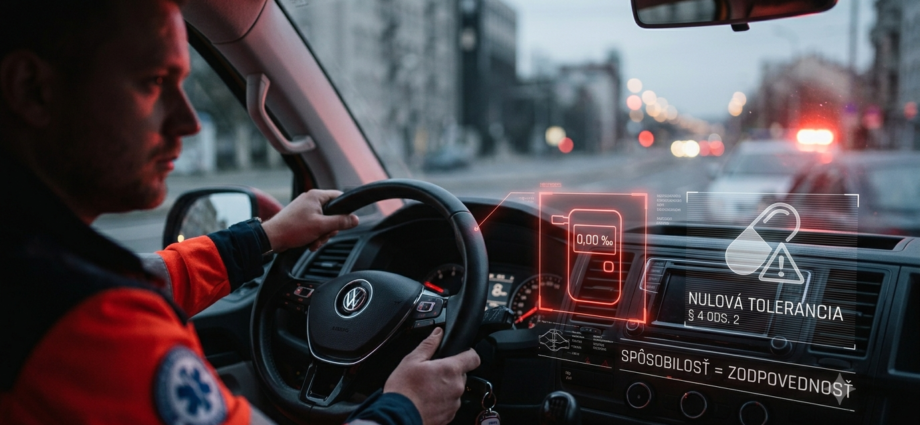
In Slovakia, motor vehicle drivers are subject to absolute zero tolerance for alcohol. Act No. 8/2009 Coll. on Road Traffic, in § 4(2)(b)–(d), prohibits a driver from consuming alcohol while driving, from driving after consuming alcohol while it may still be present in the body, and from driving if their ability to drive is impaired.
The driver must not: (b) consume alcohol or another addictive substance while driving; (c) drive at a time after consuming alcohol or another addictive substance when it may still be present in their body; (d) drive after taking a medication at a time when the medication may reduce their ability to drive.
Source: § 4(2) of Act No. 8/2009 Coll. on Road Traffic, as amendedFor an EMS driver, this results in a single rule: 0.00‰. No exception for “one beer the night before,” no exception for a night shift, no exception for priority driving. The body eliminates alcohol at a rate of approximately 0.10–0.15‰ per hour — the driver must be able to calculate when they are truly sober.
Penalties for driving under the influence — three tiers
The Criminal Code, in § 289(4), classifies the crime of endangerment while under the influence as more serious if the perpetrator carries out an occupation or activity in which the influence of an addictive substance is particularly hazardous — and explicitly names operating a mass-transit vehicle. An emergency vehicle transporting a critically ill patient falls into the same category in terms of the degree of danger.
The penalty range under § 289(4): 2 to 5 years of imprisonment.
Medications — an underestimated risk in the EMS environment
Medications are a topic EMS drivers systematically underestimate. The law is clear on this point: § 4(2)(d) of Act No. 8/2009 Coll. prohibits driving after taking a medication if that medication may reduce the ability to drive safely. It doesn’t matter whether it’s a prescription or over-the-counter medication.
The duty to warn the driver of this prohibition falls on the physician — Decree of the Slovak Ministry of Health No. 164/1997 Coll. on medical fitness to drive a motor vehicle, in § 5, requires the physician to inform the patient (driver) when prescribing such a medication and to record this fact in the medical documentation. Responsibility for complying with the prohibition, however, remains with the driver.
| Medication category | Examples | Effect on driving | EMS driver’s procedure |
|---|---|---|---|
| First-generation antihistamines | Dithiaden, Prothazin, promethazine | Strong sedation, significantly slowed reactions | Does not drive. Report to the shift supervisor. |
| Benzodiazepines | Diazepam, Xanax, Neurol, Dormicum | Sedation, impaired coordination, slowed reactions | Does not drive. Report to the shift supervisor. |
| Opioid analgesics | Tramadol, codeine, morphine | Sedation, impaired attention | Does not drive. Report to the shift supervisor. |
| Some antidepressants / antipsychotics | Trittico, Zoloft (start of treatment), haloperidol | Depends on dose and treatment phase — see the package leaflet warning | Consult the prescribing physician. When in doubt, does not drive. |
| Second-generation antihistamines | Loratadine, cetirizine, Claritine, Zyrtec | Minimal sedative effect at therapeutic doses | Usually no restriction — watch for combination with alcohol. |
| Common analgesics | Paracetamol, ibuprofen, ASA | No effect on driving at standard dosing | No restriction. |
Every medication registered in Slovakia must include, in its Summary of Product Characteristics (SPC) and package leaflet, information on the effect on the ability to drive. Look for the section “Effects on ability to drive and use machines.” If there’s any warning there — consult a physician before reporting for a shift. This information is available on the portal adc.sk (Slovak Administrative Database of Medicines).
Reduced fitness from other causes
The law, in § 4(2)(e), also prohibits driving when a driver’s ability is reduced by injury, illness, indisposition, or fatigue. This provision is extremely important for an EMS driver — and, in practice, the most commonly ignored.
The duty to submit to a breathalyzer test
Act No. 8/2009 Coll., in § 4(3), obligates a driver to submit to a breathalyzer test, or possibly a blood draw, at a police officer’s request. This duty applies without exception — including for an ambulance driver, even during a call.
A driver is obligated to submit, at a police officer’s request, to an examination determining whether they are under the influence of alcohol or another addictive substance, whether by breathalyzer test or medical examination including a blood or other biological sample.
Source: § 4(3) of Act No. 8/2009 Coll. on Road TrafficRefusing a breathalyzer test is a crime — regardless of the actual amount of alcohol in the blood. The Constitutional Court of the Slovak Republic confirmed that this is an omission-based crime completed by the refusal itself. For an EMS driver, this means: if a police officer stops you and requests a breathalyzer test — always submit to it, even during a call. The officer has the right to stop them and administer the test; the driver has the right to request the process be expedited due to the EMS call, but not to refuse.
Three scenarios from practice
The driver drank 3 beers (about 1.5‰) the evening before their shift. The shift starts at 06:00. Alcohol is eliminated at a rate of 0.12‰/hour — at 06:00 they still have about 0.3‰ in their blood.
The driver is prescribed diazepam 5 mg at night for an anxiety disorder. They report for a day shift in the morning — the medication is still active.
The EMS crew is rushing to a priority-1 call. A police officer stops the vehicle and requests a breathalyzer test from the driver.
The EMS driver’s commitment — personal responsibility
1. Calculate your sobriety time. Before every shift, check whether you’re truly sober. Rule of thumb: number of promille × 10 hours = minimum time before a call.
2. Check the package leaflet of every medication. If there’s any warning in the driving section — report it to the shift supervisor before reporting for duty.
3. Report, don’t hide. The shift supervisor has a legal duty to ensure a fit driver. A driver who reports a reason for unfitness is protected — a driver who hides it and causes an accident bears criminal liability.
4. Never refuse a breathalyzer test. Refusal is a crime — without exception and regardless of the actual state.
5. Fatigue is a legal reason to decline a call. § 4(2)(e) — a driver must not drive if their ability is reduced by fatigue. This isn’t weakness, it’s a legal duty.
- VZ-LEG-01 — Driving Under Blue Lights — Legal Framework and Driver Responsibility
- VZ-LEG-02 — EMS Driver Liability in a Traffic Accident During a Call
- VZ-LEG-03 — Alcohol, Medications, and EMS Driver Fitness (this article)
- Slovak Act No. 8/2009 Coll. on Road Traffic, § 4(2)(b)–(e) — prohibitions for the driver; § 4(3) — duty to submit to a breathalyzer test.
- Slovak Act No. 300/2005 Coll. (Criminal Code), § 289 — endangerment while under the influence of an addictive substance (paragraphs 1–4).
- Slovak Act No. 372/1990 Coll. on Offenses, § 22 — alcohol-related road traffic offenses.
- Decree of the Slovak Ministry of Health No. 164/1997 Coll. on medical fitness to drive a motor vehicle, § 5 — physician’s duty to warn the driver about medications reducing fitness to drive.
- Ruling of the Constitutional Court of the Slovak Republic — refusal of a breathalyzer test as an omission-based crime; confirmation of the constitutionality of § 289 of the Criminal Code. ustavnysud.sk
- Ficek, defense attorney. Endangerment while under the influence of an addictive substance — commentary on § 289 of the Criminal Code. obhajca-ficek.sk, 2026.
- Slovak Administrative Database of Medicines (adc.sk) — SPCs and package leaflets.
- Slovak Act No. 579/2004 Coll. on Emergency Medical Services, § 10 — paramedic duties, including the duty to report for work fit for duty.